
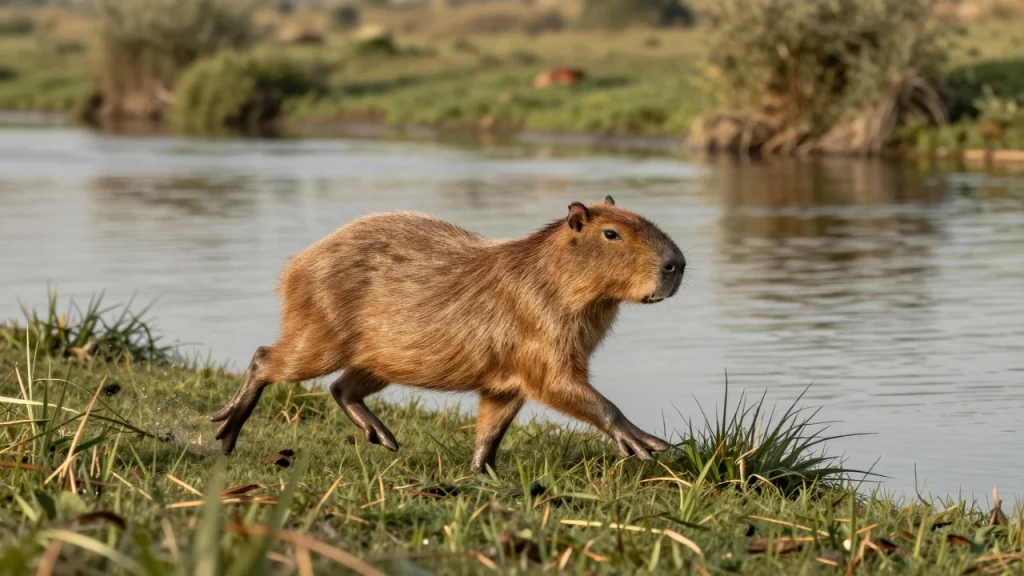
Capybaras do run, and they run well for animals of their bulk, but the honest answer to the speed question is not a single number on a stopwatch. The largest rodent alive moves at a deliberate pace by default, drops into faster gaits when alarmed, and treats a sprint as a short bridge to the nearest water rather than as a way to win a long chase. Peer-reviewed work on South American caviomorph rodents, together with the fact sheets maintained by accredited zoos, describes gaits, distances and behaviour rather than one measured top speed, so the useful answer looks more complicated than a round number.
The default gait is a pace, not a run
San Diego Zoo Wildlife Alliance reduces capybara locomotion to a single line: one basic gait, a pace that leaves three feet planted, plus good swimming ability. A pace of that kind is stable and inexpensive, but it also caps how fast the animal can travel before it has to change gear.
Body size sets the context for everything else. An adult capybara tops out at a shoulder height of 0.6 meters, measures about 1.2 meters from nose to tail, and weighs from 35 to 66 kg. An animal that heavy cannot accelerate the way a much lighter hoofed mammal does, which is why a capybara spends most of its time barely moving at all.
What changes when a capybara speeds up
Locomotor research on the cavioids, the South American rodent group that includes capybaras, has recorded the same gear-shifting sequence in this species: as speed rises, the animal switches from a transverse gallop to a rotatory gallop and then to a half bound. All of the cavioid rodents studied use that bounding gait for their fastest running.
A half bound is a bounding run in which the hind limbs land and push off together and the front limbs follow. It has an extended suspension phase, a moment when the body stays level with no foot touching down at all. For a heavy grazer this is the most violent thing it does on land, and it lasts seconds rather than minutes.
Both stride length and stride frequency climb with speed, a pattern recorded in the capybara alongside other caviomorph rodents. In practice a capybara does not simply move faster; it takes longer and more bounding steps to do it.
Bursts, not marathons
How far capybaras actually travel puts the running question in perspective. The same San Diego Zoo fact sheet records travel in bursts of no more than 200 m, with long rests in between, and a typical day of walking and grazing covering some 700 m (.43 mi). The trails they use are marked by star-shaped tracks.
So this is not an animal built to cover distance. It is an animal that stays put and occasionally bolts. The fact sheet goes further, noting that such sedentary habits even let ranchers manage capybaras without fences.
Running is only the first half of an escape
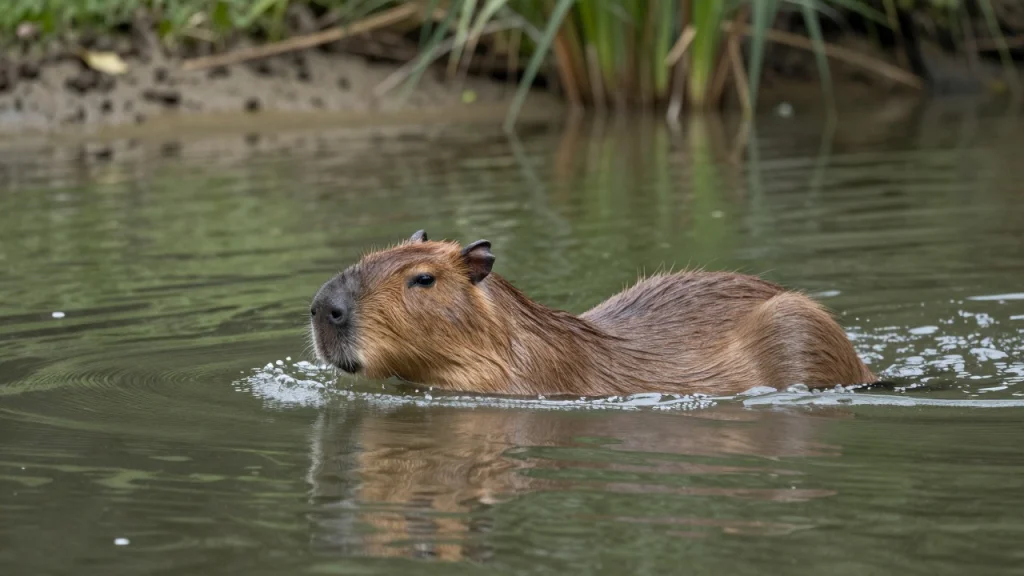
What a capybara runs toward matters more than how fast it runs. Rexford Lord, a capybara expert quoted by National Geographic, describes the animal bolting at a gallop for the nearest deep water. Then it hits the surface and is gone.
Once submerged, the escape continues below the surface. The same account notes that a capybara can change direction while out of sight and come up far from where a hunter would be waiting.
Why hiding works so well
Two features make that strategy pay off. The eyes, ears and nostrils sit high on the skull, so a threatened capybara slips underwater with just its nostrils and eyes showing and stays under for up to five minutes. Buoyancy is the second help: a body barely denser than water is easy to propel, which is why the species is described as strong swimmers and seems as much at home in water as on dry land.
Built for water, not for a chase
The skeleton explains the trade-off: a barrel-shaped, sturdy, tailless trunk, forelimbs shorter than the hindlimbs, and partially webbed feet. The San Diego Zoo counts four toes ahead and three behind, webbed and used for swimming as much as walking. Those feet complete a body plan that keeps the species so thoroughly at home in water.
A grazer’s fuel, not a sprinter’s
Their size also makes them vulnerable to heat stress, so they are mainly active around dawn and dusk and pass the hottest hours of the day in water. That schedule is tied to a diet of constant grazing: they are selective grazers that eat approximately 3 kg of fresh forage a day, choosing among several native grasses.
A grazer living on that ration is built for steady, low-intensity work, which is the opposite of the fuel profile a sustained chase would demand. Speed is the emergency option, not the everyday one.
Babies and the cost of a slow start
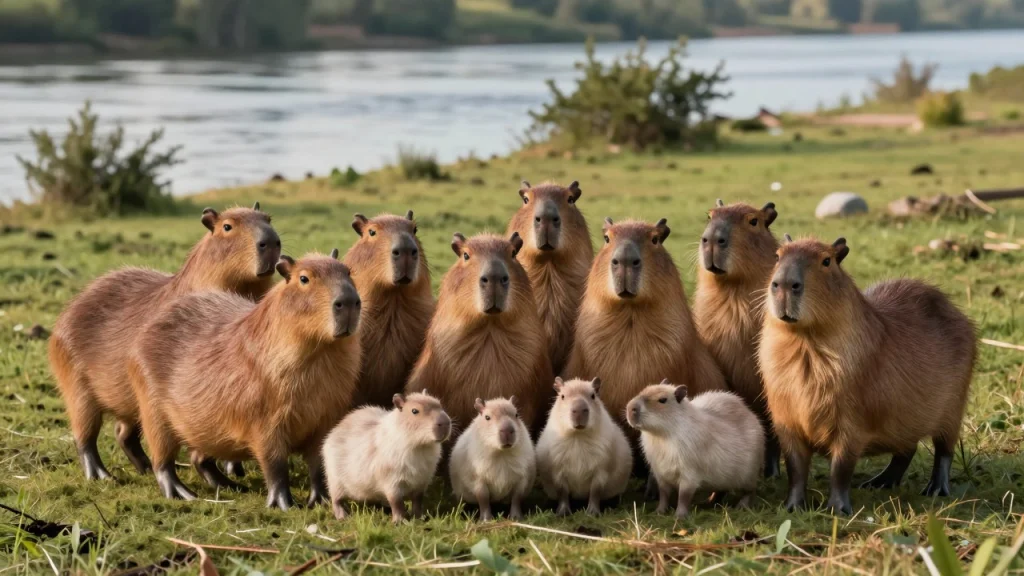
Pups stay small, slow and quick to tire through their first year, which leaves them especially exposed to whatever is hunting. Adults gather in groups of roughly 10, of both sexes, and group sizes run from 3 to 30, with much larger aggregations forming at water in the dry season.
Group living is the compensation. While grazing, capybaras watch for danger continuously and sound an alarm bark as soon as a predator is spotted. The fact sheet describes a bark going out at an intruder, followed by jumping into the river or running off if that is not enough. Faced with wild dogs, the group forms a defensive huddle with the young in the middle and adults turned outward.
Who is waiting for them
The predator list is long, and the fact sheet covering both capybaras names:
- jaguars
- puma, foxes and bush dogs
- feral dogs and ocelots
- caiman, that is alligator
- birds of prey
- humans
San Diego Zoo singles out one carnivore as the main danger to adults, the jaguar, and adds that people hunt them too.
Conservation status and lifespan
On paper the greater capybara is doing fine. The fact sheet for the two species lists the greater one as Least Concern and the lesser one as Data Deficient, with CITES status not listed.
San Diego Zoo reports that the species is not currently classed as endangered, though clearing of forest, loss of habitat and illegal poaching all press on it. Wild animals typically live 7 to 10 years, and the San Diego Zoo species profile puts the figure at 12 years for animals in expert care.
The honest answer
So how fast can a capybara run? It moves at a walking pace by default, drops into a gallop and then a bounding half bound when alarmed, and it holds that effort only across the short stretch of ground between itself and water. The speed is real and fast for a grazer of that size, but it is a bridge to a hiding place rather than a way to outlast a hunter.
Sources
- Animal Diversity Web: Hydrochoerus hydrochaeris (capybara) | INFORMATION
- San Diego Zoo Wildlife Alliance: Behavior & Ecology – Capybaras (Hydrochoerus spp.) Fact Sheet
- San Diego Zoo Wildlife Alliance: Capybaras (Hydrochoerus spp.) Fact Sheet: Summary
- San Diego Zoo Wildlife Alliance: Capybara | San Diego Zoo Animals & Plants
- National Geographic: World’s Largest Rodents On Lam From Toronto Zoo
- Mastozoologia Neotropical (hosted on Redalyc): Locomotion in the fastest rodent, the mara Dolichotis patagonum (Caviomorpha; Caviidae; Dolichotinae)