
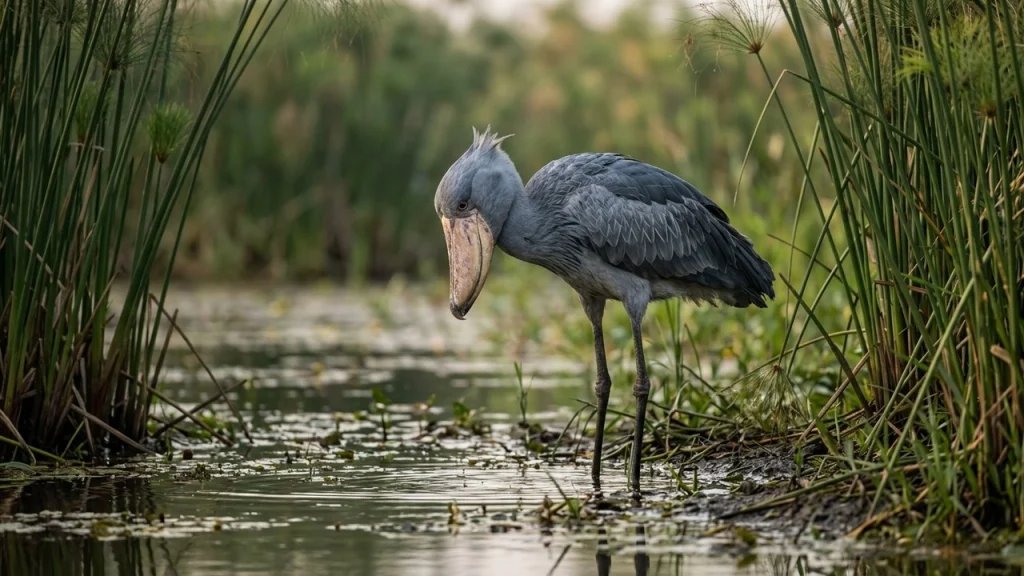
A shoebill is smart in the way a specialist ambush predator needs to be: it reads its environment, picks its hunting ground with care and adjusts its behavior to heat and hunger. Nothing in the sources used here gives it an IQ score or a lab test result. What they do show is a bird whose habits look like planning, patience and problem solving, so this article treats behavior as the evidence.
The short answer: a shoebill is clever in a targeted way. It chooses places where prey is easier to catch, times its strike, cools its own eggs with water and changes its hunting method to suit conditions.
Hunting habits that reward patience
The most striking trait is stillness. Shoebills can remain motionless for hours, so a lungfish that surfaces for air may not notice the bird until it is too late. That is not idleness. It is a strategy that depends on self-control, because the bird only acts when a target is within reach.
Two tactics dominate: waiting in ambush, or wading slowly to locate prey. Having both options is a flexible response, not a single fixed routine.
Choosing where to hunt
Shoebills often turn up in places where the water holds little oxygen. Fish in such water have to rise to the surface for air more often, which makes them easier to catch. In effect, the bird selects a spot where the odds are stacked in its favor.
Cover matters too. Shallow water with tall vegetation hides the bird as it stalks. In deep water, the bird needs a sturdy raft of floating plants to hunt from.
Senses and posture
Vision and hearing are the main senses a shoebill uses to hunt. To get binocular vision, it holds its head and bill pointing straight down against its breast. That posture lets it judge the position of a target beneath the water.
The collapse: a strike with a cost
When the bird spots prey, it starts a move known as the “collapse”. The head and neck shoot forward into the water, the bird overbalances and it falls forward and downward. The move leaves the bird off balance.
After one collapse, the bird cannot immediately repeat it. It must recover its footing and begin again from a standing position. This is one reason waiting for a good opportunity pays off: a wasted strike is costly.
Handling the catch
A collapse also scoops up a mouthful of vegetation along with the prey. The shoebill gets rid of the plant matter by swaying its head from side to side while it keeps hold of the prey. Handling food this way shows a sequence of coordinated steps rather than one reflex.
The menu is broad. Fish are not the only food: shoebills sometimes take frogs, monitor lizards and turtles, plus young crocodiles, mollusks or carrion. A varied diet suits an animal that has to cope with changing conditions.
Keeping eggs cool: a clear sign of problem solving
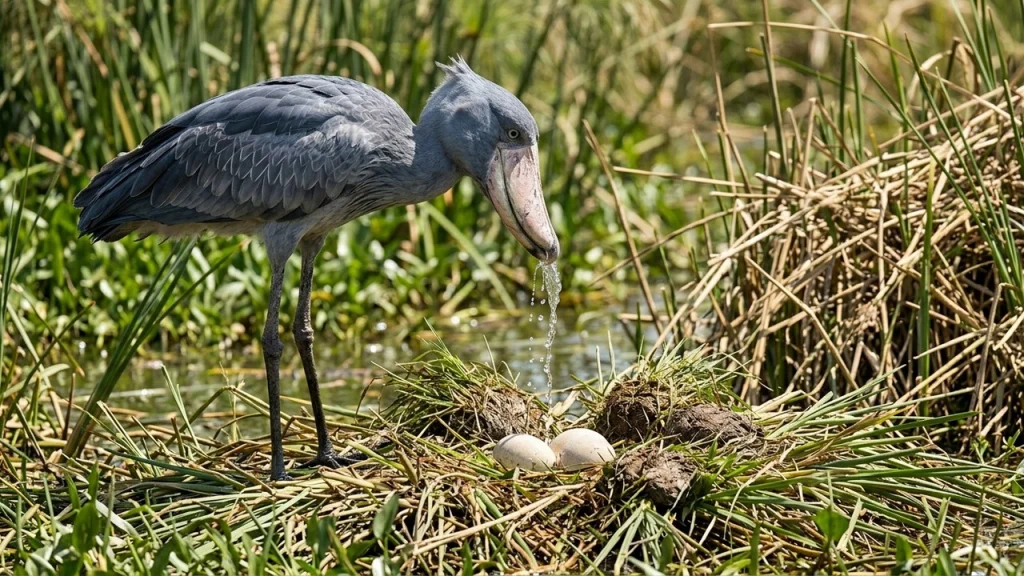
Nesting behavior gives the best hint of flexible thinking. To keep eggs from overheating, an adult fills its bill with water and pours it over the nest. It also collects mouthfuls of wet grass, places them around the eggs and rolls or turns the eggs using its feet or bill.
The cooling does not stop at hatching. Dousing and shading go on until the chicks’ feathers are fully developed. The parent is responding to a real problem (heat) with a practical fix, and it keeps using the fix as the chicks grow.
Adults also cool themselves. They use gular fluttering to manage their own body heat.
Social intelligence in a solitary bird
Shoebills are not group animals. They are never found in groups, and they only forage near each other when food is short. Even the two birds of a breeding pair often feed on opposite sides of their territory. Each pair holds a territory of approximately 3 square kilometers.
Yet the partnership is real. Breeding pairs are monogamous, and both parents share the work of building the nest, incubating and raising the chick. The whole cycle from nest building to fledging lasts 6 to 7 months.
Communication without much noise
These birds are usually silent. They do use bill-clattering, a behavior typical of true storks. Adults often do it when they greet each other at the nest, and young shoebills clatter their bills too.
Adults also make a whining or “mooing” sound, and chicks make hiccupping noises when they beg for food. A quiet species with a small vocabulary can still coordinate a partnership, especially when a shared task such as raising a chick keeps the pair close.
Slow growth, long life

A long life gives an animal plenty of time to learn. Shoebills live to almost 36 years in the wild, and National Geographic gives 35 years as an average wild lifespan. Chicks develop slowly compared to most other birds, which leaves a long window in which parents care for them.
Incubation takes about 30 days, and the birds fledge at 95 days. Parents keep feeding the young for about one month after fledging, after which the young are fully independent.
Young birds reach maturity at three to four years old. A young bird therefore has years to refine its ambush technique before it breeds.
Size and status
A shoebill stands 110 to 140 cm tall, so it is a large bird with a lot of body to keep still and balanced during those hours of waiting. National Geographic lists the species as Vulnerable on the IUCN Red List.
So how smart is a shoebill?
Judged by what it does, a shoebill is a capable, adaptable predator and a careful parent. It picks hunting grounds where fish are easier to catch, stays still for hours, adjusts its strike, cools its eggs with water and shares parenting duties with a mate. No controlled experiment in these sources ranks it against parrots or crows, so the fairest description is that its intelligence is practical and tuned to wetland life.