
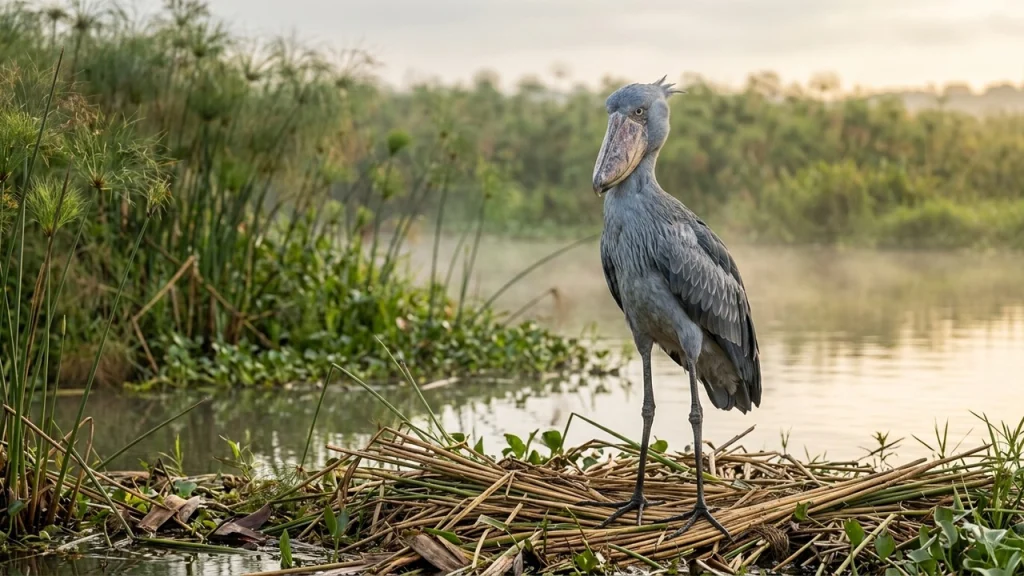
Shoebills (Balaeniceps rex) achieve remarkable longevity across the remote freshwater wetlands of tropical Africa. In pristine African wetlands, individual shoebills can endure for almost 36 years in wild conditions. Field records document a verified longevity ceiling reaching 35.7 (high) years for wild birds. Zoological institutions similarly record a benchmark species lifespan of 35 years.
In human-managed facilities, shoebills continue to demonstrate impressive multi-decade durability. Demographic research centers record an average lifespan of 36.0 years for specimens in captivity. This extraordinary longevity reflects an evolutionary strategy centered on energy conservation, low metabolic expenditures, and the successful mastery of permanent marshland territories.
Anatomical adaptations that support prolonged survival
Surviving across multiple decades in unforgiving tropical marshes demands a robust physical design:
- Shoebill height ranges from 3.5 to 5 feet (1.07 to 1.5 m) tall, body mass averages 12.3 pounds (roughly 5.6 kg), while wingspan averages 7.7 feet (measured at 2.33 m).
- Elongated toes distribute body mass over floating swamp mats, providing a secure stance.
These physical dimensions provide the leverage required to hunt large fish while conserving muscular energy during daily routines.
Specialized cranial architecture and binocular vision
The shoebill’s predatory capabilities rely upon an imposing bill structure. Their hooked bill measures from 8 to 12 inches (20 to 25 cm) long, while bill width spans 4 to 5 inches (10 to 13 cm), featuring sharp cutting edges. This massive organ functions as an effective snare and cleaver, gripping slippery prey and shearing through tough fish scales.
Visual precision is equally essential when targeting aquatic life through reflective water surfaces. To enable stereoscopic binocular vision, individuals angle their heads and bills vertically downward toward the breast. This unique posture aligns both forward-facing eyes directly over the bill tip, granting exceptional depth perception prior to launching a predatory strike.
Energy conservation and specialized wetland hunting
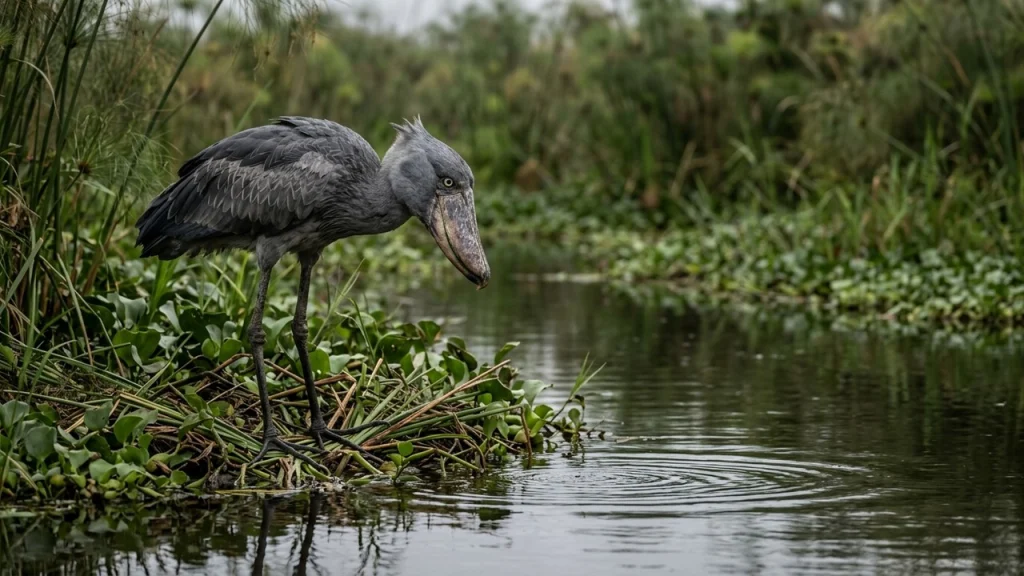
A low-expenditure energy budget plays a pivotal role in enabling shoebills to survive across several decades. Rather than expending valuable caloric reserves through constant flight or active pursuits, the bird practices extreme patience. Behavioral surveys in marsh habitats revealed that birds dedicated 85% of their daytime hours toward low-energy activities like standing, perching, and feather preening.
Sedentary habits further preserve vital bodily resources across changing seasons:
- Within local swamp complexes, resident shoebills were largely sedentary, journeying less than 3 km during more than 80% of days.
- Ornithological research indicates that shoebills are believed to stay sedentary, remaining throughout the identical regional basin all year long.
By eliminating hazardous long-distance seasonal migrations, adult birds avoid high mortality risks associated with navigation, exhaustion, and unfamiliar predator communities.
Tactical ambushes in oxygen-depleted backwaters
Shoebills deliberately select feeding zones where environmental conditions work to their tactical advantage. Shoebills specifically hunt along channels featuring poorly oxygenated water. In these stagnant aquatic habitats, submerged oxygen levels drop significantly, creating severe respiratory stress for resident gill-breathers.
Depleted oxygen forces resident fish species to surface for air repeatedly, elevating the likelihood that an awaiting hunter will capture quarry. Shoebills exploit this recurring behavioral reflex by remaining completely stationary near weed margins. Hunters are renowned for standing motionless for substantial durations awaiting food, and will even consume juvenile reptiles including baby crocodiles.
Deep-water foraging and the collapsing strike
While shallow marshes offer accessible prey, shoebills also utilize deeper channels that hold massive fish. For hunting across deep wetlands, an extensive bed of floating vegetation represents an absolute requirement. These buoyant platforms support specialized hunting maneuvers:
- Large catfish constitute the main prey of Shoebills, ambushed by adopting patient stand-and-wait methods atop floating mats.
- When pursuing quarry across deep swamps, the bird dives forward from vegetation platforms using a specialized technique called collapsing.
- This physical collapse strike is remarkably swift, typically lasting less than a second while being executed with immense mechanical force.
- Plunging into deep waters yields lower foraging success than shallow hunting, yet the catfish harvested from deep pools are on average larger.
Prey items supporting their carnivorous diet include lungfish (Protopterus), tilapia (Tilapia), catfish, bichirs (Polypterus), alongside aquatic watersnakes. Catching substantial, nutrient-dense fish allows individuals to maintain body condition without expending energy on frequent hunts.
Solitary territories and breeding dynamics
The extended longevity of the shoebill balances an exceptionally slow, low-yield reproductive rate. Because adult survival remains high under natural conditions, populations do not depend on large annual clutches to maintain their presence. Breeding adults lead an intensely isolated life, coming together only to cooperate on nest construction and chick rearing.
Mated pairs are solitary breeders that vigorously defend wetland territories measuring approximately 3 square kilometers. Within these vast boundaries, resident adults guard exclusive hunting access against conspecifics. To avoid depleting localized food patches, paired mates frequently forage at opposite margins across their home territory. This spatial partitioning ensures that each parent gathers sufficient nourishment without interfering with the other’s hunting attempts.
Direct communication between individuals occurs infrequently and stays confined to formal nesting interactions. Adults stay silent for the most part, yet produce a rapid bill-clatter greeting when reuniting with their mate at the mound. These rhythmic acoustic clatters reaffirm pair bonds and establish parental identity, preventing territorial conflict between mates around the nest platform.
Nest construction and climatic cooling techniques
Breeding pairs construct massive floating mounds using woven reeds, papyrus, and grass clumps situated in deep, secluded marshes. Females normally lay two eggs, with occasional clutches containing one or three eggs separated by intervals of up to five days, resulting in only one chick surviving to fledge.
Incubating eggs beneath an intense equatorial sun presents severe physiological challenges. Shared parental incubation lasts approximately 30 days, during which adults continually turn the clutch and douse eggs using water transported within enormous bucket-beaks. Nesting birds participate in a behavior called egg-watering, pouring water or moist greenery over the structure and rolling the eggs to cool them. This rigorous thermoregulation prevents embryo mortality during the hottest hours of the day.
Protracted chick development and brood reduction
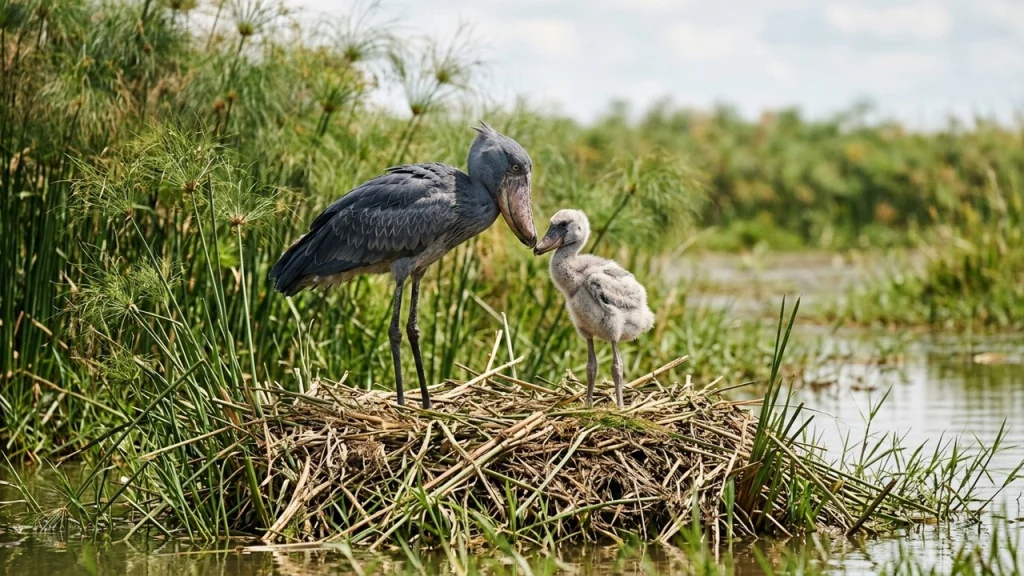
The developmental timeline of a young shoebill is among the longest recorded among wetland birds. Nestling growth represents an exceptionally slow process compared to developmental schedules found in most other birds. Hatchlings require constant parental oversight and frequent food provisioning to gain mass and build feather layers.
Natural brood reduction occurs rapidly within the nest mound. Parental pairs typically only raise one chick, leaving the smaller hatchling to perish from aggressive sibling attacks known as siblicide. The older, stronger chick monopolizes food deliveries and attacks its younger sibling, ensuring that parental investment concentrates entirely on a single viable descendant.
Growth milestones demonstrate the extensive investment required before an offspring attains independence:
- Full fledgling maturity occurs at about 95-105 days after hatching.
- Fledged juveniles are unable to fly until roughly 105 to 112 days old, continuing to depend on parents for daily meals.
- Young birds reach independence at an average age of 125 days after hatching.
Because raising an offspring requires months of arduous parental labor, pairs produce few surviving fledglings over their lifetime, making multi-decade adult survival essential for generational continuity.
Conservation status and threats to wild lifespans
Despite their potential to live for more than three decades, wild shoebills face severe ecological pressures that truncate average survival. Taxonomically, the shoebill stands as the sole member constituting the Balaenicipitidae family, living as an evolutionary specialist. This singular lineage possesses no close living counterparts, making its survival irreplaceable.
Wild populations persist almost entirely in vast, undisturbed papyrus swamps across east-central Africa. Their extreme ecological dependence on intact hydrology leaves them exceptionally vulnerable when wetland ecosystems face disruption. On the official IUCN Red List, the shoebill is currently classified as Vulnerable (VU).
Comprehensive range-wide census data reveals a precariously small global population. Census assessments estimate that mature individuals range from 3,300 up to 5,300 across wild habitats. Populations dwindle due to widespread habitat degradation from agricultural drainage, seasonal burning of marshes, and human disturbance.
Human encroachment affects wild longevity at several vulnerable life stages:
- Agricultural drainage lowers wetland water levels, drying out essential foraging channels.
- Seasonal burning sweeps through papyrus beds, degrading the nesting and feeding habitat.
- Fishermen disturb the birds’ habitat, especially their feeding areas.
Protecting the multi-decade lifespan of wild shoebills requires preserving contiguous, undisturbed swamp basins. Targeted conservation initiatives, community-led nest guardians, and hydrologic preservation projects across key strongholds like the Bangweulu Wetlands provide essential security. By safeguarding specialized wetlands from degradation, conservationists help ensure that wild shoebills can achieve their natural lifespans and continue their ancient ecological roles.
Sources
- Animal Diversity Web: Balaeniceps rex (shoebill)
- IUCN SSC Stork, Ibis and Spoonbill Specialist Group: The Shoebill’s Silent Struggle: Guarding the Future in Zambia’s Wetlands
- Scientific Reports: Changes in surface water drive the movements of Shoebills
- ZooTampa at Lowry Park: Shoebill Stork – ZooTampa at Lowry Park
- The Dallas World Aquarium: Shoebill stork – The Dallas World Aquarium