
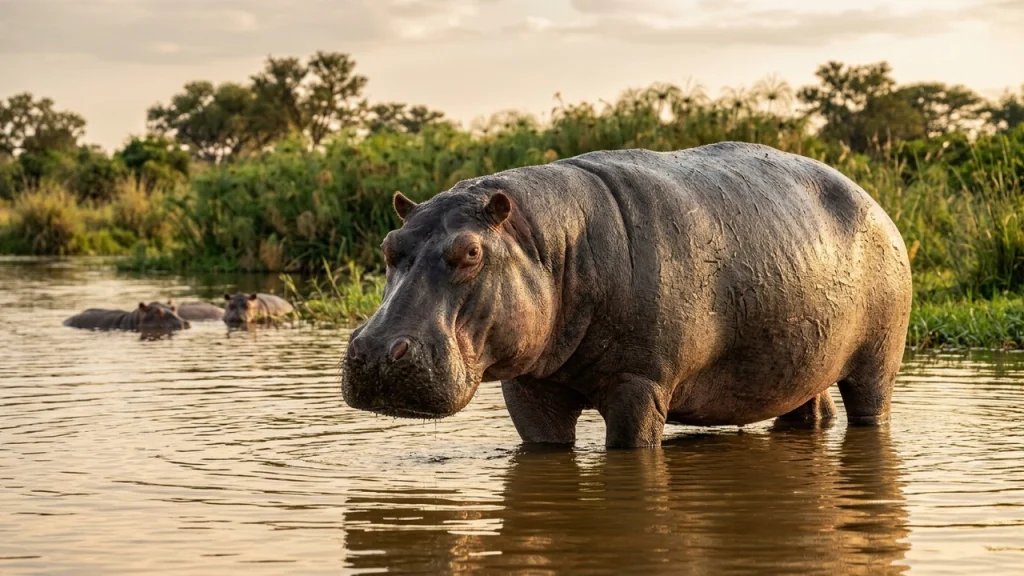
In the wild, most common hippos die by 40 to 45 years old, and the IUCN SSC Hippo Specialist Group says their exact longevity is not known. San Diego Zoo Wildlife Alliance puts the average wild life span at 25 to 30 years.
Hippos in human care have lived longer. San Diego Zoo Wildlife Alliance says a hippo named Rube reached 51 years, one of the oldest in human care, and the IUCN group reports that the oldest captive male died at more than 59 years old (in Cleveland, USA) while the oldest female was 61 (in Munich, Germany). Those are records for single animals rather than typical life spans. The pygmy hippo is a separate case: Animal Diversity Web says its lifespan in the wild is unknown, and individuals in captivity have lived up to 43 years.
Median life expectancy and how long hippos keep breeding
San Diego Zoo Wildlife Alliance also gives a median life expectancy of 36 years for the common hippo, a median rather than the average it lists for the wild. The IUCN group says both sexes can breed until at least age 45, citing captive data, and gives 43 years for the wild.
Pygmy hippos compared with common hippos
San Diego Zoo Wildlife Alliance lists a life span of 31 years on average for female pygmy hippos and says it is unknown for males. The IUCN group says pygmy hippos reach sexual maturity between 2.5 and 3 years of age, and that calves weigh approximately 5 kg at birth.
A pygmy hippo has only one pair of incisors, where hippos have two or three, San Diego Zoo Wildlife Alliance says. The IUCN group adds that the front incisors grow continuously and the canines elongate into tusks used for defence rather than for feeding. Leopards (Panthera pardus) are the main predators of pygmy hippos, according to Animal Diversity Web.
Growing up: maturity, pregnancy and size
For common hippos, San Diego Zoo Wildlife Alliance gives the age of maturity as 5 to 6 years for females and 7 years on average for males. Gestation lasts 8 months, and a newborn weighs 50 to 110 pounds (25 to 45 kilograms). Animal Diversity Web says infant mortality rates are low, at 0.01 deaths per year.
Males appear to keep growing all their lives, while females reach their maximum weight at around age 25. The greatest weight reported in the wild was 2065 kg, for a male in Uganda. A captive male in Munich, Germany, is the largest hippo ever recorded, at 4,500 kg, and the IUCN group says captive specimens are larger, mostly because of obesity caused by improper food.
Predators and conservation status
San Diego Zoo Wildlife Alliance says lions have been known to take down hippos, with the outcome depending on the number of lions, the hippo’s age and its distance from the water.
The common hippopotamus is classed as Vulnerable (VU A4acd) on the IUCN Red List and is listed under Appendix II of CITES. For the pygmy hippo, the IUCN group cites the most recent IUCN Red List estimate as 2000 to 2500 individuals, and declining.
Teeth, jaws and feeding
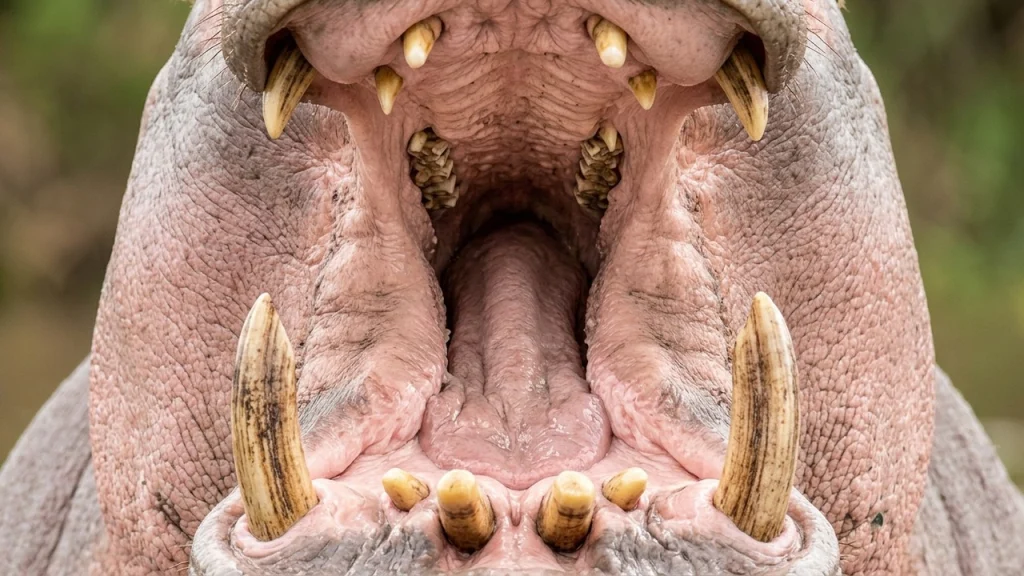
The IUCN group gives the dental formula of the common hippo as 2/2 incisors, 1/1 canines, 3-4/3-4 premolars and 3/3 molars, for 36 to 40 teeth. San Diego Zoo Wildlife Alliance says the canine and incisor teeth grow continuously, with the canines reaching 20 inches (51 centimeters) in length. The IUCN group also notes a feature unique to Hippopotamus: a lower jaw that is heavier than the skull above it.
Hippos do not chew their meals with their teeth. Animal Diversity Web says they tear and soften grasses instead, preventing any nutritive loss. Each night hippos are known to eat an enormous amount: 1 to 1.5% of their body weight, or usually around 40 kg.
Daily life in and out of the water
Hippos are sedentary animals: they rest for most of the day and leave their resting pools at dusk to feed, according to Animal Diversity Web. Because their bodies are too dense to float, San Diego Zoo Wildlife Alliance says, they push off from the river bottom or walk along it in a slow-motion gallop, their slightly webbed toes only lightly touching the bottom.
A reflex lets a sleeping hippo bob up for a breath and sink back down without waking up. Whales are the closest living relatives of hippos.
Sources
- Animal Diversity Web: Hippopotamus amphibius (hippopotamus)
- San Diego Zoo Wildlife Alliance: Hippo (Hippopotamus amphibius)
- IUCN SSC Hippo Specialist Group: Common Hippopotamus (Hippopotamus amphibius)
- IUCN SSC Hippo Specialist Group: Pygmy Hippopotamus (Choeropsis liberiensis)
- San Diego Zoo Wildlife Alliance: Pygmy Hippopotamus (Choeropsis liberiensis)
- Animal Diversity Web: Hexaprotodon liberiensis (pygmy hippopotamus)