
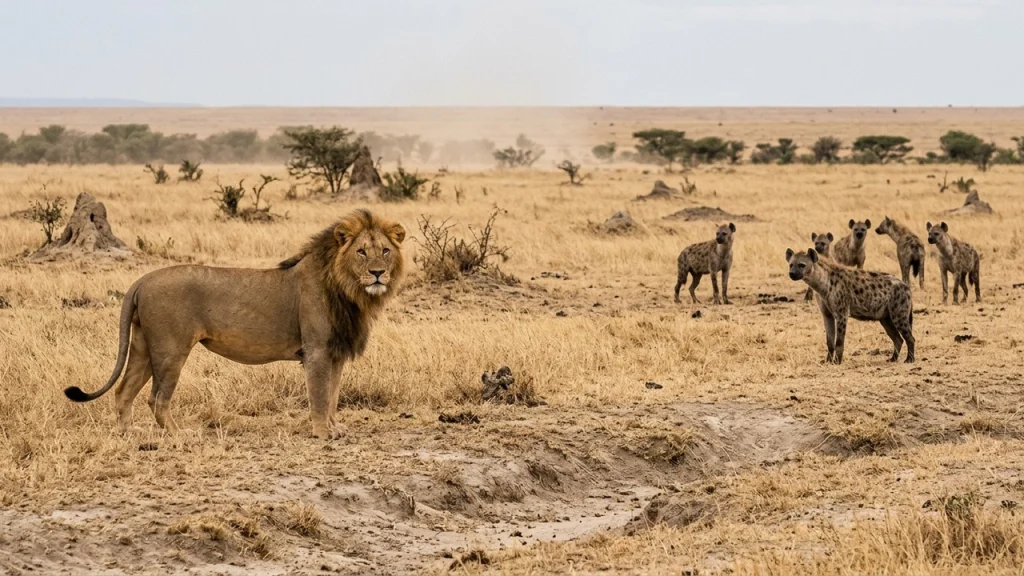
A study in Current Zoology notes that lions possess significantly greater size and strength than hyenas and constitute the leading cause of mortality across many hyena populations. However, hyenas frequently confront lions by launching synchronous coalitionary mobbing attacks. Research published in Current Zoology found that hyenas were only capable of obtaining food from groups containing adult male lions during sessions with high hyena to lion ratios.
Animal Diversity Web notes that hyenas and lions compete directly for prey and regularly scavenge kills from one another. While hyenas actively defend food against immature and female lions, they typically surrender it to a big male lion. According to a study in PLOS ONE, hyenas took over up to 100% of kills made by lions in the Ngorongoro Crater whenever adult males were absent.
Physical differences in size and bite strength
According to Animal Diversity Web, adult male lions typically weigh 189 kg, with the heaviest measured male on record reaching 272 kg on Mount Kenya. Female lions weigh 126 kg on average, and male lions reach an average height of 1.2 m. By comparison, male spotted hyenas range from about 45 to 60 kg, while female spotted hyenas weigh 55 to over 70 kg. According to Animal Diversity Web, the shoulder height of a spotted hyena ranges from about 75 cm to 85 cm.
The build of Crocuta crocuta features longer front legs than hind legs, which creates a downward slope along the back. Animal Diversity Web states that spotted hyena jaws are probably the strongest relative to size of any mammal. The San Diego Zoo Wildlife Alliance reports that specialized teeth and digestion enable spotted hyenas to consume meat, bones, and hair from their prey.
Carcass contests and group mobbing
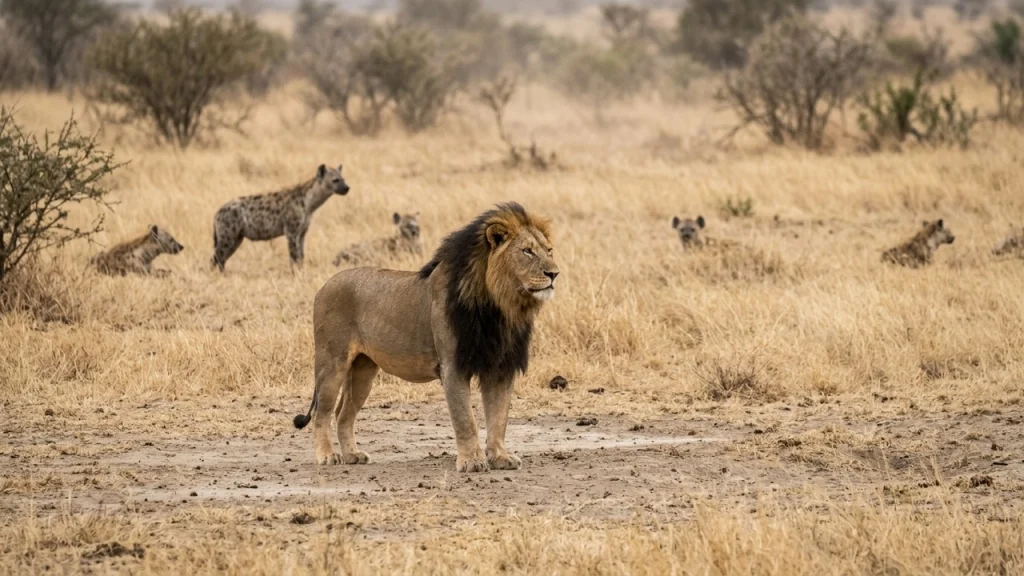
A study in Current Zoology reports that once in possession of a carcass, male lions keep hyenas away far more effectively than female lions do because of their larger body size. In documented observations, hyenas secured food around male lions in 26 of 93 sessions. In 25 of 121 feeding sessions centered on a kill or carcass, hyenas mobbed male lions, though mobbing rates dropped significantly compared to encounters where male lions were absent.
According to Current Zoology, hyenas often rally group members to spots where they confront lions by broadcasting far-reaching vocal signals. According to Animal Diversity Web, spotted hyena clans may contain anywhere from 3 to 80 members. Within these clans, all females are dominant to all males and stay in their natal group throughout their lives.
Hunting strategies and open landscapes
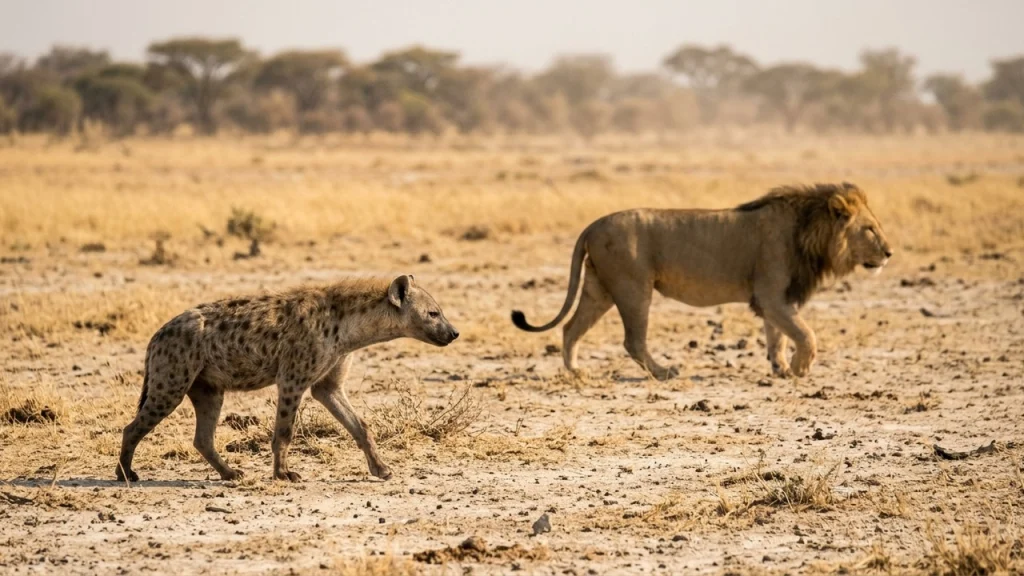
A study in PLOS ONE notes that lions primarily use stalk-and-ambush tactics on small herds, while hyenas mainly hunt large groups and pick quarry from rushing herds. Because hyenas are cursorial runners, they are likely to benefit in open habitats, while lions hold the advantage in closed environments. Animal Diversity Web notes that spotted hyenas often chase prey over long distances at speeds up to 60 km/hr, and records a 24 km pursuit of an eland in the Kalahari before capture.
A report in PLOS ONE notes that both predators appear to lessen some competitive impacts of a common diet by pursuing quarry of differing ages or sizes. Even so, the study in PLOS ONE found at least an 80% overlap between the daily activity budgets of lions and hyenas.
Mortality risks and predation on young
Animal Diversity Web cites an investigation where 13 of 24 hyena carcasses examined were killed by lions. Animal Diversity Web reports that hyenas are known to kill lion cubs, young individuals, or weak and sick adult lions. Animal Diversity Web notes that cubs are often left by themselves for over a full day at 5 to 7 months old, creating a vulnerable window for predator attacks, frequently from hyenas.
Sources
- Animal Diversity Web, University of Michigan: Lion (Panthera leo)
- Animal Diversity Web, University of Michigan: Spotted hyena (Crocuta crocuta)
- San Diego Zoo Wildlife Alliance: Spotted Hyena (Crocuta crocuta) Fact Sheet
- San Diego Zoo Wildlife Alliance: Lion | San Diego Zoo Animals and Plants
- Current Zoology: Lions, hyenas and mobs (oh my!)
- PLOS ONE: Coursing hyenas and stalking lions: The potential for inter- and intraspecific interactions