
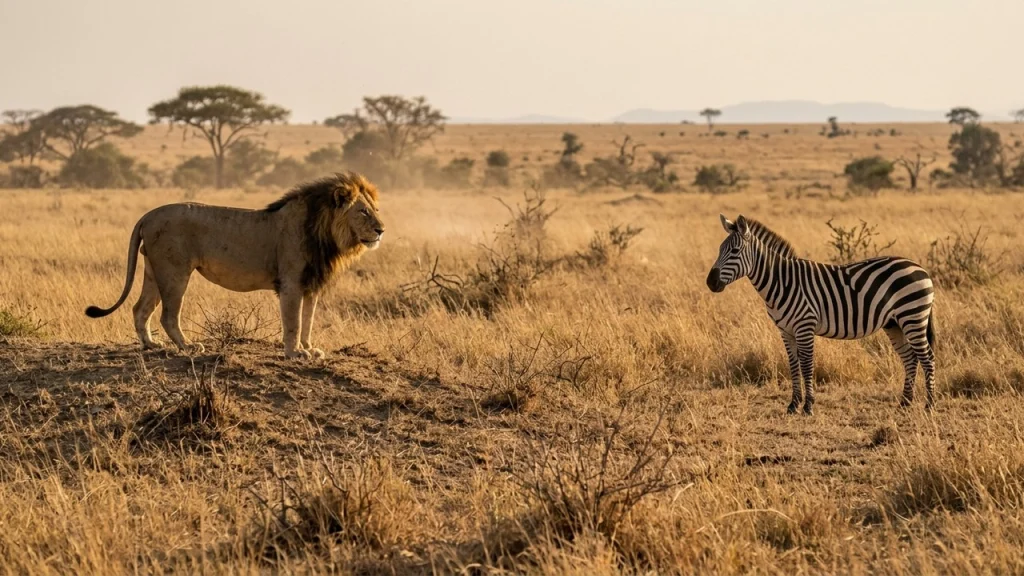
A zebra’s kick, the San Diego Zoo Wildlife Alliance says, is strong enough to cause serious injury to a predator such as a lion, a hyena or an African wild dog. That same organization adds that the lead male of a herd, called a stallion, usually holds the back of the group and defends it against predators if necessary, while mares and foals run away. The Smithsonian’s National Zoo describes lions in turn as compact and strongly built, with forelegs, teeth and jaws used to pull down and kill prey.
Neither description settles a strength comparison between the two animals. None of the zoo, wildlife agency or research sources behind this article records a fight between a zebra and a lion.
A zebra’s kick and the stallion that guards the herd
Animal Diversity Web adds that a stallion protects his harem with powerful kicks and pushes. He also bites at predators.
The San Diego Zoo Wildlife Alliance also describes zebra hooves. The same zoo describes the hooves as hard, designed to take the impact of the animal’s weight and to let it run easily over rocky ground.
How a lion hunts and what it is built for
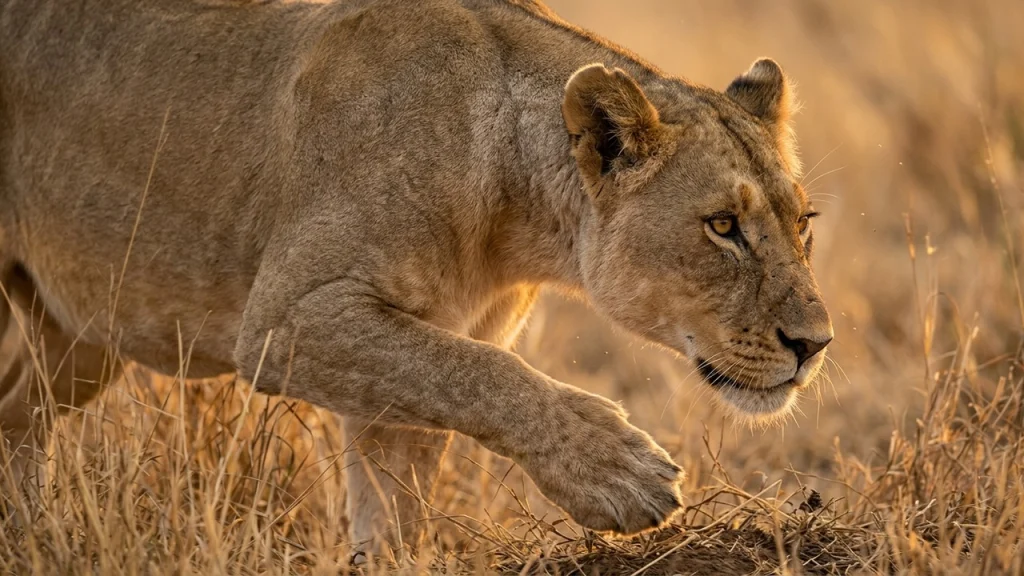
The Smithsonian’s National Zoo says that, depending on the prey item, several lions may approach the chosen animal from different angles. They can get as close as 100 feet (30 meters) before attacking.
The San Diego Zoo Wildlife Alliance reports that lions usually hunt at night, especially around dusk and dawn, with females doing most hunting. Animal Diversity Web cites Serengeti research in which a single lion succeeded on 17% of hunts while group hunts reached 30%. A PLOS ONE paper measured successful predation once an encounter begins at between 10 to 28% of attempts, and that paper chose 4 upper limits for how far an encounter may start and still lead to an attack: 30 m, 40 m, 50 m and 60 m.
The prey base is wide. Zebra and wildebeest appear on the Smithsonian’s National Zoo list of the large animals lions eat, and it gives that prey a weight range of 100 to 1,000 pounds (45 to 453 kilograms), while the San Diego Zoo Wildlife Alliance has seen lions take down animals as big as buffalo and giraffes. A lioness often suffocates her prey by holding its nose and mouth shut in her jaws, that zoo reports.
Animal Diversity Web notes that no creature preys on a grown lion. People who hunt them are the exception.
Weight and height figures for the two animals
- Adult male lion: typically 189 kg, with the record male from Mount Kenya reaching 272 kg.
- Female lion: 126 kg on average.
- Lion height: 1.2 m for males on average and 1.1 m for females, as reported by Animal Diversity Web.
- Burchell’s zebra: a range mass of 175 to 385 kg, from Animal Diversity Web.
Each figure belongs to its own group, whether males, females or Burchell’s zebra. The accounts present them separately.
Speed and the value of staying together
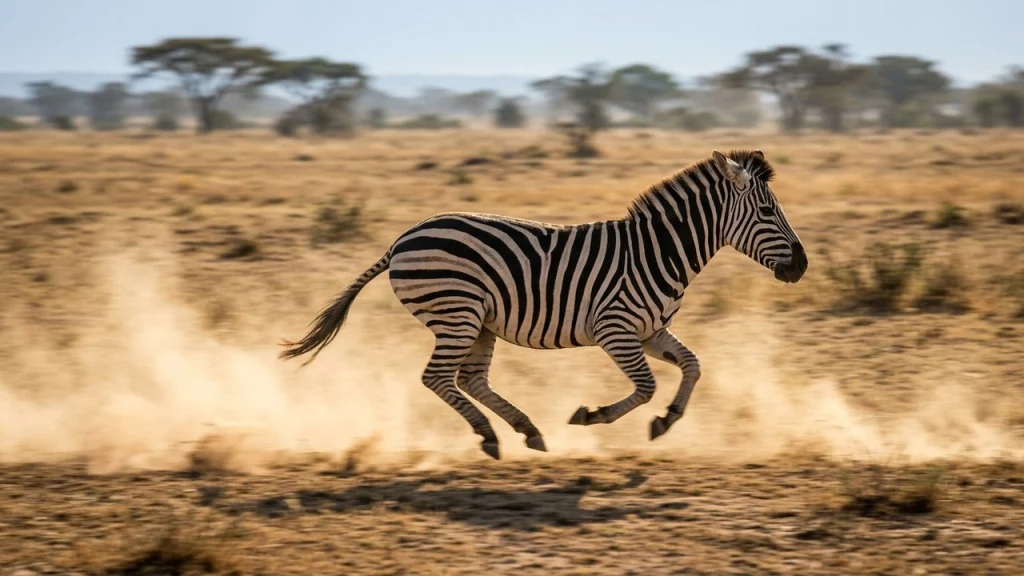
Zebras run fast. The San Diego Zoo Wildlife Alliance says they can exceed 40 miles per hour (64 kilometers per hour), and Animal Diversity Web reports that a chased Burchell’s zebra reaches up to 55 miles per hour.
Lions are quick as well, though the sprinting figure given is for a lioness, who the San Diego Zoo Wildlife Alliance puts at up to 33 miles (53 kilometers) per hour. A charging lion crosses a distance equal to a football field within six seconds. The San Diego Zoo Wildlife Alliance says zebras that group together benefit from stripes that overlap, which makes it hard for a lion or a leopard to single out and pursue one animal.
Watchfulness at night and the cost of living under threat
Even at rest a herd keeps watch. Through the night, at least one resting member stays awake in tall grass cover, watching for danger. The San Diego Zoo Wildlife Alliance says a zebra’s night sight is thought to be about as good as an owl’s.
Animal Diversity Web says that when threatened by predators, a Burchell’s zebra emits a high-pitched alarm call repeating two syllables, “kwa-hi”. That account also states that 50% of juvenile Burchell’s zebras die every year to predation.
Sources
- Animal Diversity Web: Panthera leo (lion)
- Animal Diversity Web: Equus burchellii (Burchell’s zebra)
- San Diego Zoo Wildlife Alliance: Lion | San Diego Zoo Animals & Plants
- San Diego Zoo Wildlife Alliance: Zebra | San Diego Zoo Animals & Plants
- Smithsonian’s National Zoo: Lion
- PLOS ONE: Resolving a conservation dilemma: Vulnerable lions eating endangered zebras