
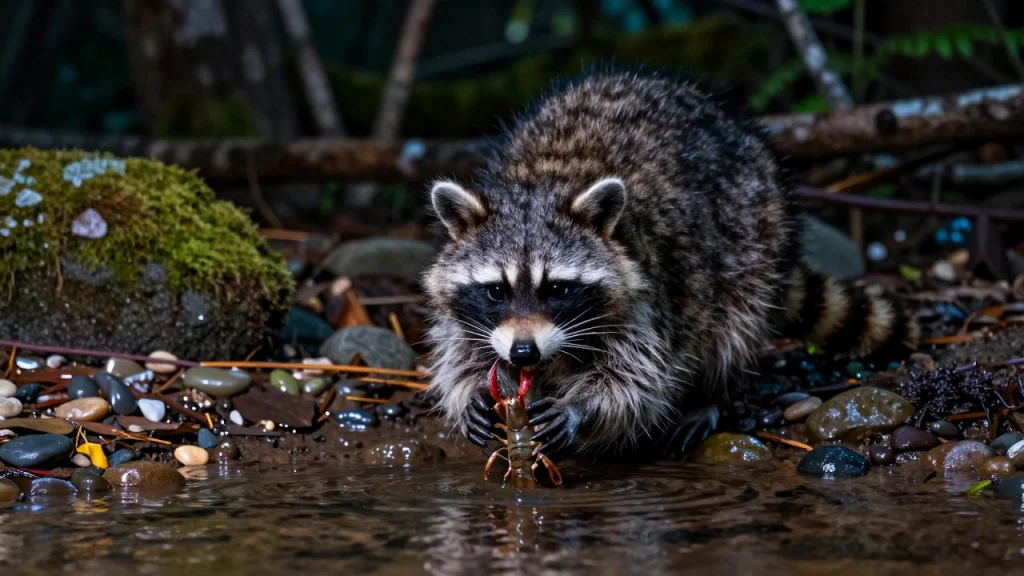
Raccoons dunk food in water because the water sharpens their sense of touch, not because they are keeping it clean. Researchers studying the behavior call it dousing, a word that describes boosting a sense rather than scrubbing a surface. So the familiar image of a masked bandit rinsing food under a stream is misleading: nothing in that ritual is about hygiene.
The reputation is old, though, and it is baked into the animal’s scientific name, where the second word is Latin for the washer. That label was attached in the 1700s from reports about captive animals, and it has outlived the evidence behind it. What the paws are actually doing is closer to running a quality check on every meal.
Forepaws that work as sense organs
Raccoons are built for exactly that kind of work. Their forelimbs resemble slender human hands, and both fore and hind feet carry five toes, which makes them unusually dexterous for a carnivore. The front toes are long and slender with sharp claws, and the soles are hairless, so bare skin meets whatever the animal picks up.
Those front digits rank among the animal’s most sensitive tools, and they matter enormously when it harvests plant or animal food. Touch is where the species excels: the forepaws are sensitive enough to pry apart prey and to climb with ease, and a meal is picked up in those paws long before it reaches the mouth.
That same dexterity keeps coming up in research. A field study on raccoon tool use describes their vision as excellent and their manual dexterity as built for tactile exploration and for manipulating objects, and these animals are well known for handling a wide variety of things:
- lifting, holding, pushing, pulling and carrying objects of many shapes
- working latches, levers and other fittings on gates and bins
- prying food out of hidden places, such as bird feeders and clam shells
- opening garbage cans and unlocking locks
What the water changes
The scientific literature confirms the same term: dousing, not washing.
Brain anatomy backs this up: the rear of the cerebrum, home to the somatosensory cortex and to a cluster of related cortical, thalamic and subcortical areas, is unusually large in raccoons, which points to amplified pathways for handling touch. A larger tactile system gets more out of every contact, and contact is what decides whether a meal gets eaten at all.
How the name was invented

The washer label is Linnaeus’s doing. By the 10th edition (1758) of his classification he had reclassified the animal as Ursus lotor, the washer bear, relying on accounts of captive raccoons that persistently dunked food in water.
In 1780, Gottlieb Conrad Christian Storr, a German naturalist, moved the species into a genus of its own named Procyon, alluding to their dog-like appearance, and kept lotor as the species name. Every nickname invented since has repeated the same misreading.
Washing, or just wetting
Not all food dunking is the same, and researchers have set a deliberate bar for real washing. An animal has to tell clean items from dirty ones, and it has to go out of its way to haul the dirty one to a stream.
Wild boar pass that bar. Dusty apple chunks were carried to a creek, nosed about under water for up to 30 seconds, and swallowed only after the sand had gone. Clean apples were never taken to the creek.
Raccoons do not meet that bar as far as it has been documented. Rolling food between the hands reflects an animal that depends on touch to find and judge what it eats, not a tidying instinct.
Where dousing fits into a night of foraging
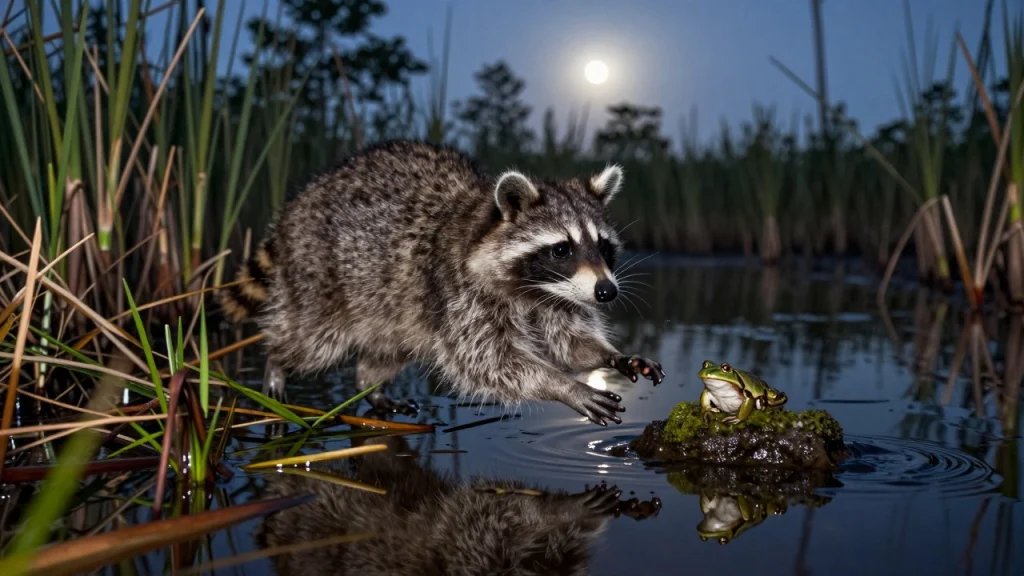
Raccoons favor wooded country beside waterways, which is exactly where observers see a meal dunked before it is eaten. Their dependence on water also shapes where they live: such adaptable animals turn up anywhere water is available, in marshes, prairies, forests and even urban areas.
Water is where much of the food comes from. A good share of the natural diet is pulled straight out of the shallows, where fast paws snatch crayfish and frogs along with other aquatic prey.
On land the menu widens. Invertebrates outweigh vertebrates in what gets eaten, though certain regions run mostly on plant food. Possible items include:
- crayfish
- insects
- rodents
- frogs
- fish
- eggs taken from bird nests
The species is nocturnal and rarely seen by day, which leaves touch doing much of the work. Cold weather slows them down as well: they do not hibernate, but their body weight can fall by 50 percent while they live off fat reserves for weeks at a time.
One limit is worth noting. Their coat is not waterproof, so they may hesitate to soak even though they are excellent swimmers. Dunking is a quick errand, not a bath.
Not a dry mouth problem
The old explanation, that a raccoon needs moisture to swallow, does not hold up. Salivary glands in this species are well developed, and handling food in water is not about wetting it at all, since plenty of what they eat is consumed unmoistened.
Much of the activity serves a practical purpose in the sequence of finding, seizing, identifying and orienting a meal.
Raccoons around people
That dexterity pays off around people every day. Raccoons are not a single species either. Six other species exist beyond the North American form, and most of them live on tropical islands, while the familiar one was carried far beyond its native range during the 20th century, with a wide introduced range that now includes Germany, Russia and Japan.
A typical home range spans 1 to 3 km across, stretching as far as 10 km in the west of the range. Among the animals that hunt raccoons are coyotes, wolves, big hawks and even owls.
None of this threatens the species. Globally it is not considered threatened, since it carries a Least Concern category on the IUCN Red List.
Next time a raccoon appears to scrub food under a stream, the motion is not hygiene. It is a nocturnal hunter running a quality check with the most sensitive part of its body, and the name washer is an old guess that has outlived the evidence behind it.
Sources
- Animal Diversity Web, University of Michigan: Procyon lotor (northern raccoon) | INFORMATION | Animal Diversity Web
- San Diego Zoo Wildlife Alliance: Raccoon | San Diego Zoo Animals & Plants
- State University of New York College of Environmental Science: Raccoon | Animal Diversity Knowledge Center
- National Geographic: Picky Pigs Take Washing Certain Foods Seriously
- Animal Cognition, via PubMed Central: Do wild raccoons (Procyon lotor) use tools?
- Peer Community In reviewed preprint, via PubMed Central: Food-washing monkeys recognize the law of diminishing returns