
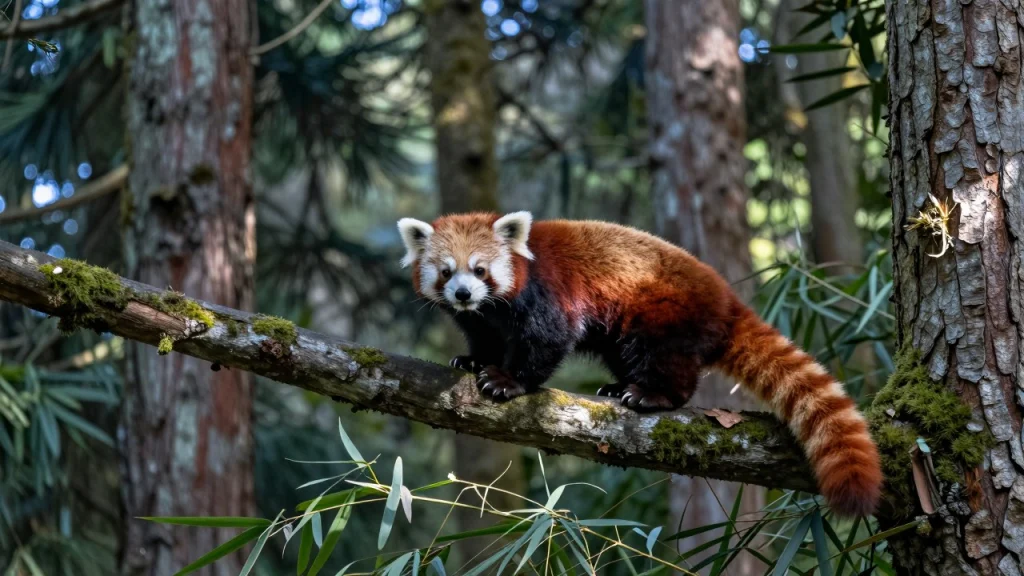
The red panda survives today as the sole living representative belonging to the family Ailuridae. Throughout the rugged mountain terrain of Asia, this arboreal mammal encounters numerous natural predators that hunt among the trees and forest floor. Yet, when considering what is a red panda’s worst enemy, the answer does not point to wild carnivores. The most destructive adversary facing the red panda is humanity, whose expanding footprint has devastated populations across the continent.
In temperate mountain woodlands, natural hunters such as snow leopards, common leopards, and wild dholes regularly pursue red pandas. Nevertheless, human activities exert pressures that wild carnivores could never duplicate. Expanding human settlements drive widespread habitat degradation, fragmentation, illegal poaching, and the introduction of domestic animals into fragile montane ecosystems. These cumulative human-driven impacts have pushed the species into a precarious conservation crisis.
Natural Predators Across Montane Forests
In the wild, red pandas inhabit cool, temperate forests with bamboo understories, thriving across the Himalayas alongside other high mountains.
The most prominent natural predator of the species is the snow leopard ( Uncia uncia ). Common forest leopards and jackals also hunt red pandas when the animals venture close to the ground or rest in accessible branches. Furthermore, wild dholes also hunt red pandas.
To minimize dangerous encounters with these daytime and terrestrial predators, red pandas have adopted specialized daily routines:
- Nocturnal and crepuscular activity: The solitary mammals remain active primarily at dusk, dawn, and through the night, remaining hidden during peak daylight hours.
- Elevated resting sites: They seek safety high off the ground, sleeping in nests in evergreens to stay out of reach of ground hunters.
- Canopy vigilance: Spending time in the trees provides an elevated vantage point to detect approaching carnivores.
Anatomical Adaptations and Defensive Tactics
The physical characteristics of the red panda reflect an arboreal lifestyle shaped by the constant necessity of escaping predators. Adult specimens reach between 8 and 17 pounds, equating to 3.6 and 7.7 kilograms; their bodies measure 22 to 24.6 inches (or 56 to 62.5 centimeters), while their bushy tail extends 14.6 to 18.6 inches, which represents 37 to 47.2 centimeters.
Their agility in the canopy relies on specialized skeletal features. Their leg joints possess exceptional flexibility, with a specialized junction of the tibia and fibula that permits their fibula to rotate along its anatomical axis. This morphological adaptation permits red pandas to descend tree trunks headfirst, maintaining absolute control while fleeing a threat. As they descend headfirst, they grip the trunk firmly with their sharp hind claws.
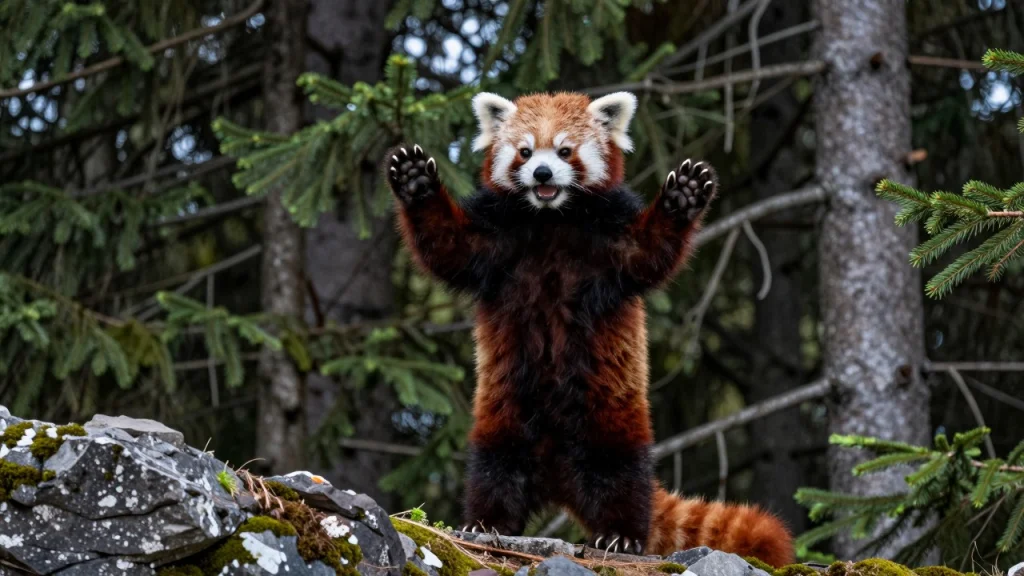
When escape into the high canopy is impossible and a predator corners a red panda on the ground or on an isolated rock, the animal turns to an active defense:
- Threat display: The animal stands upright on its hind legs to increase its perceived size and strike out forcefully with sharp claws.
- Semi-retractile weapons: Its semi-retractile claws deliver defensive swipes to repel attackers.
- Auditory warnings: An alarmed red panda produces an ear-splitting, grumbly barking sound to startle and deter predators.
- Chemical deterrents: If intimidation fails, the red panda discharges a foul-smelling secretion from scent glands situated at the base of its tail to discourage a predator from consuming it.
These evasive and defensive tools allow red pandas to survive routine encounters with native carnivores. However, they provide virtually no defense against large-scale habitat alteration or human hunters.
Dietary Specialization and Vulnerability
A critical factor that amplifies the vulnerability of the red panda is its highly restricted diet. This vegetation represents the core of their nutritional intake, as bamboo constitutes about 95% of their total food consumption.
To handle tough stalks and foliage, the red panda possesses a modified wrist bone called a pseudo-thumb, which allows it to grasp bamboo stems with remarkable dexterity. Their absorptive efficiency remains low, processing about 24 percent of the overall bamboo consumed. Because they extract such a small fraction of nutrients from their food, they must consume vast amounts of bamboo daily and conserve energy whenever possible.
In winter, when freezing temperatures deplete available energy, red pandas can enter periods of dormancy, suppressing their metabolic rate and waking every few hours to seek nourishment. They also rely heavily on specific microhabitat structures. The animals favor forest sections containing fallen logs, abundant tree stumps, alongside fresh water sources.
Anthropogenic Pressures: The Ultimate Threat
While natural predators claim individual animals, human activity threatens the survival of the entire taxon. Deforestation eliminates essential nesting trees and bamboo food resources, isolating small populations in fragmented forest patches separated by inhospitable terrain.
In protected landscapes, local human populations harvest forest products extensively. Local communities residing along reserve peripheries depend heavily on bamboo grass as a primary fodder source for their livestock. Because red pandas depend directly on this vegetation, they consistently avoid zones subjected to intense bamboo grass extraction. Domestic livestock herds actively compete with these small mammals for available bamboo leaves while degrading fragile montane woodlands.
Direct hunting and poaching compound these habitat stresses. In several areas, hunters set wire snares targeting musk deer, which accidentally snare and kill wandering red pandas. Poachers also intentionally hunt red pandas to supply the illegal trade in pelts, a threat documented across multiple range nations. Law enforcement confirmed this persistent demand in 2010 after two red panda pelts were seized from a pastoral livestock shed located in the Barse block.
The Menace of Domestic Dogs and Disease
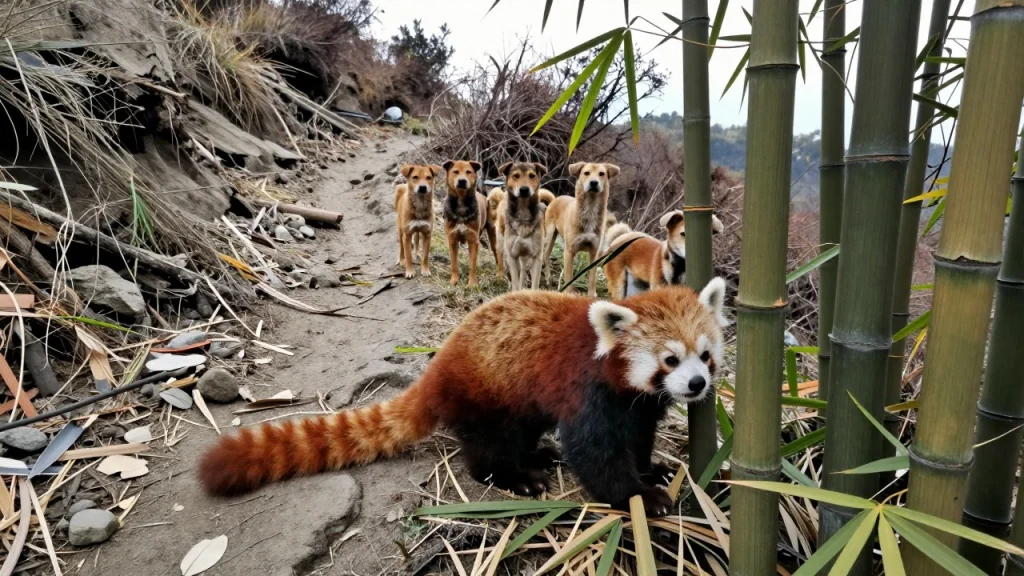
Among the most devastating human-introduced threats are free-ranging domestic dogs.
Free-roaming dogs act as aggressive alien predators in montane ecosystems. Field investigations have documented multiple instances of free-ranging stray dogs directly attacking and killing red pandas in both Nepal and Bhutan.
Beyond direct predation, domestic canines introduce fatal pathogens to wild carnivores. Domestic dogs transmit infectious diseases, particularly canine distemper, which causes fatal illness in red pandas.
Conservation Status and Prospects
The cumulative impact of habitat loss, fragmentation, poaching, and domestic dog incursions has caused severe population declines. Biologists determine that across their native habitats, the species experienced a 40 percent population drop during the past two decades.
In response to this steep decline, the red panda is classified as an endangered species. It receives full legal protection across its historical range countries, including India, Bhutan, China, Nepal, and Myanmar.
Protecting the species requires urgent interventions to counter human-induced threats:
- Mitigating forest disturbance: Halting unregulated bamboo harvesting and livestock grazing in critical core zones.
- Managing domestic canines: Enforcing vaccination and spaying campaigns for dogs near protected boundaries to prevent fatal disease outbreaks and direct attacks.
- Halting illegal trafficking: Enhancing anti-poaching patrols to eradicate snares and stop the illicit trade in skins.
- Securing forest corridors: Restoring forested migratory pathways to connect fragmented populations.
In the wild, red pandas live for approximately 8 to 10 years, though individuals in protected zoo environments can survive for up to 15 years. Their slow reproductive cycle, marked by a gestation period of 98 to 145 days, small litters of 1 to 4 young (usually 2), and a maturity age of 18 to 20 months, means that populations recover very slowly from human disturbance. Addressing human encroachment, eradicating illegal poaching, and controlling domestic canines are essential to protecting this extraordinary mammal from its worst enemy.
Sources
- Smithsonian’s National Zoo and Conservation Biology Institute: Red Panda
- San Diego Zoo Wildlife Alliance: Red Panda
- Animal Diversity Web: Ailurus fulgens (red panda)
- Ecology and Evolution: Habitat requirements of the Himalayan red panda (Ailurus fulgens) and threat analysis in Jigme Dorji National Park, Bhutan
- PLOS ONE: Large anthropogenic impacts on a charismatic small carnivore: Insights from distribution surveys of red panda Ailurus fulgens in Nepal