
Short answer: sperm whales are not aggressive toward people. What the species shows, and what scientists have documented, is defensive aggression: pushing back when killer whales threaten a group or a calf, and taking hooked fish off longlines. The species is a deep-sea predator, and nothing in its behavior suggests people fit that menu.
That distinction matters, because an animal that fights to protect its young behaves very differently from a predator that hunts people. Sperm whales belong firmly in the first camp, and almost everything known about their aggressive behavior comes from watching what happens when they are threatened, harassed, or tangled. A visitor is far more likely to meet a whale focused on food far below the surface.
The equipment is real, the danger to people is not
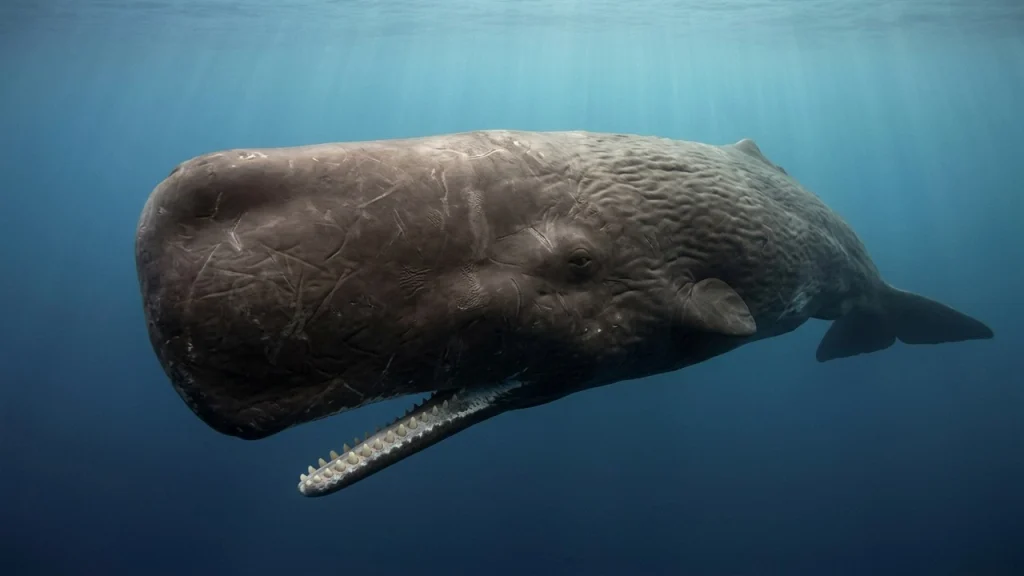
It is the largest toothed whale alive, with a global distribution matched by few other marine mammals, and it is easy to read menace into a head like that one. Each side of the narrow lower jaw carries 20 to 26 large teeth, and the upper jaw carries almost nothing, because those teeth rarely push through the gums. That head accounts for about one-third of total body length, and much of it is the spermaceti, an oil sac used to focus sound. Females weigh 15 tons and males 45 tons, with lengths from 40 to 52 feet. All of it is impressive, and none of it points at a swimmer.
Hunting makes the orientation clear. Sperm whales feed on dives that routinely reach 2,000 feet and can run 45 minutes, on a menu built from squid, sharks, skates, and fish of the deep ocean. A whale of this size takes in roughly 3 to 3.5 percent of its body weight every day. Every item on that list comes from the deep water the whales work in, and human beings are not part of it.
What the aggressive behavior actually is
The aggressive behavior researchers have documented falls into three categories, and each one has a clear trigger.
Defending calves and family groups
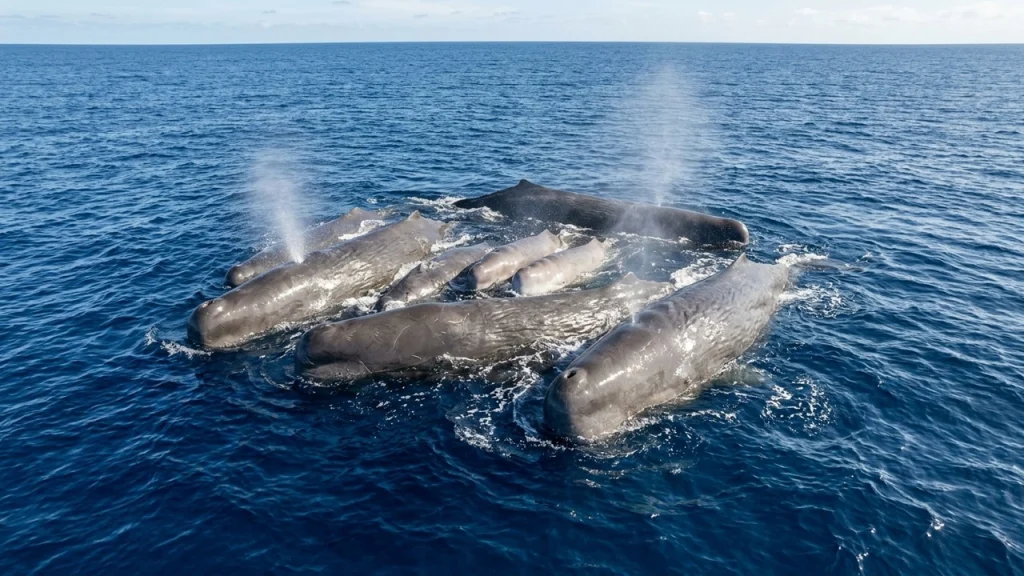
The clearest aggressive behavior in this species is protective, and it depends on numbers. Social units average 12 females along with their young, and those groups act as the shield. Females defend themselves and their calves by grouping, and researchers suggest that defense may be the main reason the species is social at all.
Killer whales are the main documented threat, and deaths of calves and adult females from attacks have been reported. When researchers played recordings of mammal-feeding killer whales to five usually solitary adult males, the responses were not the escape dives anyone expected. Instead of diving away, the males cut their dives short, surfaced, changed their vocal production and began behaving socially. Three of the five responded that way, and all four whales that were foraging when the playback started fell silent or nearly silent.
The silence is the clue. Sound is how these whales know something is out there, and solitary males that almost never produce codas started producing them during the playback, while previously separate animals clustered together at the surface. A whale built for life alone will gather with strangers and announce its alarm when it hears a predator’s voice, which is about as far from unprovoked aggression as cetacean behavior gets.
Taking fish off the line
The other place sperm whales put those teeth to work is around fishing gear, and here the behavior is opportunistic rather than defensive. NOAA documents sperm whales stripping hooked fish off longlines, a behavior called depredation: they grip the line with their long jaw and create tension on it, which shakes the fish off the hooks. Scientists think the technique may be learned between individuals.
The maneuver carries risk for the whale as well, because working around vessels and gear raises the odds of entanglement or injury, and an entangled whale may swim long distances while dragging the gear behind it.
Male encounters that end in sound
Between adult males, physical fighting is rare. There is little evidence for combat among them, and no sign that they guard females or young, since males generally keep their distance and roam independently in breeding areas, with only rare aggressive interactions recorded. Most of what looks like rivalry is settled acoustically instead: the clicks of a large male advertise its size and can serve as a warning to competitors, and other whales pick them up from 60 km away. That may be why big males keep their distance at the breeding grounds.
The social structure explains the rest. Young males leave the family group between the ages of 4 and 21 and gather in bachelor pods made up of males of roughly the same age and size. As they grow they begin migrating toward the poles, the pods shrink, and the largest males are usually alone.
When people and sperm whales meet
No one should test the arrangement. NOAA describes whales as wild, unpredictable animals capable of surprisingly fast movement, and its guidance for viewing by watercraft is a standoff of 100 yards from large whales. Swimming with, riding, petting, or touching a marine mammal in the wild is discouraged, and a breaching or flipper-slapping whale can hurt a person or a boat. The signs of an unhappy whale are behavioral rather than obvious: rapid changes in swimming speed or direction, and erratic patterns. NOAA advises moving away when you see them, and it warns that trying to free an injured or entangled animal is dangerous for the person doing it.
Why a depleted species raises the stakes
All of this plays out on a population still recovering from whaling. Commercial whalers hunted them from 1800 to 1987, and the slaughter nearly wiped out their numbers. In the United States, protection comes through the Endangered Species Act, and the species carries depleted status under the Marine Mammal Protection Act. The IUCN lists it as Vulnerable globally. A population model published in 2022 estimated 844,761 animals in 2022, against 1,949,698 in 1711, an overall decline of 57% and a three-generation decline of 48%. The same study found populations recovering slowly where little human impact is felt, while decline is possible in areas with a substantial human footprint.
So the aggressive behavior is best read as defense, not menace. Sperm whales fight for calves, for group safety and for a meal, and they treat a human being as neither threat nor prey. Getting that right matters for a species whose numbers are still being counted, slowly, back up.
Sources
- NOAA Fisheries: Sperm Whale
- NOAA Fisheries: Marine Life Viewing Guidelines: What You Can Do
- Scientific Reports: Responses of male sperm whales (Physeter macrocephalus) to killer whale sounds: implications for anti-predator strategies
- Scientific Reports: Migration to breeding areas by male sperm whales Physeter macrocephalus from the Northeast Atlantic Arctic
- Scientific Reports: Current global population size, post-whaling trend and historical trajectory of sperm whales
- IUCN SSC Cetacean Specialist Group: Red List Updates Published for Sperm Whales and Lahille’s Bottlenose Dolphins