
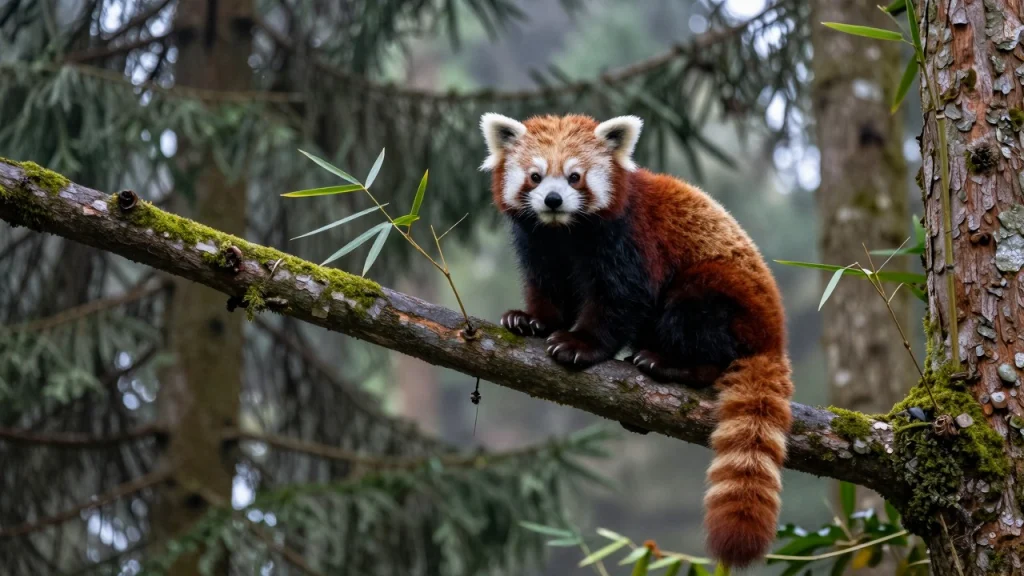
A wild red panda typically reaches 8 to 10 years of age, and the most extreme wild case runs to 14 years. Under human care the figures climb, with captive red pandas averaging 13.4 years and the Smithsonian’s National Zoo putting the ceiling at 23 years. That gap between the two numbers is the real answer to the question, because captivity adds years, not months, to a life.
A red panda in the mountains has a harder time on every front. It eats a diet that is about 95% bamboo, digests that bamboo with a simple carnivore stomach, and spends part of each winter dormant in the cold. Disease, habitat loss and people add pressure on top of that, and an 8 to 10 year wild average starts to look less surprising.
Aging comes late, and it comes unevenly
Red pandas in human care start displaying visible signs of ageing at roughly 12 to 14 years. Females stop breeding after the age of 12, while males remain reproductively capable past that point, so an aging male can still contribute cubs to a captive breeding program long after his physical prime has passed. A female’s breeding career, in other words, can end well before her life does.
Wild red pandas have no such documented birthday curve, mostly because nobody finds them. Census work is complicated by the fact that the animals are active at night, perch high in trees, and occupy remote, steep terrain, so population estimates come from indirect signs such as fresh feces, tracks and evidence of feeding. Red pandas are also naturally found at low population densities, which means a long-lived animal is also an easy animal to miss.
A bamboo diet leaves little spare energy
Every part of the wild diet is a compromise. Being an obligate bamboo feeder gives the red panda a tight energy budget across a large part of the year. Each animal needs at least 1.5 kg of fresh leaves, or 4 kg of fresh shoots, every day.
The payoff for all that feeding is poor, because the machinery is built for meat rather than leaves. The stomach has 1 chamber and food clears the gut in just 2 to 4 hours, so a lot of bamboo leaves the body before its nutrients do. A red panda eats constantly and still extracts relatively little, and it takes frequent rest periods across the day to save energy.
Food is also harder to reach than it looks. Wild red pandas keep to themselves except in the breeding season, and each one ranges over about 1 square mile of steep, remote ground, so the daily search for bamboo fills a large share of a wild animal’s life.
Winter dormancy slows the whole system
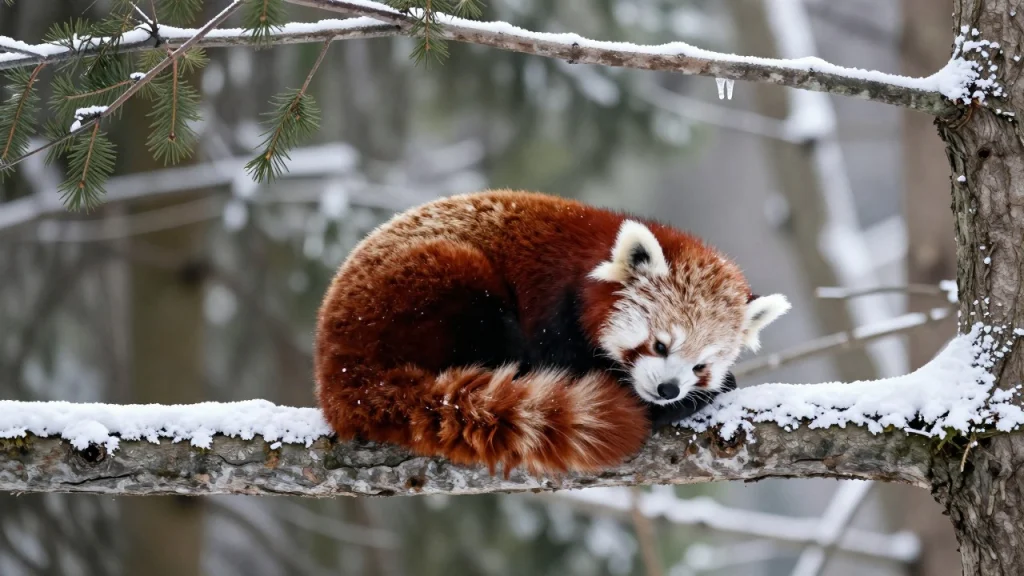
Freezing weather tips them into a dormant state, in which the metabolic rate drops and rises again every few hours as they rouse themselves to find food. In a zoo enclosure, the same cold is answered by curling into a ball to hold onto body heat.
That caution about fuel runs through the breeding calendar too. Researchers believe the lengthy pregnancy of a red panda comes from a slow metabolic rate, so even the cost of producing cubs is set by the animal’s energy supply.
Growing up is a two year job
Adults breed only once a year, and mating takes place in early winter. Gestation spans 98 to 162 days, and much of that window is spent paused, because embryo development is on hold for about 40 to 85 days before real growth begins.
Litters are small as a result. The usual number is 1 or 2 cubs, and while 4 falls inside the recorded range, litters of 3 or 4 are uncommon. A newborn weighs about 100 g. In managed care, the Himalayan form bears again within 377 days in about 75% of cases.
A cub is full grown by around 12 months and reproductively mature by around 18 months, and it stays with its mother for about a year. When twins arrive, one is normally larger than its sibling, and the smaller one starts life with less to put into growth.
Most of the danger is human
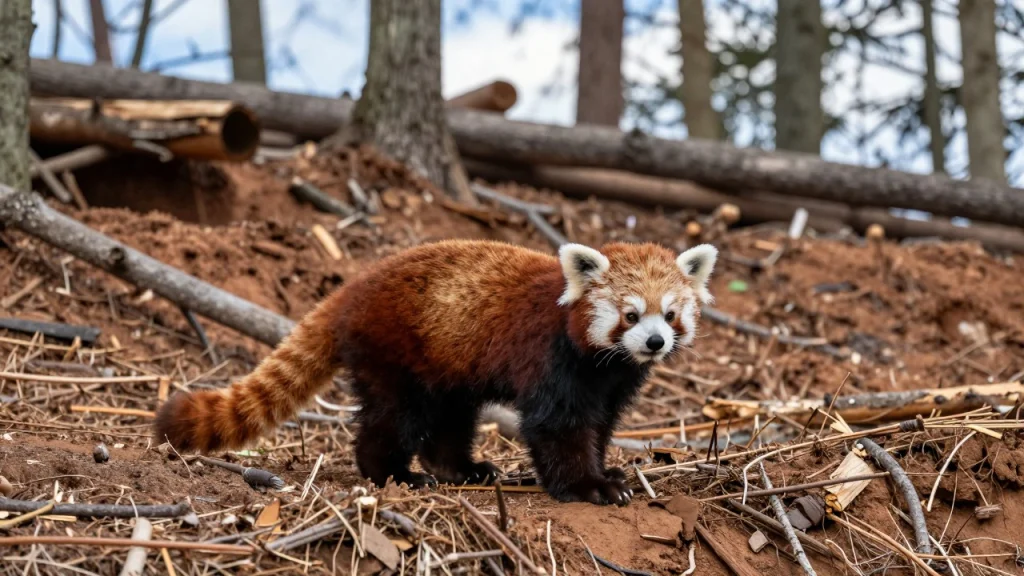
The primary threats, according to the Smithsonian’s National Zoo, run from habitat loss and degradation to human interference and poaching, and much of that harm is indirect. Domestic dogs hunt them and can also carry canine distemper. Snares set for musk deer catch red pandas as a byproduct, and local livestock outcompete red pandas for food, taking the bamboo leaves a wild animal needs.
Habitat loss damages lifespan as well as numbers. Cleared forest takes away the places red pandas nest and the food they eat at the same time, and it separates what is left into small fragments of inhospitable terrain. Fragmentation leaves each group small and isolated, which contributes to inbreeding depression and raises the risk to a small population from natural disasters. Predation is a smaller share of the danger, though leopards and jackals are among the animals a red panda climbs trees to escape.
Long-lived animals are also slow to replace. When an adult is lost to disease, dogs or habitat loss, the population does not refill that space quickly, because each female raises so few cubs. That is the quieter reason to worry about the red panda beyond any single population estimate.
Two species, two conservation pictures
Genetic studies have split the red panda into two species, the Himalayan form (Ailurus fulgens fulgens) and the Chinese form (Ailurus fulgens styani), and the Chinese form is generally the larger of the pair, with deeper red coloration. The Himalayan form lives predominantly in Nepal, and extends into India and Bhutan, while the Chinese form is found mainly in China and Myanmar.
Numbers and habitat quality differ between the two as well. Roughly half of all individuals are thought to live in China, and the wild population holds more Chinese than Himalayan red pandas. Apart from Bhutan, the Himalayan form’s habitat is more broken up than the Chinese one. The IUCN’s 2015 assessment classifies the species as Endangered with a decreasing population trend, and estimated the global total at fewer than 10,000 individuals.
That trend is not new. A drop of as much as 50% over only a 20-year period is on record, and the decline is projected to continue as forest and bamboo keep shrinking and as disease takes its share.
What the long captive lives are for
Protected animals live longer, which is the point of protecting them. The National Zoo treats self-sustaining zoo populations as a high priority and a hedge against extinction, while adding to what is known about the species’ biology, and its conservation work has produced more than 100 surviving cubs since 1962. One of the animals on the Asia Trail, a female named Asa, was born in 2014 at the Smithsonian’s research institute.
International rules reinforce that work. The red panda sits on CITES Appendix I, raised from Appendix II in 1994 to place it under the toughest protection against commercial trade, and every one of its 5 range countries protects it by law. What rules cannot do is stop forest from being logged and split, and a captive birth count does not replace the habitat a wild red panda needs to reach old age. The long lives in zoos show what the species can do; the shrinking forest decides how many red pandas ever get the chance to try it.
Sources
- Smithsonian’s National Zoo and Conservation Biology Institute: Red panda
- Animal Diversity Web: Ailurus fulgens (red panda) | Information
- San Diego Zoo Wildlife Alliance: Population & Conservation Status, Red Panda (Ailurus fulgens) Fact Sheet
- San Diego Zoo Wildlife Alliance: Diet & Feeding, Red Panda (Ailurus fulgens) Fact Sheet
- San Diego Zoo Wildlife Alliance: Reproduction & Development, Red Panda (Ailurus fulgens) Fact Sheet
- San Diego Zoo Wildlife Alliance: Behavior & Ecology, Red Panda (Ailurus fulgens) Fact Sheet