
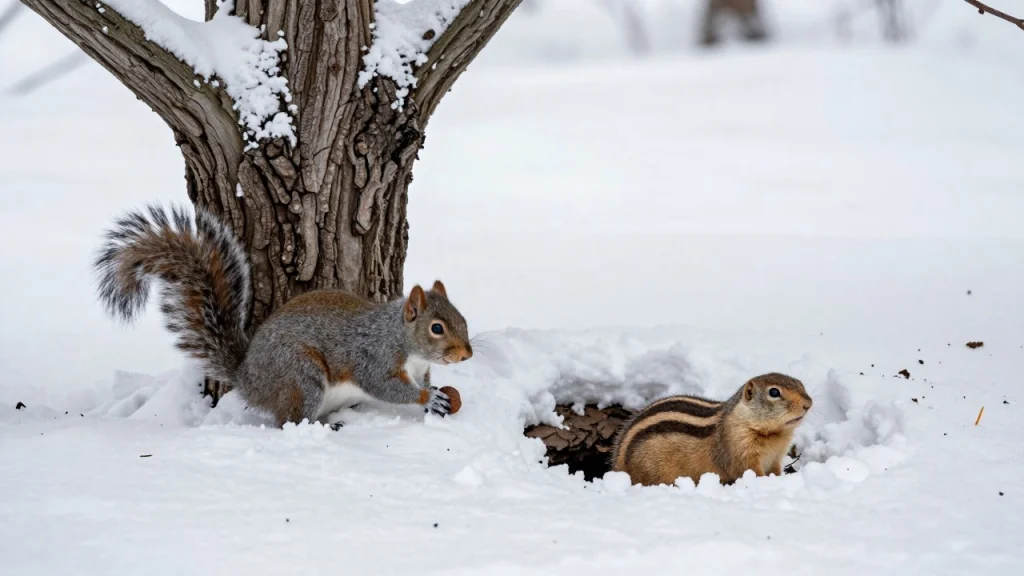
No, tree squirrels do not hibernate. Ground squirrels, however, do hibernate.
The squirrels raiding your feeder in every season are not asleep through winter. Tree squirrels do not hibernate. They keep moving on cold days and pay for the season with food they gathered and buried earlier in the year. Hibernation is real inside the squirrel family, but it belongs to a different branch of it, the ground squirrels that seal themselves in burrows and let their body temperature fall toward freezing.
That split explains a puzzle most people notice: a squirrel crossing fresh snow in January, right beside a patch of ground where nothing has stirred since the previous August.
Tree squirrels stay active through the cold
The Smithsonian’s National Zoo draws the distinction plainly for Prevost’s squirrels, a tree species of Southeast Asia, and it is the ground squirrels in this family that sleep through winter, not the tree squirrels. The Washington Department of Fish and Wildlife, describing the gray, red, Douglas and flying squirrels of the Pacific Northwest, agrees, and adds what a non-hibernating squirrel actually does when the weather turns: it stays in its nest during cold or stormy spells and comes out to retrieve food it stored nearby.
Staying warm costs energy, and tree squirrels manage that cost by spreading it across the autumn rather than banking it in body fat. They cache food and recover it as needed, keeping stores in hollow trees, stumps and abandoned burrows, and in human leftovers such as flowerpots, exhaust pipes and abandoned cars.
Their diet is mostly plant material, including seeds, acorns, tree buds and berries, which makes autumn the season for a very visible kind of work. Squirrels harvest by cutting, because the crops they want grow in clusters at the ends of fragile twigs that snap easily. The harvest is collected on the ground or carried to a storage site. Where red squirrels or Douglas squirrels have been working, a large pile of discarded cone scales, called a midden, gives them away. In winter, small holes in the snow mark the places where stored food was dug back up.
Cold still shapes their routine, just not dramatically. Activity peaks around dawn and dusk, and where cold spells run long, red squirrels sometimes dig a winter nest underground, usually right beside a food store.
How a squirrel stocks up for winter
Hoarding is the name researchers give all of this, and it is not a single tactic. The North American red squirrel uses both larder and scatter-hoarding strategies, switching according to the conditions at a given cache site. For red squirrels it pays off in winter survival, though the work is energetically expensive, slow and risky because it exposes the animal to predators.
The payoff is that winter is already paid for by the time it arrives, against a running toll of digging and remembering. Squirrels tune how much they cache to their expected energy demand, with the amount differing between sexes because the two invest different amounts of energy in mating.
The ground squirrels that really do hibernate
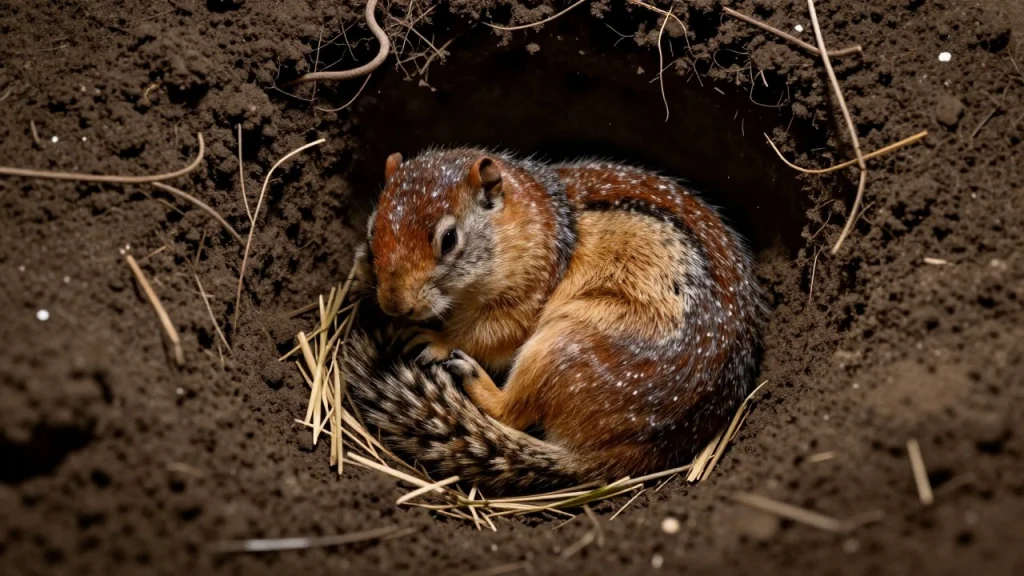
Hibernation means passing the winter in a state where normal physiological processes are cut back far enough that an animal’s energy requirements fall sharply.
The Arctic ground squirrel is the northernmost hibernating terrestrial mammal and the extreme case in its family. It is an obligate hibernator, and only three to five months go to being active, the rest of the year spent underground. It copes with winters where the temperature can fall under -20° Celsius, seven to eight months of the year. Its answer is fat: in the five to seven weeks before settling in, it builds up fat reserves that reach 30 to 41.5% of its body weight, an enormous battery assembled in a very short window.
Timing is staggered by sex. Females go down first, in August, and males follow about a month behind. Then comes the long wait: 215 to 240 days, with adult females staying down longer than males and adults longer than young. Males emerge first, in mid-April.
The thirteen-lined ground squirrel runs a similar calendar, going below ground from August through March. It qualifies as a true hibernator in the strongest sense, with body temperature falling to just above freezing and heart rate dropping to 20 beats per minute from a usual 200. Weight loss is steep, with individuals shedding up to 1/3 of their body weight, and the autumn feeding push matches: these squirrels can gain up to 4 gm of fat per day as winter closes in.
Torpor, arousals and the price of waking up
Hibernation is not one long sleep. Arctic ground squirrels supercool their core temperature to -2.9° Celsius, and each bout of torpor lasts up to three weeks. Even that deep a chill is not enough to switch off completely, because ambient and soil temperatures in their burrows fall to -18.8° Celsius and they must still defend their core. Their physiology is the most efficient of any endothermic hibernator studied, reaching a minimum metabolic rate of 0.012 ml O2/g/h when torpid at ambient temperatures of 4° Celsius.
Between those long cold bouts come brief arousals, when the animal rewarms toward 34 to 36° Celsius, staying there one to two days. Those episodes are the single most expensive part of the entire cycle. Rewarming happens through shivering and through non-shivering heat production driven by brown fat, with fatty acids serving as the fuel.
Scientists think the arousals do necessary housekeeping. They are required to maintain certain homeostatic processes that the cold inhibits, such as brain function, and may also be the only chance to sleep, since a body chilled this far cannot sleep properly.
Burrow site shapes the odds too. Shrubby vegetation over an entrance traps more snow and holds warmer soil than clear, windswept ground, and the best sites are fought over hard, with males becoming especially fierce in late summer when they begin defending their hibernacula.
What the winter costs and how it is repaid
Emergence is not a moment of restored strength. Arctic males have shed close to 30% of their body weight by the time they stir, and females come out having lost more than 30% of their mass since going in. Males cannot produce sperm at sub-zero temperatures and have to become warm again for gonadal development.
The recovery plan is already underground. Arctic males eat the food they cached in their hibernaculum the previous season, regain that mass, and leave the burrow at the same weight they went in with. Thirteen-lined ground squirrels do the same on a smaller scale, eating their caches during hibernation arousals, with the heaviest feeding concentrated just before they emerge.
The middle option: daily torpor
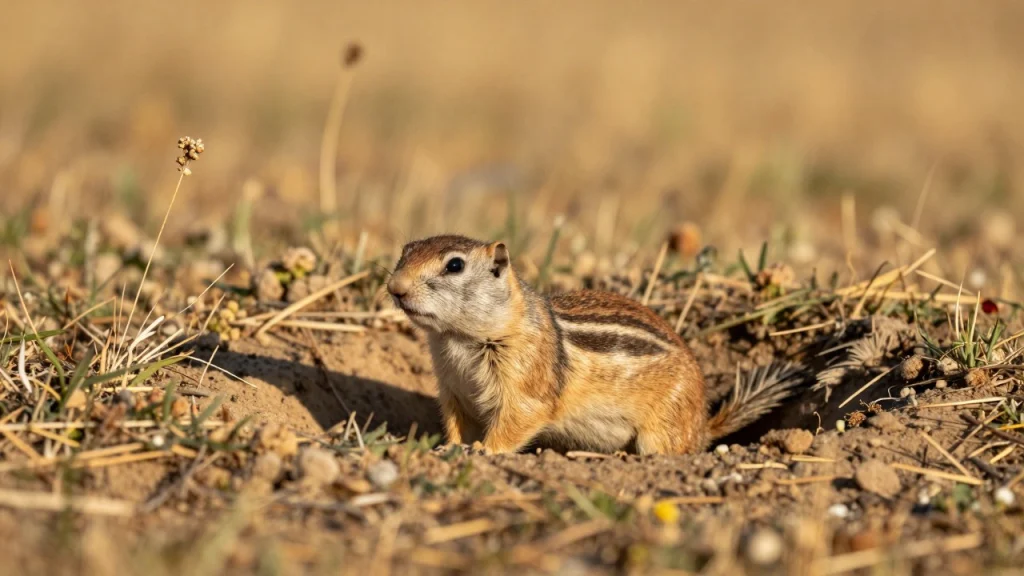
Not every ground squirrel commits to a full winter shutdown. European ground squirrels hibernate through winter, yet they also use daily torpor, a short-term version of the same deep sleep, to conserve energy across the rest of the year. The result is a species that is partly dormant and partly active in every month, and which spends about half the year below ground.
Their hibernation runs roughly 180 days, and it typically begins around August. Emergence is tied tightly to temperature rather than to the calendar: they come up once average temperatures rise above 0°C, with the earliest sightings reported around March 18 and most animals appearing around April 1.
When the cache strategy meets a warming climate
The tree squirrel approach carries a hidden requirement. Red squirrels depend on cold and humid conditions to preserve the cones they collect in the fall and eat through winter, which makes the whole strategy sensitive to a warming climate. The Mount Graham red squirrel, a subspecies of the North American red squirrel complex isolated from the core of its species range for at least 11 million years, sits at the southern limit of that range and is described by researchers as directly threatened by climate change, with regional mean temperature predicted to increase 1.5°C until 2100.
That subspecies had a single population, numbering around 274 individuals while it was being studied, and it is severely undermined by poor habitat, insect outbreaks, exotic species and human activities. Fire cut it to about 35 individuals in 2017, with a recovery to 67 squirrels in 2018.
Caching is not a fixed script either. On Mount Graham, the number of pits excavated to cache cones tracked with slope aspect and tree density, and males excavated 47% more pits than females.
The short version
So the answer is no for the squirrels most people picture, and yes for a specialized minority. Tree squirrels ride out winter on stored food, staying active but nesting down during storms. Ground squirrels of cold open habitats hibernate properly, dropping close to freezing for months and rebuilding on caches on the way out.
How long do squirrels hibernate?
According to the National Park Service, Arctic ground squirrels spend 7 to 8 months in hibernation. For thirteen-lined ground squirrels in Texas, Texas Tech University cites research by Howard McCarley showing that hibernation lasts about 240 days. Animal Diversity Web notes that dormancy continues for around 180 days in most European ground squirrels, which utilize burrows to hibernate.
Do red squirrels hibernate?
Red squirrels do not hibernate through the winter, and the University of Arizona notes that most of their activity in this period takes place around midday when temperatures are warmest. For Eurasian red squirrels, Animal Diversity Web explains that individuals do not hibernate, choosing to remain in nests during harsh storms or powerful winds that make traveling through tree branches hazardous. They emerge from their shelters only when they need to locate food.
At what temperature do squirrels hibernate?
The National Park Service states that during hibernation, a squirrel’s body temperature falls below freezing, a condition referred to as supercooling. Animal Diversity Web notes that Arctic ground squirrels lower their body temperature to -2.9 degrees Celsius through supercooling, staying in that torpid condition for up to three weeks at a time. For thirteen-lined ground squirrels, the same outlet reports that body temperature drops to just above freezing, with heart rates declining from their usual 200 beats per minute to as low as 20 beats per minute. For European ground squirrels, emergence occurs once local temperatures average above 0 degrees Celsius.
Sources
- Smithsonian’s National Zoo and Conservation Biology Institute: Prevost’s squirrel
- Washington Department of Fish and Wildlife: Living with wildlife: Tree squirrels
- Animal Diversity Web, University of Michigan: Spermophilus parryii (Arctic ground squirrel)
- Animal Diversity Web, University of Michigan: Spermophilus tridecemlineatus (thirteen-lined ground squirrel)
- Animal Diversity Web, University of Michigan: Spermophilus citellus (European ground squirrel)
- PLOS ONE: Does caching strategy vary with microclimate in endangered Mt. Graham red squirrels?
- National Park Service: Arctic Ground Squirrel
- Texas Tech University: Species account of the Thirteen-lined Ground Squirrel | Mammals of Texas | Natural Science Research Laboratory | Texas Tech
- University of Arizona: CRL: Mount Graham Red Squirrel Monitoring Program: MGRS Natural History
- Animal Diversity Web, University of Michigan: Sciurus vulgaris (Eurasian red squirrel) | INFORMATION