
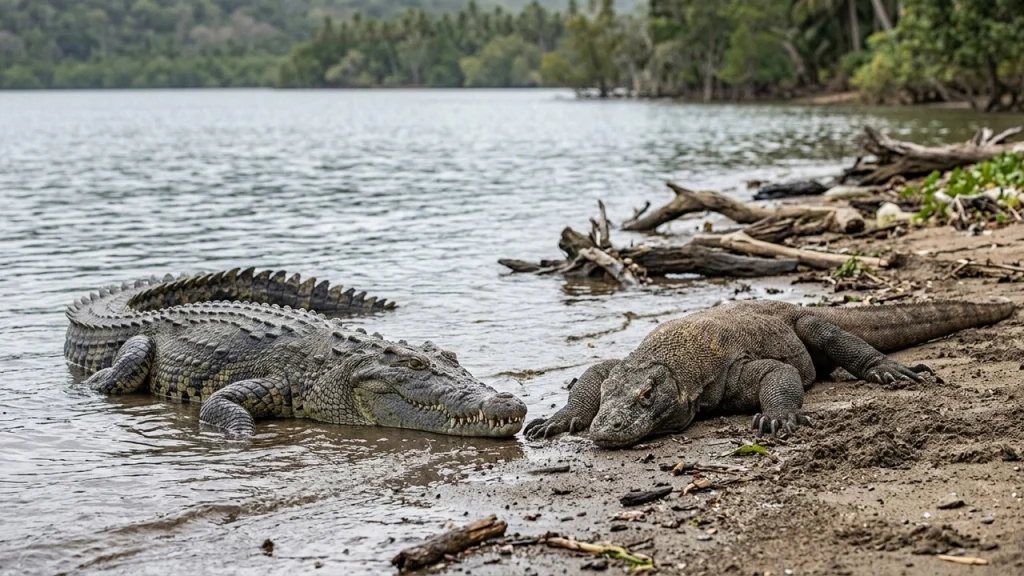
The crocodile wins on bite force: crocodilians exhibit the most intense bite forces documented across all living fauna, while, according to the Smithsonian’s National Zoo, the Komodo dragon’s jaw power is relatively modest. Within that PLOS ONE investigation, an individual saltwater crocodile (Crocodylus porosus) registered 16,414 N, establishing the peak bite force ever recorded in any animal. The PLOS ONE report observed that heavier specimens generated larger maximum forces among the examined monitors, topping out at 148.56 N.
None of the zoo, wildlife agency or research sources behind this article records a direct comparison or contest of strength between a Komodo dragon and a crocodile.
Bite mechanics and jaw pressure
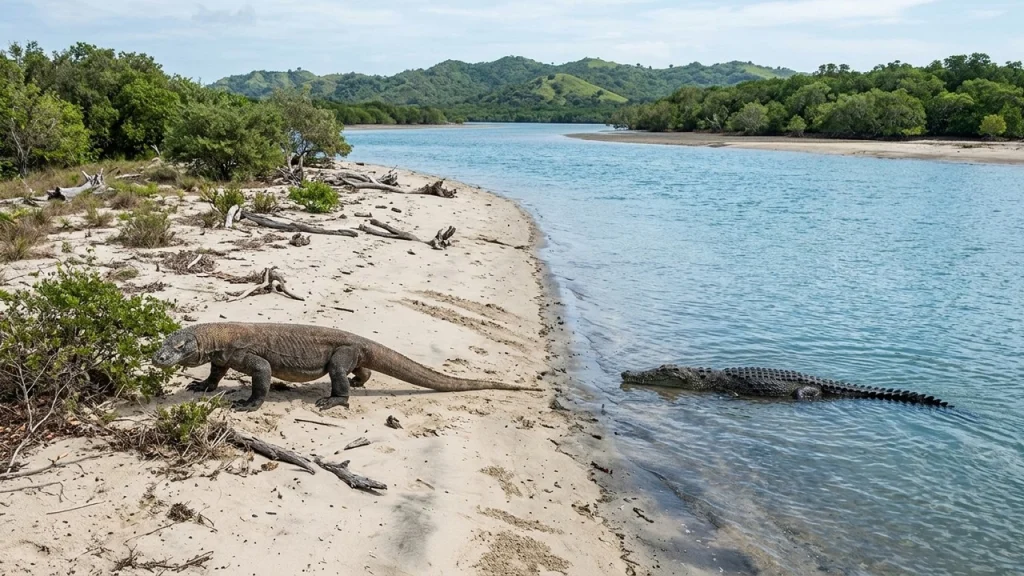
The San Diego Zoo Wildlife Alliance reports that crocodilians concentrate their highest muscular effort into rapidly shutting their jaws. For crocodilian species equipped with large jaws, closure can deliver as much as 5,000 pounds per square inch of pressure.
In contrast, research in PLOS ONE evaluating live specimens confirmed that the jaw adductor muscles of Varanus komodoensis yield an unexpectedly modest bite for an animal of its dimensions. The same paper noted that the monitor lizard’s measured clamping output remains low in proportion to its body mass when compared against other vertebrate animals.
Body mass and dimensions
Data compiled by Animal Diversity Web indicate that typical mass for the saltwater crocodile spans from 1000 to 1200 kg. Fully grown males of this crocodilian species can attain lengths of 6 to 7 meters. By comparison, females remain considerably smaller, rarely surpassing 3 meters in total length, while an individual measuring 2.5 meters is already regarded as large.
The Smithsonian’s National Zoo and Conservation Biology Institute identifies the Komodo dragon as the world’s largest living lizard species. In the wild, these monitors typically reach an estimated weight of around 154 pounds (70 kilograms), with males generally growing bulkier and longer than females. The heaviest and longest verified individual on record attained a length of 10.3 feet (3.13 meters) alongside a weight of 366 pounds (166 kilograms).
Teeth structure and hunting adaptations
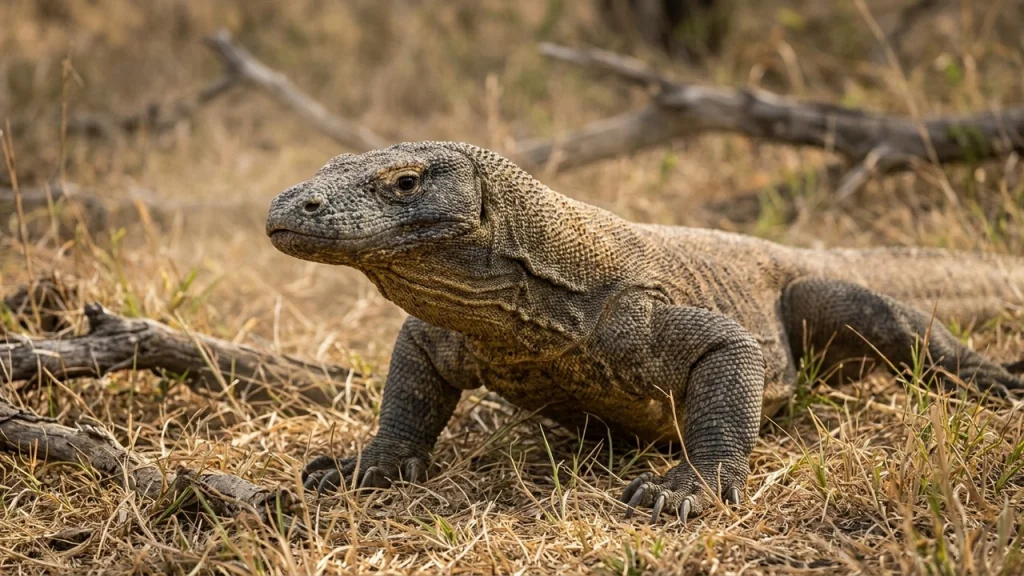
According to Animal Diversity Web, a saltwater crocodile possesses a heavy set jaw lined with between 64 and 68 teeth. The San Diego Zoo Wildlife Alliance highlights that simultaneous tooth counts across crocodilians range from 60 in the slender-snouted crocodile up to 110 in the gharial, with an individual potentially cycling through 8,000 teeth over its life. The same organization explains that in particular crocodilians, certain grasping teeth possess great strength without sharpness, whereas separate teeth within the mouth stay sharp as glass.
The Smithsonian’s National Zoo and Conservation Biology Institute characterizes the monitor’s serrated, curved, large teeth as its most lethal armament. Upon clamping down, the lizard engages powerful neck muscles to shake side-to-side violently, tearing flesh and muscle apart while inflicting massive shock and bleeding.
The same institution notes that Komodo dragons rank among the rare lizards equipped with a venomous bite, as well as being the heaviest lizards alive. Their venom stops blood from clotting, triggering heavy bleeding and driving prey into shock. In addition, scientists have documented approximately 50 distinct bacterial strains inside the lizard’s saliva, including at least seven that produce severe sepsis.
Movement speeds and hunting tactics
Crocodilians can attain swimming speeds up to 32 kilometers per hour (20 miles per hour), as noted by the San Diego Zoo Wildlife Alliance. On land, they can move as fast as 17.6 kilometers per hour (11 miles per hour) over short distances. The same wildlife organization adds that these reptiles can stay submerged on a single breath for more than an hour.
On land, the Smithsonian’s National Zoo and Conservation Biology Institute explains that a Komodo dragon centers its predation around power and stealth, despite being capable of momentary bursts measuring 10 to 13 mph (16 to 20 kph). In addition to speed, the monitor commands exceptional scent detection, occasionally locating decaying meat or carrion situated up to 2.5 miles (4 kilometers) away.
Our estimate
This section is our own inference from the figures cited above. No source records this outcome directly.
Going by measured bite force alone, the Crocodylus porosus individual would likely have the advantage over the tested monitors, at about 110.5 times the force.
Sources
- Smithsonian’s National Zoo and Conservation Biology Institute: Komodo dragon
- Smithsonian’s National Zoo and Conservation Biology Institute: How Dangerous Are Komodo Dragons? And Other Komodo Dragon Facts
- San Diego Zoo Wildlife Alliance: Crocodilian
- Animal Diversity Web: Crocodylus porosus (Saltwater crocodile)
- PLOS ONE: The Effects of Biting and Pulling on the Forces Generated during Feeding in the Komodo Dragon (Varanus komodoensis)
- PLOS ONE: Insights into the Ecology and Evolutionary Success of Crocodilians Revealed through Bite-Force and Tooth-Pressure Experimentation