
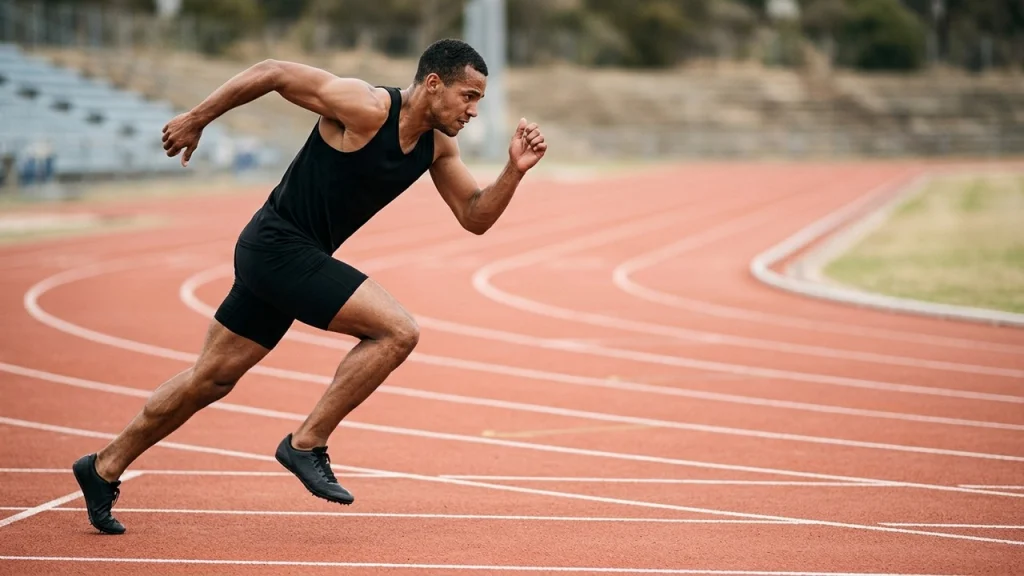
Human muscle power and work capacity put a ceiling on how fast a person can run. One Biology Letters study found that where instantaneous muscle power production is capped, small animals are held back by the power their brief stance periods demand, while a cap on muscle work capacity per contraction leaves big animals constrained by the mechanical work each step requires.
Muscle properties put a ceiling on how much extra speed one contraction can add. Speed climbs with body mass, reaches a peak at a certain mass and then falls away, while a Nature Communications paper argues that dependable maximum speed estimates exist only for race horses, race dogs and elite human sprinters.
None of the zoo, wildlife agency or research sources behind this article records a measured top speed for a human beyond the elite 100 m record,
Where the ceiling comes from

Body size alone does not settle how fast an animal can go. In one modelling study, a cheetah of 35 kg reaching 29 m/s serves as the reference observation for the fastest animal at the least constrained size, and that work credits its middle-of-the-road mass about as much as its special anatomy for the high top speed.
For the human side of the ledger, the fastest 100 m ever run by a person came in 9.58 s, set by Usain Bolt. A cheetah caught on radar at up to 98 km/h covered the same distance in 5.95 s.
What human muscle is made of
Untrained people carry equal shares of the slow and fast fibre types. Elite sprinters run at about 73% fast fibres, while distance runners sit at about 70% slow fibres.
Researchers in PLOS Biology report that elite sprinters tend to carry larger lower limb muscles than distance runners and nonathletes, which the paper links to their need to produce high ground reaction forces. The same PLOS Biology study also notes that human hind limb muscles have greater mass and PCSA yet shorter fascicle lengths.
Specialists differ depending on the event. Among elite decathletes, results in the fast events tracked in the opposite direction from results in the 1500 m.
Humans and chimpanzees compared
Fibre by fibre, chimpanzee leg muscle outguns the human equivalent by about 30% for force and power, which researchers attribute to a much larger share of the fast fibre type. Humans, in turn, carry significantly more hindlimb muscle by body mass, about 250 g per kg against 170 g per kg in chimpanzees.
Heat and the ability to keep running
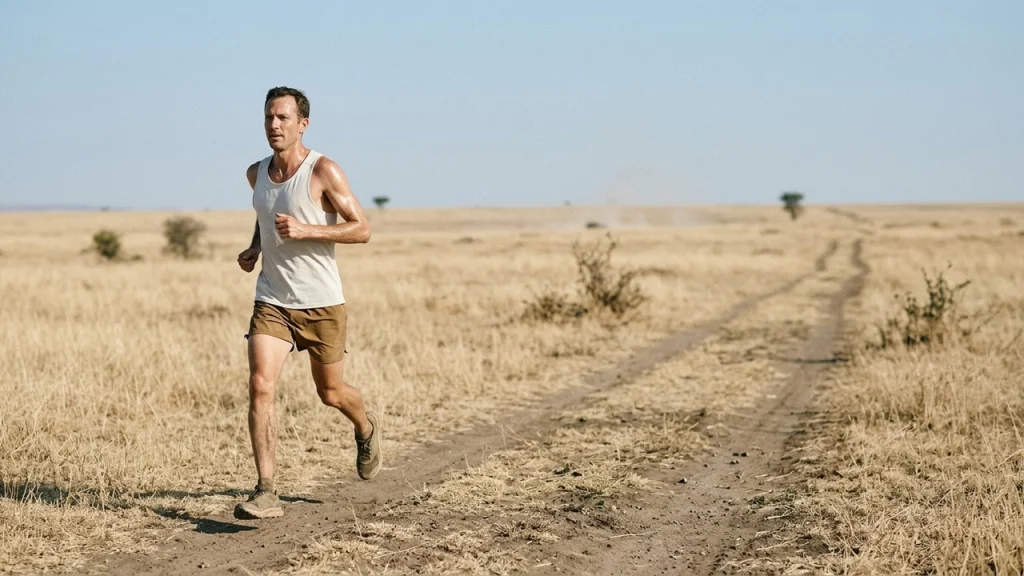
A PLOS Biology study reports that people can sustain sweat rates up to between 2 and 4 l/h, roughly 2 to 3.4 times what an eland manages, and the eland is an antelope that sweats better than most large quadrupeds. The same study reports that bipedal humans can decouple respiration and gait while running, which is described as the physiological basis of persistence hunting, where thermoregulatory capabilities gave running hunters an advantage over the animals they chased.
Galloping animals cannot manage that decoupling, because a galloping quadruped cannot pant, and panting is their main route to shedding heat.
Running on two legs or four
Work in Frontiers in Bioengineering and Biotechnology found human runners using a transverse gallop while cheetahs use a rotary gallop, and observed only small angular excursion in the human case rather than the cheetah. That study suggests humans might cover ground faster on four legs if they moved up to the rotary gallop, lengthened their strides and added wide sagittal trunk motion.
Record data suggest neither pattern has levelled off, and modelled bipedal and quadrupedal 100 m times cross in 2048, when the projected winning quadrupedal time of 9.276 s would edge below the projected bipedal time of 9.383 s.
Sources
- Frontiers in Bioengineering and Biotechnology (PubMed Central): How Fast Can a Human Run? Bipedal vs. Quadrupedal Running
- Biology Letters (PubMed Central): Why are the fastest runners of intermediate size? Contrasting scaling of mechanical demands and muscle supply of work and power
- Nature Communications (PubMed Central): Dynamic similarity and the peculiar allometry of maximum running speed
- PLoS Biology (PubMed Central): The evolution of human fatigue resistance
- San Diego Zoo Wildlife Alliance: Cheetah | San Diego Zoo Animals & Plants
- Animal Diversity Web, University of Michigan: Antilocapra americana (pronghorn)