
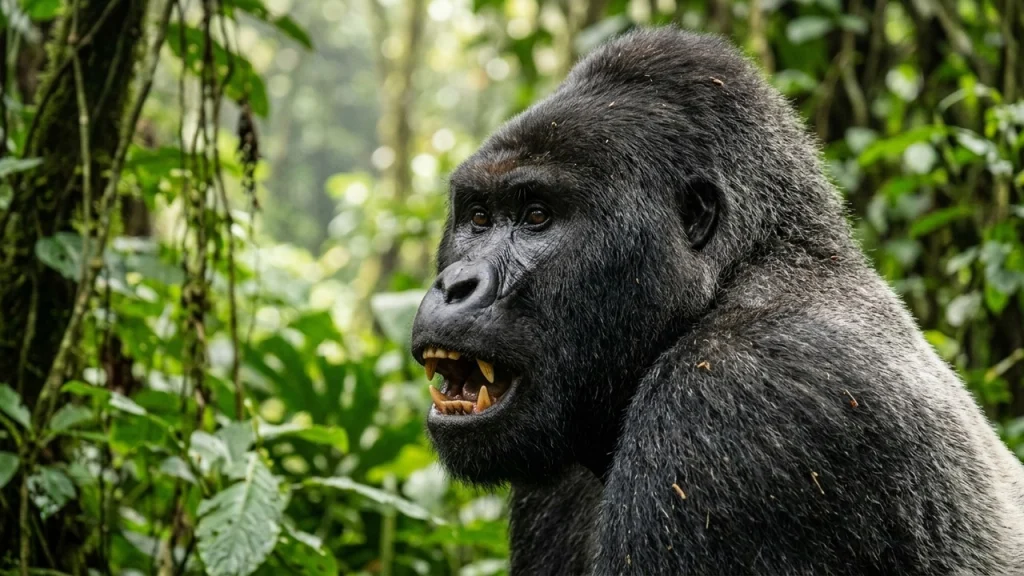
Gorillas have large canine teeth set in large jaws, and the skull carries the muscles that work both. The Smithsonian’s National Zoo says bony crests along the top and back of the skull anchor the massive muscles used to support and operate those jaws and teeth. Animal Diversity Web says that large males, combining big body size, canines and jaw musculature, hold increased physical and social power inside the group.
Those teeth also show up in behavior. Animal Diversity Web describes mountain gorillas as robust animals with long muscular arms, short legs and massive heads, and reports that males carry large, sharp canine teeth. The San Diego Zoo Wildlife Alliance says a silverback drums on his chest with cupped hands to raise a loud noise, shouts, bares his teeth and then charges forward to scare unwanted gorillas away.
The shape of a great ape canine
The Center for Academic Research and Training in Anthropogeny says great ape canines are sexually dimorphic, extreme in Pongo and Gorilla. It says canines scale in a positively allometric manner with body size.
In both sexes a canine sits well below the occlusal plane of the remaining teeth, and the gap left in the opposing arch is called a diastema. The crowns are described as basically conical, the mesial borders convex and the distal borders concave, while the roots and the visible crowns both run taller than the incisors beside them.
Wear on the mesial border of an upper canine and on the distal border of a lower canine happens in a distinctive way. That process leaves behind a sharp, elongated, blade-like facet.
The skull behind the teeth
The Smithsonian’s National Zoo says an adult male gorilla’s head looks conical because of the big bony crests on top and back of the skull, and adult females carry these crests too, in a much less pronounced form.
Animal Diversity Web describes large jaw muscles and broad, strong teeth in western gorillas. Mountain gorillas differ from the rest, with longer hair, bigger jaws and teeth, smaller noses and shorter arms.
Size, dimorphism and the group
Animal Diversity Web calls the marked sexual dimorphism of western gorillas critical to group structure and to mating. In the wild, male gorillas average 180 kg, and females are often almost half that weight. Males carry stocky bodies and stand usually 1.75 meters in height with bent knees.
In mountain gorillas, females weigh 70 to 114 kg while males average 160 kg. Animal Diversity Web calls that species very large and says it lives where predators are not many. The Smithsonian’s National Zoo places gorillas at the top of the great apes for size, with the western lowland gorilla the smallest of the subspecies.
Chest beating and facing rivals
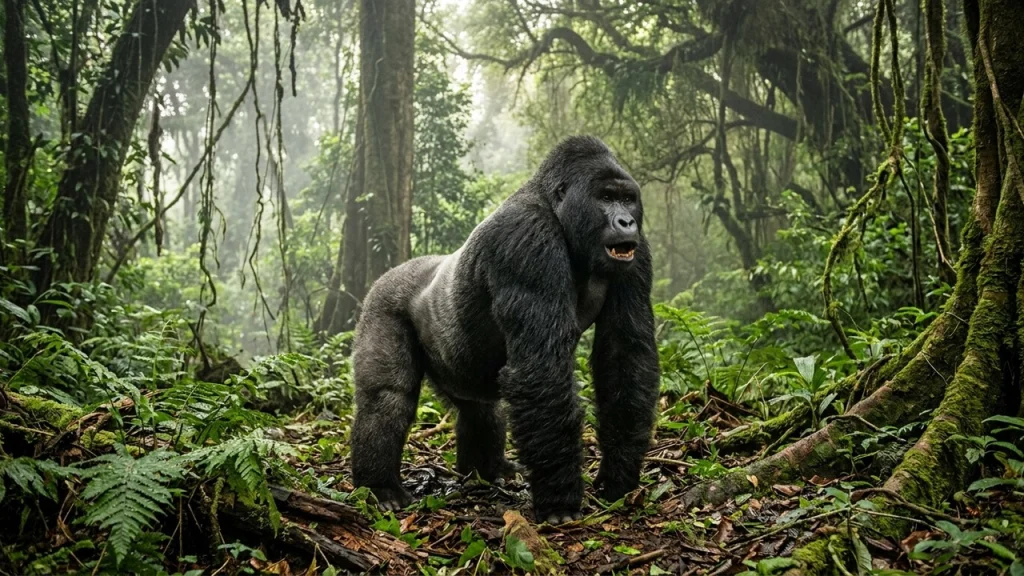
Animal Diversity Web says a male rises onto his legs and hammers his own chest with his hands as a way of looking threatening or showing how strong he is.
Behind that display sit social arrangements. The Smithsonian’s National Zoo says a silverback mates exclusively with the adult females in his group, and a black back may try to take over an established territory and family group.
A troop holds 5 to 30 gorillas, and the San Diego Zoo Wildlife Alliance puts the safety and well-being of its members in the hands of the strong, experienced male at the front. That zoo describes gorillas as naturally peaceful, and still a young male from another troop can come forward to challenge the silverback.
Teeth that mostly handle plants
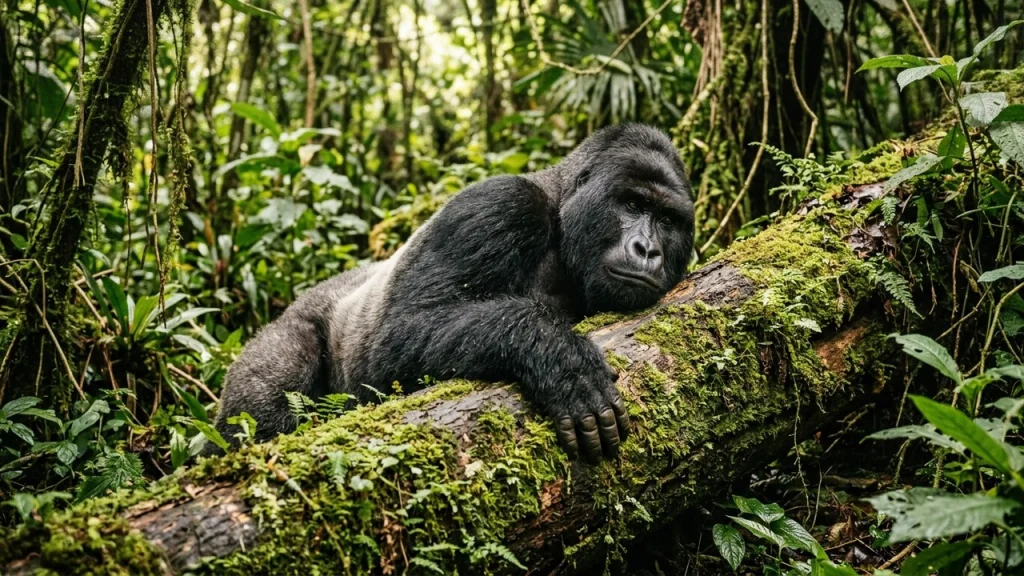
The San Diego Zoo Wildlife Alliance says nearly everything a gorilla eats is plant material. The menu runs to leaves, stems, fruits, seeds and roots, plus ants and termites, and at the San Diego Zoo Safari Park the animals use their teeth to peel radishes before eating them.
Animal Diversity Web lists roots, leaves, stems and pith from herbs, vines, shrubs and bamboo in the mountain gorilla diet. Small amounts of bark, wood, flowers, fruit, fungi, galls, invertebrates and even gorilla dung supplement it.
An adult male gorilla eats about 45 pounds (32 kilograms) of food per day. Females eat about two-thirds of the adult male amount.