
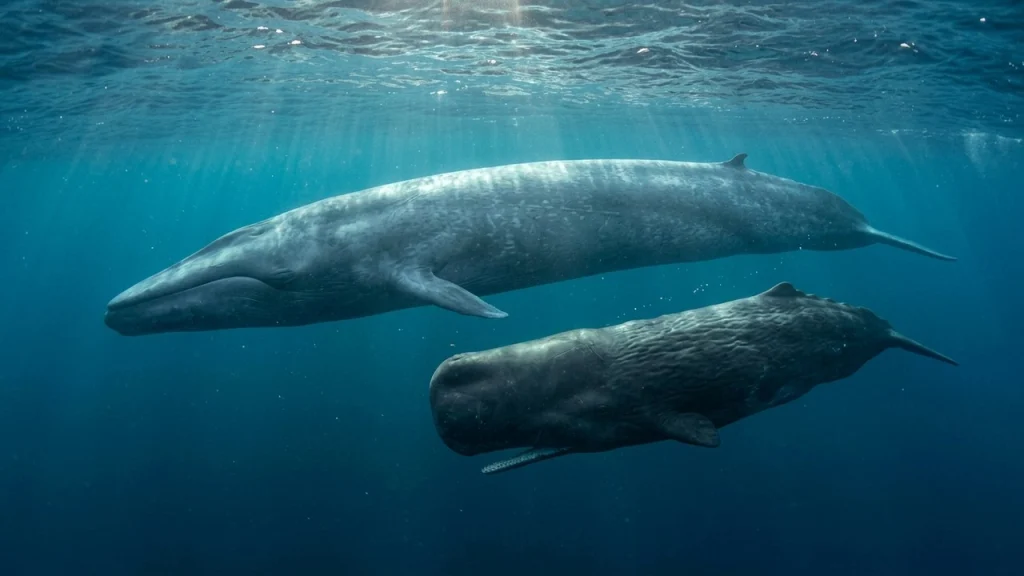
The blue whale is the largest animal on Earth, and NOAA Fisheries calls the sperm whale the largest of the toothed whales. None of the NOAA Fisheries, Animal Diversity Web or whale research studies behind this article records a fight, a strength test or a bite force comparison between a sperm whale and a blue whale.
What can be set side by side is size, weight and swimming speed. Animal Diversity Web puts the longest confirmed blue whale it lists at 33.5 m and its heaviest at 190,000 kg, and typical head-body length there is 25 m for adult males and 27 m for females. For the sperm whale, NOAA Fisheries gives 15 tons for females up to 45 tons for males, and Animal Diversity Web lists a range mass running from 35,000 to 50,000 kg.
How large each whale gets
On its species page NOAA Fisheries gives the blue whale up to 330,000 pounds and up to 110 feet. The same page puts sperm whale length at 40 feet for females to 52 feet for males.
In meters, Animal Diversity Web puts sperm whale length at up to 19 m for males and only 12 m for females. One agency works in feet, pounds and tons, the other in meters and kilograms.
Swimming speeds
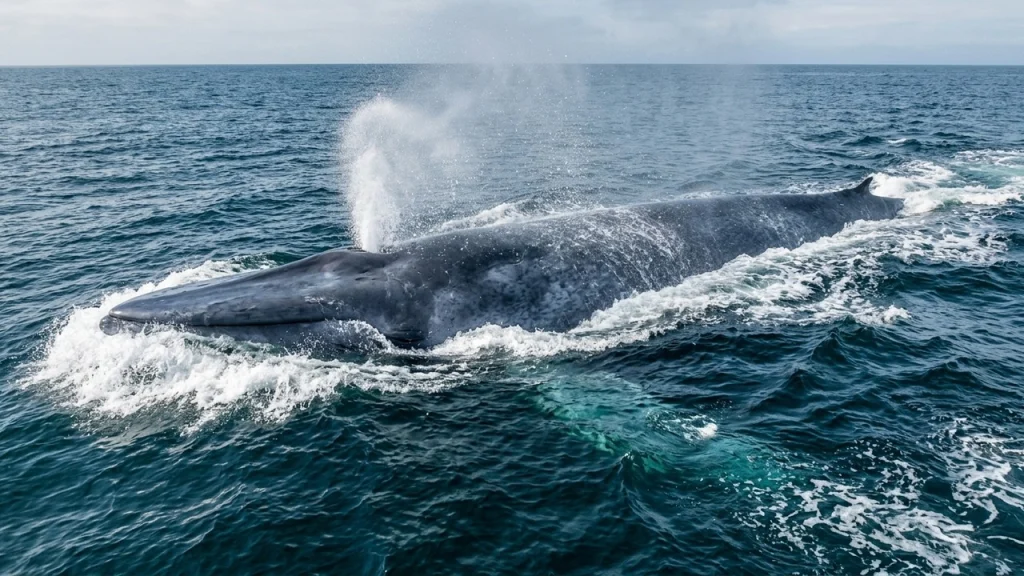
Speed is the one measure that both accounts describe in the same way. Animal Diversity Web has blue whales swimming normally at around 22 km/hr and reaching 48 km/hr when alarmed, while sperm whales in the same account stay at or below 10 km per hour and can hit 30 km per hour when disturbed. Both top figures carry a condition with them, an alarmed blue whale and a disturbed sperm whale. A study of the energetic and physical limits of breaching in large whales puts ‘racing’ blue whales at about 7.5 m/s with faster bursts, and treats that as its best estimate of the top speed the species can reach.
The sperm whale’s massive head
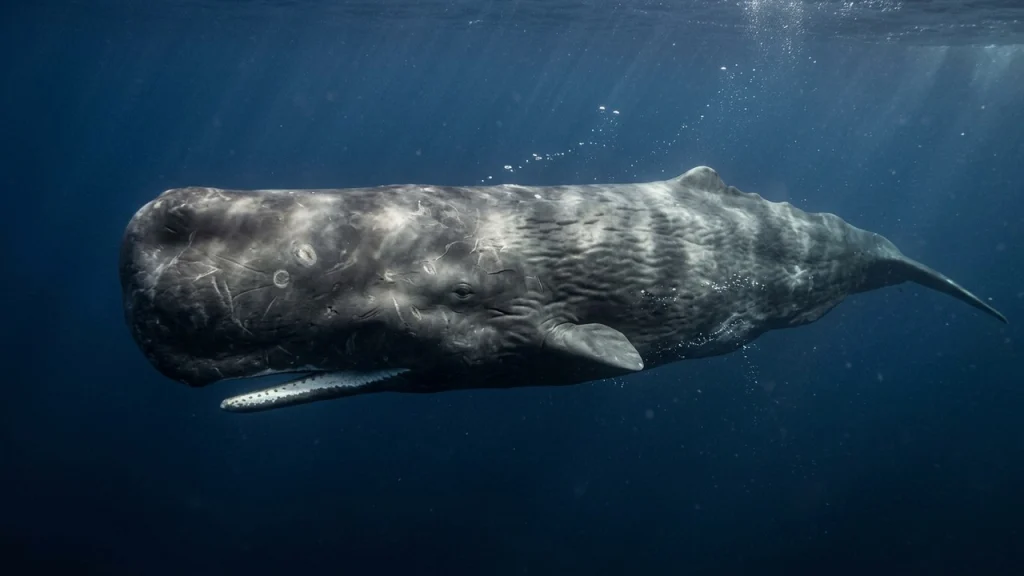
The sperm whale’s head makes up an enormous proportion of the animal, roughly one-third of its total body length. In a finite element modeling study of the forehead, the spermaceti organ and the junk appear as two oil-filled compartments making up to one-quarter of body mass.
The same study reports that where the connective tissue partitions are missing, stresses in the skull go up, most sharply in the rostral part of the upper jaw, and the authors take that as a hint that the junk architecture has a role in ramming events. It also cites a hypothesis that the spermaceti organ of males may act as a weapon and is better developed in males due to sexual selection.
Teeth and behavior
NOAA Fisheries counts 20 to 26 large teeth on either side of the lower jaw. The lower teeth sit in sockets in the upper jaw, and along that upper jaw teeth rarely push through the gum tissue.
Bull sperm whales, Animal Diversity Web notes, were fierce enough to threaten people in small boats on whaling voyages in the 19th century. NOAA Fisheries also places the species range among the widest of any marine mammal species.
Our estimate
This section is our own inference from the figures cited above. No source records this outcome directly.
On the one measure both accounts record in the same way, the top speed reached when alarmed or disturbed, a blue whale would probably be the faster of the two. Animal Diversity Web gives 48 km/hr for an alarmed blue whale against 30 km per hour for a disturbed sperm whale, about 1.6 times as fast. That is our estimate drawn from two recorded figures, not a measured outcome.
Sources
- NOAA Fisheries: Sperm Whale | NOAA Fisheries
- NOAA Fisheries: Blue Whale | NOAA Fisheries
- Animal Diversity Web: Physeter catodon (sperm whale)
- Animal Diversity Web: Balaenoptera musculus (blue whale)
- PubMed Central: Energetic and physical limitations on the breaching performance of large whales
- PubMed Central: Architecture of the sperm whale forehead facilitates ramming combat