
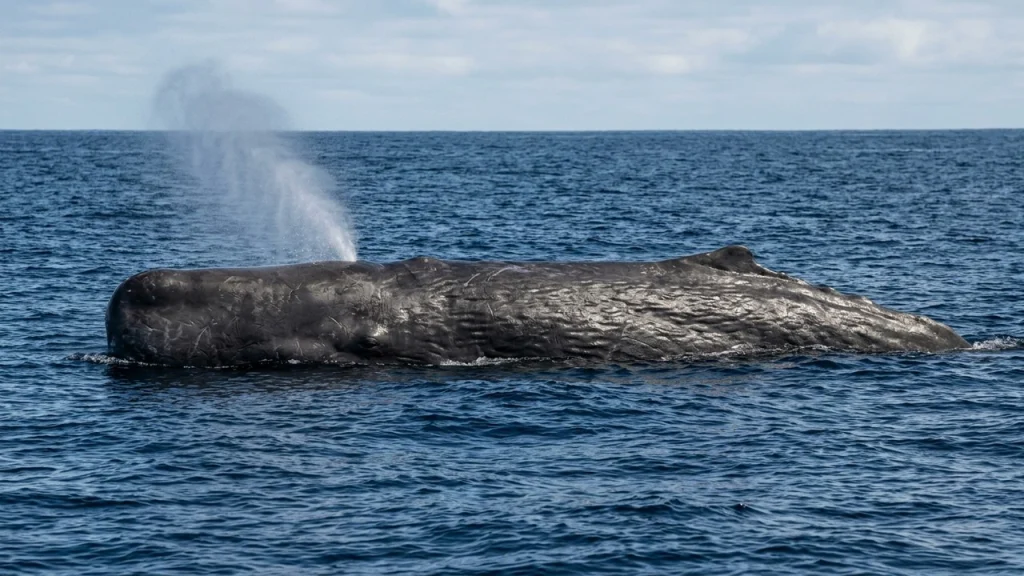
Orcas do not simply steer clear of sperm whales. In October 1997, authors writing in Marine Mammal Science watched a herd of approximately 35 killer whales set upon a pod of nine sperm whales, 130 km off central California’s coast. The authors say their observations clearly establish that sperm whales are vulnerable to killer whales.
Sperm whales had previously been thought immune to predation, according to the same authors, because of various behavioral and morphological adaptations. None of the wildlife agency, park service, zoology database or research sources behind this article says that orcas avoid sperm whales or explains why they would.
What happened in the October 1997 attack
Over the four hours the authors watched, adult female killer whales, some of them with calves, launched attacks in waves of four to five animals. The sperm whales’ main defensive behavior was forming a rosette, with their heads together and tails out. The authors also name tail-slapping as a potential defense behavior.
The authors never observed the sperm whales deliberately striking at the killer whales, and they saw no attempt to escape by diving, even on the many occasions when the killer whales withdrew from the attack. They add that a rosette may be the best choice when 10 to 15 individuals or fewer are present.
How orcas hunt
NOAA Fisheries describes the orca, also called the killer whale, as the ocean’s top predator. It says killer whales often hunt in a coordinated way, working as a team to catch prey.
Pods typically hold a few to 20 or more closely related individuals, NOAA Fisheries says, and larger groups sometimes gather for short-term social contact, for mating or around seasonal concentrations of prey. NOAA Fisheries adds that the diets of transient killer whales are more varied and can include squid and marine mammals such as seals, sea lions, porpoises and dolphins, along with other whale species.
Size and range of the two whales
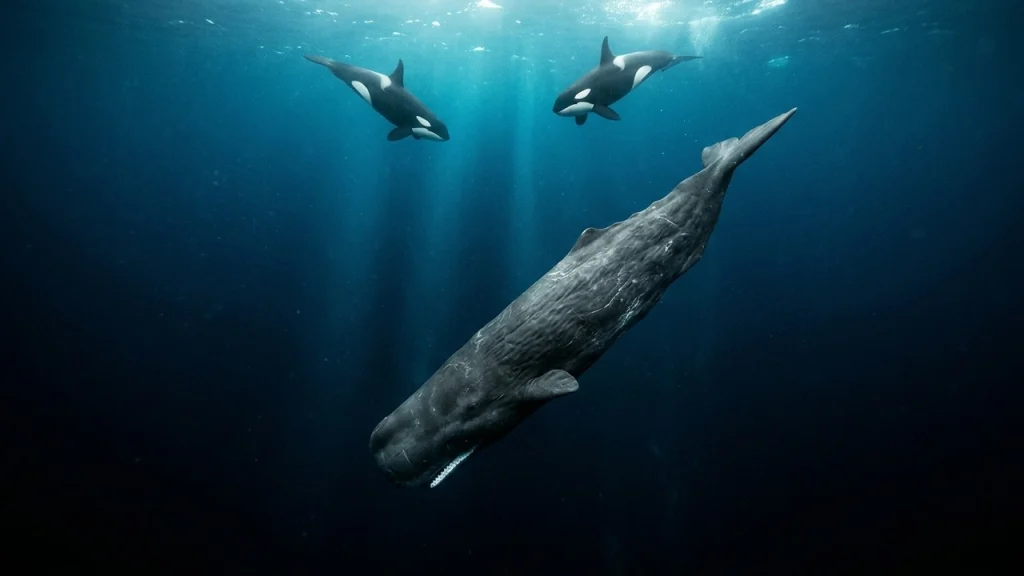
NOAA Fisheries calls the sperm whale the largest of the toothed whales, with one of the widest global distributions among marine mammals. Sperm whales live in all of the world’s oceans, and killer whales, it says, are found in all oceans too.
Animal Diversity Web says males of the sperm whale may reach 19 m, whereas females are only 12 meters. The National Park Service describes orcas as the largest member of the dolphin family, reaching 23 to 26 feet in length and four to eight tons in weight.
Sources
- NOAA Fisheries: Sperm Whale | NOAA Fisheries
- NOAA Fisheries: Killer Whale: Science | NOAA Fisheries
- U.S. National Park Service: Orca (Killer Whale) – Kenai Fjords National Park (U.S. National Park Service)
- Animal Diversity Web: Physeter catodon (sperm whale) | INFORMATION | Animal Diversity Web
- Marine Mammal Science: Killer Whale Predation on Sperm Whales: Observations and Implications
- Marine Mammal Science: Killer Whale Predation on Sperm Whales: Observations and Implications (full text)