
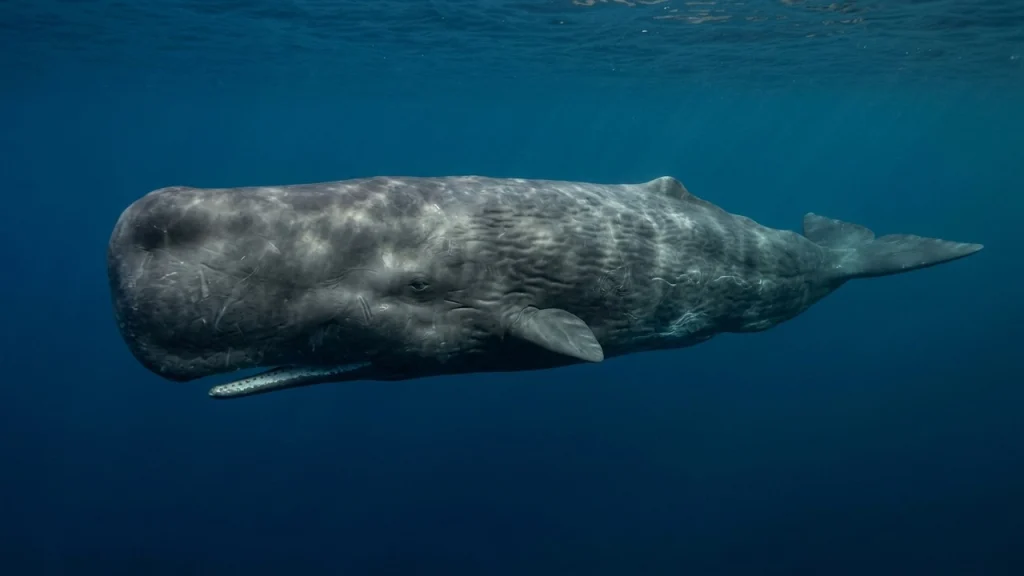
The sperm whale ranks as the undisputed giant among toothed predators, dominating the pelagic oceans with unmatched anatomical proportions. Adult cows typically measure roughly 40 feet in length and weigh 15 tons, whereas mature bulls commonly reach 52 feet long, tip the scales at 45 tons, and can attain a lifespan up to 60 years. Under exceptional growth conditions, the largest documented males may reach 19 m in length, whereas adult females attain only 12 meters. These physical metrics firmly place the creature as the largest extant toothed whale in the world.
Marine biologists classify this species as the most sexually dimorphic among all cetaceans, with fully grown males becoming three times larger than mature females. This biological asymmetry produces an astonishing weight disparity, leaving adult females to weigh only about one-third the bulk of mature bulls.
Massive cranial anatomy and the spermaceti organ
A massive, blunt snout dominates the whale’s physical outline, with the head accounting for about one-third of overall body length. This disproportionately large front end gives the species its iconic silhouette. In fully grown bulls, this exaggerated forehead projects forward by a meter and a half past the jaws’ leading edge.
Internally, two enormous lipid-rich chambers occupy the snout, designated as the dorsal spermaceti organ and the underlying junk structure. Together, these dense fluid compartments span one-third of overall body length, making up more than one-quarter of total animal mass.
Nestled directly behind these fluid reservoirs rests the animal’s central nervous system. Directly behind the nasal apparatus sits the largest brain found in any mammal, possessing an average mass of approximately 9 kg.
Unique facial asymmetry and feeding adaptations
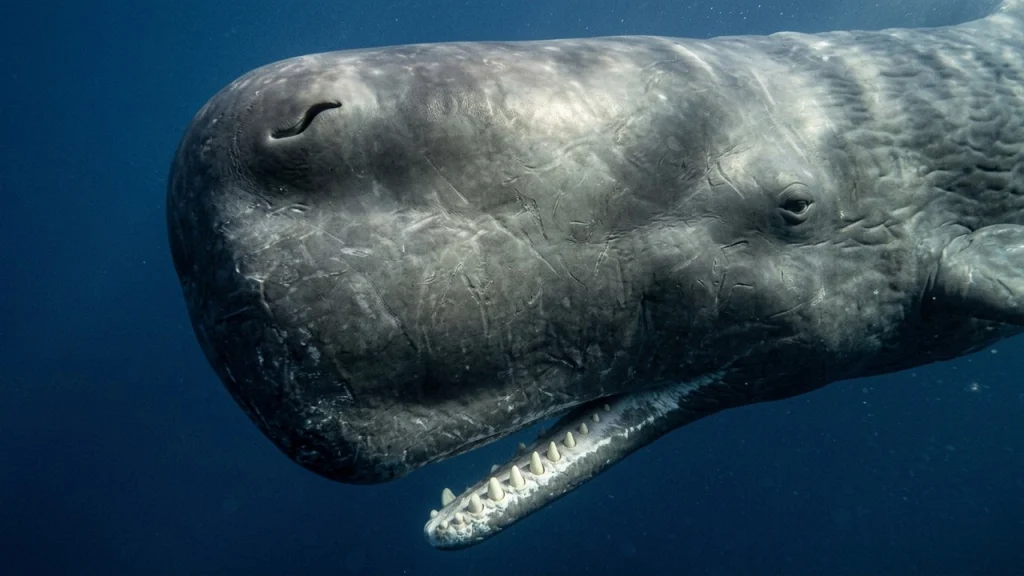
The respiratory design of the species diverges sharply from all other marine mammals. The sperm whale represents the only living cetacean possessing a solitary blowhole positioned asymmetrically upon the crown’s left side. Externally, this solitary breathing passage opens as an S-shaped slit positioned on the forward left portion of the head. The dark integument located directly behind the massive forehead often displays a distinctly wrinkled surface, giving the animal a weathered, corrugated appearance.
Beneath the towering forehead lies an extraordinary feeding apparatus specialized for hunting deep-sea prey:
- A narrow, elongated lower jaw accommodates between 20 and 26 heavy teeth along each row.
- Along the upper palate, maxillary teeth rarely break through the surface of the gums.
- Whenever the animal snaps its jaws shut, each conical lower tooth fits snugly into corresponding receiving sockets within the upper jaw.
Designed to ingest giant deep-sea prey whole, the gullet of this predator is the largest among all cetaceans, forming the only throat in the mammalian kingdom broad enough to swallow a human.
Hydrodynamic propulsion and deep diving endurance
The postcranial morphology reflects powerful adaptations for efficient propulsion and extreme thermoregulation in freezing deep waters. The pectoral flippers appear paddle-shaped and relatively small compared to overall body size, whereas the propulsion flukes form a broad, triangular silhouette. Rather than carrying a conventional curved dorsal fin, the whale features a low spinal hump followed by low ridges along the back, while each pectoral fin measures approximately 200 cm long.
Tremendous locomotive power originates from the rear of the animal. Across their trailing span, the massive horizontal tail flukes measure between 400 and 450 cm. Propelled by caudal flukes measuring approximately 16 feet between opposite tips, the giant can cruise open waters at sustained speeds around 23 miles per hour. To withstand freezing polar waters and deep benthic depths, an insulating layer of dense blubber wraps the body in thicknesses up to 35 cm. This fatty envelope preserves internal warmth while serving as a vital energy reservoir during long migrations.
These streamlined physiological adaptations enable unprecedented underwater endurance during offshore foraging expeditions:
- During standard foraging patrols, adults regularly descend to depths of 2,000 feet on hunting dives lasting about 45 minutes.
- When tracking bathypelagic prey, these oceanic divers can descend as deep as 3,280 feet into total darkness.
- To complete these exhaustive underwater searches, individuals must hold their breath for prolonged intervals lasting up to 90 minutes.
Powering such immense physiological exertion requires daily nutrition amounting to roughly 3 to 3.5 percent of total body weight.
Growth stages and lifelong social migrations
The reproduction and growth trajectory of this ocean giant requires decades of gradual development. Following an extended gestation period lasting 14 to 16 months, a mother gives birth to a single calf measuring about 13 feet long. At birth, newborn calves measure about 4 m in length and weigh roughly one-twenty-fifth the mass of an adult female.
Male and female development diverges markedly as the animals mature through successive life phases:
- Young females reach full physical maturity around 30 years old, at which point they attain a maximum adult length up to 35 feet.
- During the first decade of development, young bulls grow only slightly larger than their female peers, but they continue expanding substantially well into their thirties.
- Males conclude their prolonged skeletal growth and attain full physical maturity around 50 years of age, measuring approximately 52 feet long.
This developmental divergence deeply influences the geographic distribution and social structure of the species. Females maintain tight social structures with matrilineal kin, gathering into stable nursery units averaging 12 females and their accompanying calves.
In contrast, males undergo extensive lifelong wanderings. Subadult males disperse from their natal families between the ages of 4 and 21 years old, congregating in bachelor pods with other young males of matching proportions. As bulls grow older and heavier, they abandon warm nurseries and begin migrating toward cold polar waters. After spending years foraging in polar latitudes, solitary mature males in their late twenties or older return periodically to warm equatorial waters to mate.