
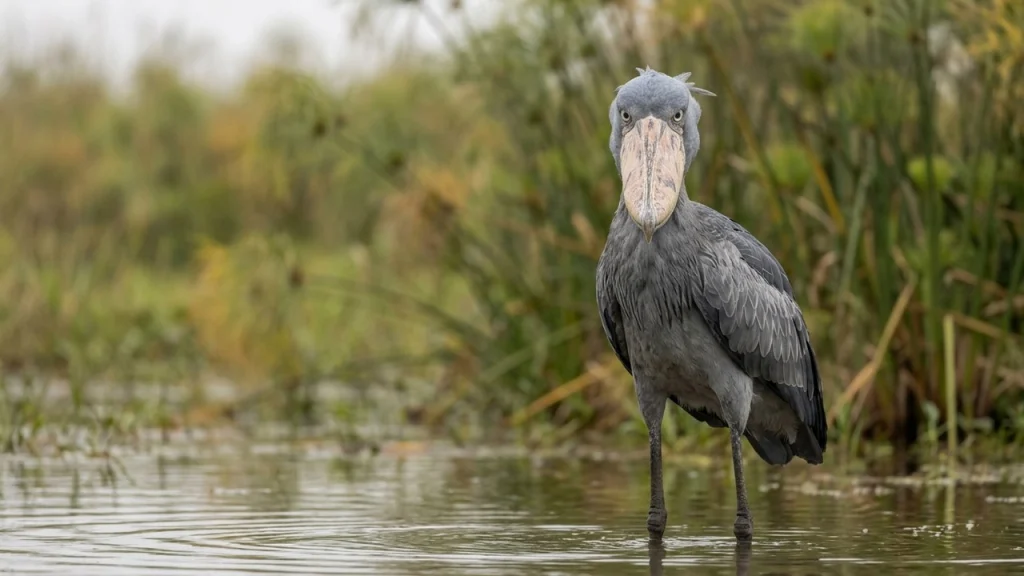
A shoebill stares because staring is its hunting method. The bird stands almost perfectly still in shallow water and fixes its gaze on the surface, waiting for a fish to come within range. When a person walks up to the fence, the shoebill often keeps doing what it always does: watching, without moving. The result feels like a death stare, but it is patience, not hostility.
Zoo visitors notice this more than anyone, because a captive shoebill has little reason to move. Its wetland skills carry over to any audience, and a human becomes one more thing to watch quietly.
The stare is a hunting technique
Shoebills are known for standing motionless like a statue, gazing at the water for hours at a time. They also blink very little, which is why the golden, green or blue eyes seem so intense.
That focus pays off. A shoebill that stays silent and still next to the water can wait for the perfect moment, then throw itself forward with its wings spread and its bill aimed at a fish. Prey that sees nothing unusual has no reason to flee.
Two ways to hunt
Researchers describe two hunting mechanisms: “stand and wait” and “wade and walk slowly”. The stare belongs to the first one. In both cases the bird depends on being unnoticed, so the stillness is part of the trap.
Why the head hangs down
Vision and hearing are the main senses a shoebill uses to hunt. To get both eyes pointed at the water, it tucks its head and bill straight down against its chest. Seen from the side, that posture looks like a bird brooding over something. Seen from the front, the big eyes and heavy bill seem to lock onto you.
What a shoebill actually sees in you
A shoebill does not treat people as a threat or as food. Animal Diversity Web notes that it will not threaten humans and simply stares back at them. The gaze is a default mode, not a warning.
Size adds to the effect. An adult can reach about five feet tall, only inches shorter than an average person, so it can nearly meet your eyes. Add a wingspan of eight feet, and the impression of a small dinosaur watching you is easy to understand.
- Eyes: large, yellowish or grayish-white in color according to Animal Diversity Web, and yellow according to National Geographic.
- Bill: it can measure nine inches long and four inches wide.
- Crest: a small feathered crest sits on the back of the head.
The wetland setting behind the behavior
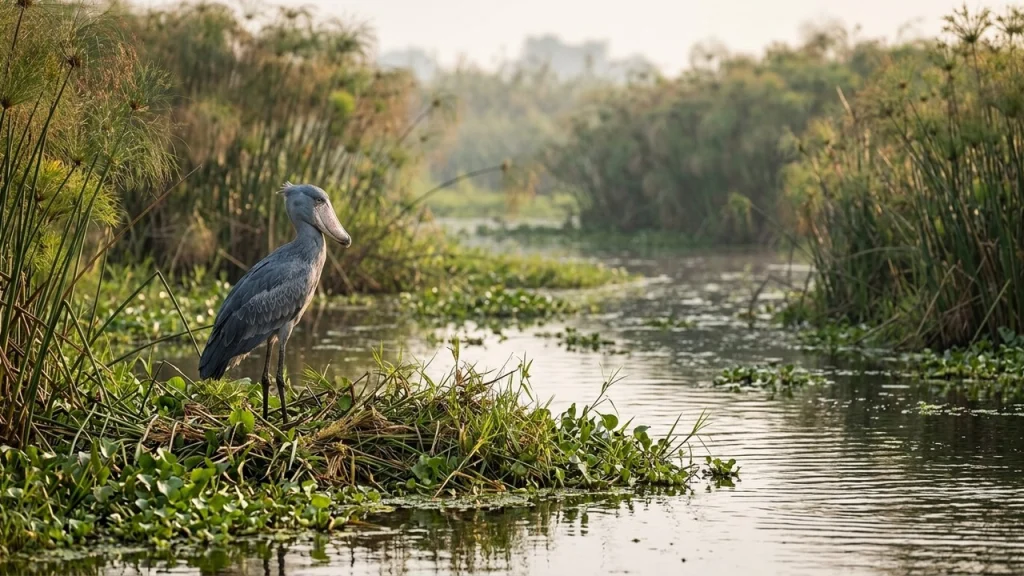
Shoebills live in freshwater swamps and dense marshes of east-central Africa. The main populations are in southern Sudan, northern Uganda, western Tanzania and northeastern Zambia. Most of their time goes to foraging in the water.
The best hunting spot has shallow water and tall plants that hide the bird while it stalks. Where the water is deep, a floating mat of vegetation gives it a place to stand. Poorly oxygenated water helps too: fish in it come to the surface for air more often, which raises the odds of a catch.
Waiting for lungfish
The favorite prey is the lungfish, a fish of marshes and mud that can reach six feet in length. Because a lungfish must rise to breathe, a bird that watches the surface for hours will eventually see it. National Geographic points out that the fish may not notice the looming bird until it is too late.
Shoebills also take catfish, eels and water snakes, and sometimes small crocodiles.
A strike built for violence
The end of a long stare is a move called the collapse. The head and neck shoot forward and the bird topples downward into the water, bill first. It takes only seconds and is carried out with power and accuracy.
The impact would injure many birds. The shoebill’s beak and thick skull work as shock absorbers, protecting it from harm. After one collapse, the bird has to regain its balance and start again from a standing position, so it cannot strike twice in a row. That is one more reason to choose the moment carefully and wait.
Quiet birds with a few sounds
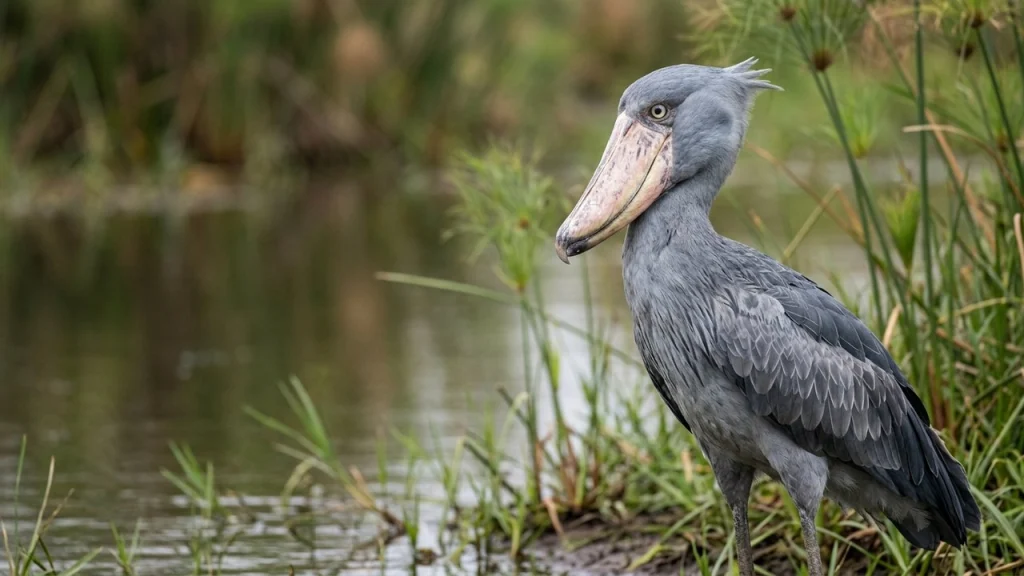
Silence is part of the strategy. Shoebills are usually quiet, though they clatter their bills, a habit shared with true storks, most often when greeting each other at the nest.
Adults also make a whining or “mooing” noise. A visitor waiting for a shoebill to react will usually get nothing but the stare.
Why the shoebill’s future matters
Shoebills are hard to count, since their populations are scattered and mostly out of human reach for much of the year. Animal Diversity Web gives the most accurate estimate as 11,000-15,000 birds across the whole range. National Geographic lists the species as Vulnerable, with a population trend that is decreasing.
The stare also has a scientific side. The bird looks like a stork, yet newer research, DNA included, places the shoebill closer to the pelicans than to the storks.
Reading the stare correctly
Next time a shoebill looks at you without moving, remember what you are watching: an ambush predator in standby mode. It is conserving energy, staying hidden and ready to act. Being stared at by one is a small glimpse of a hunting strategy that has worked in African wetlands for a long time.