
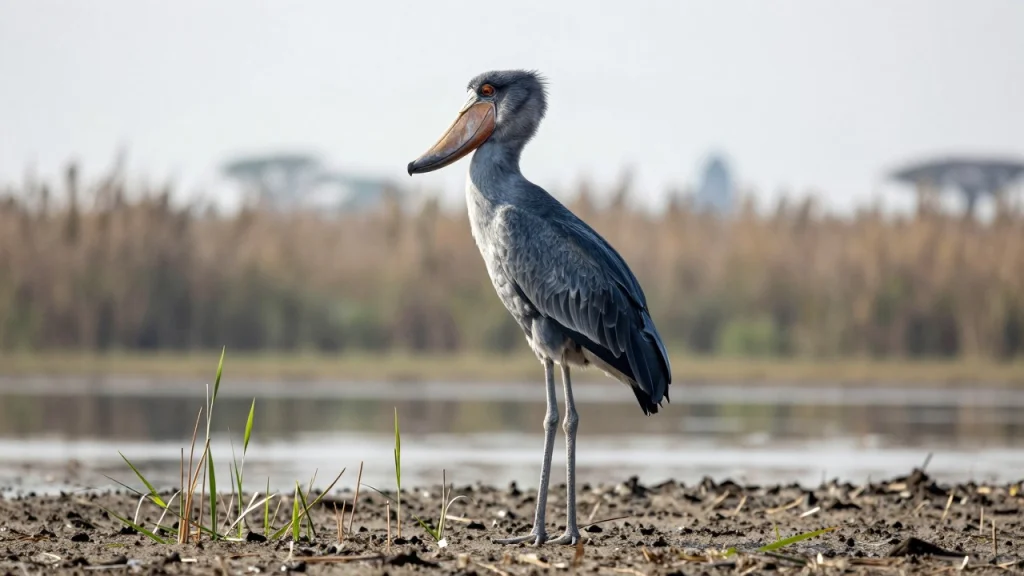
The shoebill commands immediate attention across African wetlands with its towering stature and prehistoric appearance. When perching on dry ground, an adult shoebill reaches up to five feet tall. Field surveys record that mature birds measure 110 to 140 cm tall when standing upright. Size dimorphism characterizes the species, as males grow larger than females with noticeably longer bills. These vertical dimensions position the bird among the tallest wading species inhabiting freshwater marshes.
Their airborne mobility relies on an enormous wingspan reaching almost eight feet across. Despite their imposing stature, individuals remain surprisingly light, only weighing up to 16 pounds. Such modest body mass prevents the bird from sinking into soft mud while enabling sustained flight across vast swamp systems. The bird carries an enormous facial structure measuring nine inches in length and four inches wide. Mottled in tan with brown splotches, the beak spans five inches wide across its broadest curve, creating an imposing silhouette that defines the species.
Specialized anatomy of the shoe-shaped bill
The head of the shoebill accommodates one of the most remarkable predatory apparatuses in the avian realm. This dominant feeding tool distinctly resembles a wooden shoe, giving the species its common name. Thick keratin layers strengthen the structure, granting the bird enough mechanical leverage to capture slippery aquatic prey within murky wetlands.
The upper jaw forms a heavy structure that terminates in a sharp, curved hook designed to impale slippery fish. Both the upper and lower mandibles have sharp edges that assist during feeding. These razor-like edges function like shears, allowing the predator to carve through tough fish scales and muscular flesh with minimal effort.
Subduing substantial prey requires decisive anatomical action before ingestion occurs. To handle cumbersome quarry prior to swallowing, the prey is usually decapitated with forceful shearing motions. Removing the head of an armored fish makes the carcass significantly easier to swallow whole through the bird’s expanding throat.
Hunting tactics and wetland diet
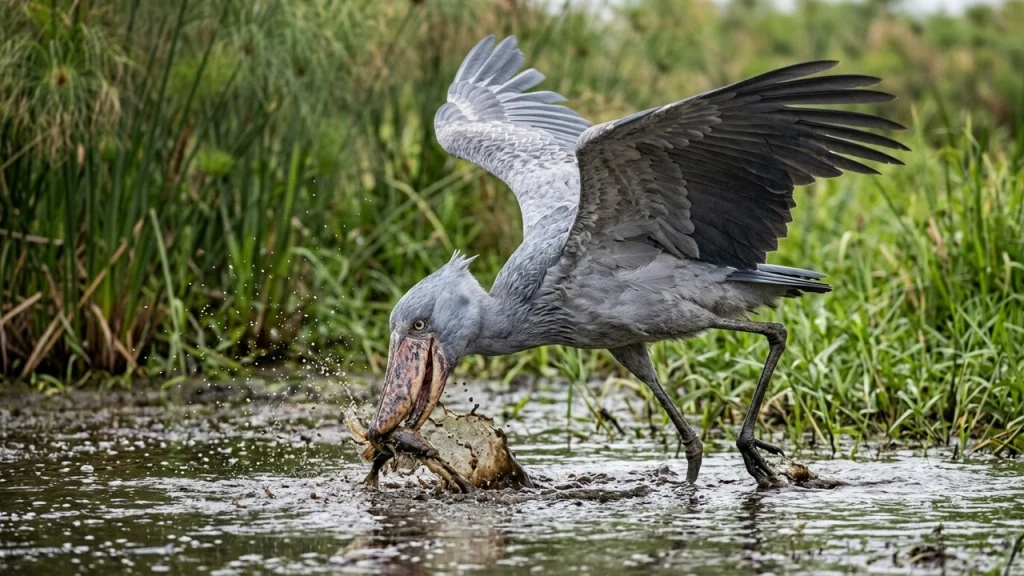
Shoebills function as patient ambush predators, waiting motionless along water channels for extended periods. Foraging individuals practice a hunting technique called collapsing, where they suddenly pitch forward over submerged targets. This violent downward plunge uses the bird’s momentum to pin victims against muddy substrate before they can dart into deep water.
A successful strike often scoops up aquatic plants along with the targeted animal. To discard muddy swamp grass while keeping hold of the catch, the bird shakes and sways its head from side to side. Once the vegetation falls away, the bird repositions its meal for swift consumption.
A highly specialized bill allows the bird to grasp substantial wetland animals, including lungfish, tilapia, eels, and snakes. The opportunistic carnivore also regularly snacks on baby crocodiles alongside juvenile Nile monitor lizards. These diverse prey choices reflect the hunter’s capacity to overpower armored aquatic vertebrates that few other waterbirds attempt to catch.
Hunting success depends heavily on specific ecological conditions across tropical marshes:
-
Hunting grounds are commonly situated in marshes where there is poorly oxygenated water.
-
Stagnant conditions force gill-bearing prey to ascend and surface for air more frequently, boosting strike success.
-
The predator exploits these predictable ascents by remaining completely static until targets reach the surface.
Adaptations for marsh locomotion and temperature control
Navigating dense papyrus swamps requires specialized anatomical adaptations beneath the water surface. Adapted for navigating freshwater marshes and swamps, the birds inhabit East Africa, ranging across wetlands from Ethiopia and South Sudan to Zambia. Providing elevated vantage points in tall grasses, the bird’s legs are long and blackish.
Supporting such a large bird on soggy ground demands an expansive contact area. Its toes are remarkably long and completely divided, possessing no webbing between them to impede walking across marsh vegetation. By spreading these elongated digits across floating vegetation mats, the bird distributes its weight without breaking through flimsy reed beds.
The plumage reflects subtle color variations that provide camouflage among wetland reeds. Adult feathering displays a slaty blue-grey overall appearance paired alongside a darker grey head. A small tuft located on the back of the head can erect into a crest when the bird reacts to rivals.
Locomotion and thermoregulation involve distinctive physiological patterns:
-
During flight, the bird flaps its large wings about 150 times per minute, displaying measured aerial locomotion.
-
To shed excess warmth under the equatorial sun, individuals practice gular fluttering by rapidly vibrating the throat muscles.
-
These coordinated actions allow the shoebill to conserve energy and maintain stability across equatorial heat gradients.
Breeding habits and expansive nesting mounds

Shoebills maintain solitary habits throughout most of their annual cycle. Nesting pairs avoid close neighbors because shoebill storks are solitary breeders defending feeding territories of approximately 3 square kilometers. Such vast territorial buffers prevent excessive competition for food resources within localized swamp sections.
Young birds attain maturity when three to four years old, with pairs demonstrating monogamous fidelity. When preparing a nursery site, both partners invest substantial labor into nest construction:
-
To establish an open platform, marsh vegetation across a 3 meter diameter zone is trampled and flattened by the pair.
-
The birds weave swamp grasses to shape a sturdy mound of about 1 meter in diameter as their central brooding platform.
-
Nesting pairs establish pads on water or floating mats, creating platforms that span up to eight feet wide across their perimeter.
After attentive incubation by both parents, egg hatching occurs in about a month. Both adults continue guarding the nestling, bringing food and water directly to the brooding platform until the chick achieves independence. This prolonged parental commitment ensures offspring develop adequate physical strength before facing swamp hazards alone.
Evolutionary heritage and urgent conservation needs
Taxonomists long debated the precise classification of this unique bird due to its mixed morphological traits. Although historically grouped with storks, modern genomic evidence demonstrates closer affinity to pelicans than to true storks. Unique evolutionary adaptations place the shoebill as the sole extant member belonging to the family Balaenicipitidae.
Because of this isolated evolutionary position, the bird cannot be replaced if local populations disappear. Under conservation assessments by the IUCN Red List, this wetland bird is officially classified as Vulnerable. Habitat disturbance, seasonal burning, and agricultural drainage continue to threaten populations throughout east-central Africa.
Recent census data suggest that wild populations contain from 3,300 to 5,300 mature individuals across their fragmented range. To safeguard vulnerable breeding sites, community rangers maintained round-the-clock surveillance across 13 active nests in February 2026. Ongoing protection initiatives remain vital for securing a sustainable future for these iconic marshland birds.