
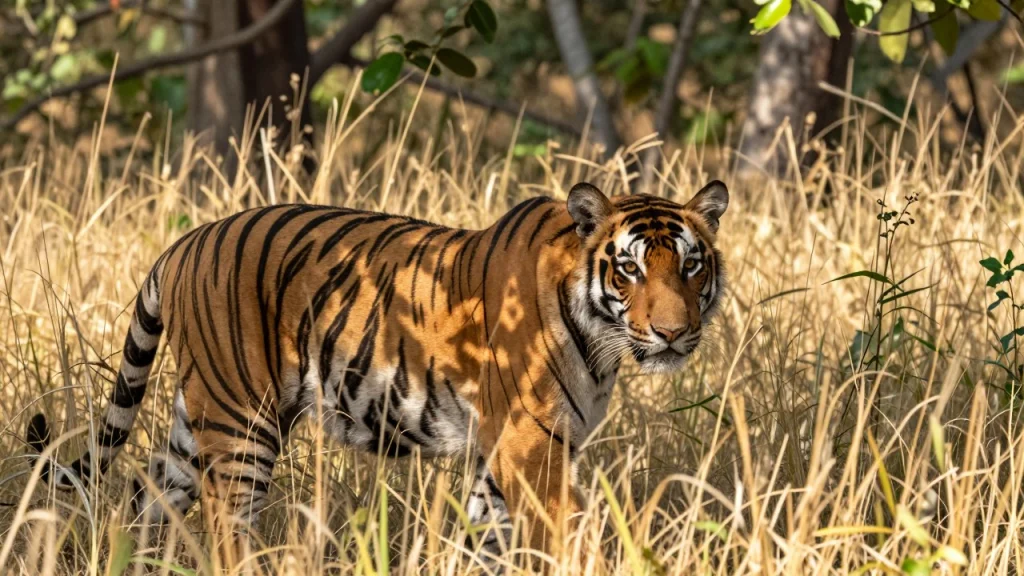
Tigers are among the most recognizable big cats in the world, largely due to the bold black or dark brown stripes that cover their reddish-orange coats. Far from being a mere aesthetic feature, a tiger’s stripes are a crucial evolutionary adaptation designed to help this formidable apex predator survive and hunt in the wild.
The primary function of a tiger’s stripes is camouflage. Tigers inhabit a variety of environments, ranging from dense tropical rainforests and mangrove swamps to dry deciduous forests and tall grasslands. In these habitats, sunlight filters through leaves, tall grass, and branches, creating a complex pattern of light and shadow. A tiger’s striped pattern breaks up the outline of its body, allowing it to blend seamlessly into this environment, a phenomenon known as disruptive coloration.
Disruptive Coloration and Stalking
Tigers are solitary, ambush predators. Unlike wolves or African wild dogs, which rely on long-distance endurance chases to tire out their prey, tigers depend on stealth to get as close as possible to a target before striking. Because they are heavy-bodied mammals, remaining unseen until the final leap is essential for a successful hunt.
The vertical stripes break up the tiger’s outline against vertical vegetation such as reed beds, tall grass, and forest trees. When a tiger crouching in shadows remains still, its shape dissolves into the background clutter of the landscape.
- Breaking the outline: Disruptive coloration prevents prey from recognizing the continuous, distinct silhouette of a large carnivore.
- Maximizing ambush success: By closing the distance unnoticed, tigers minimize the energy expended during the brief, high-speed burst of a attack.
How Prey Animals View Tiger Stripes
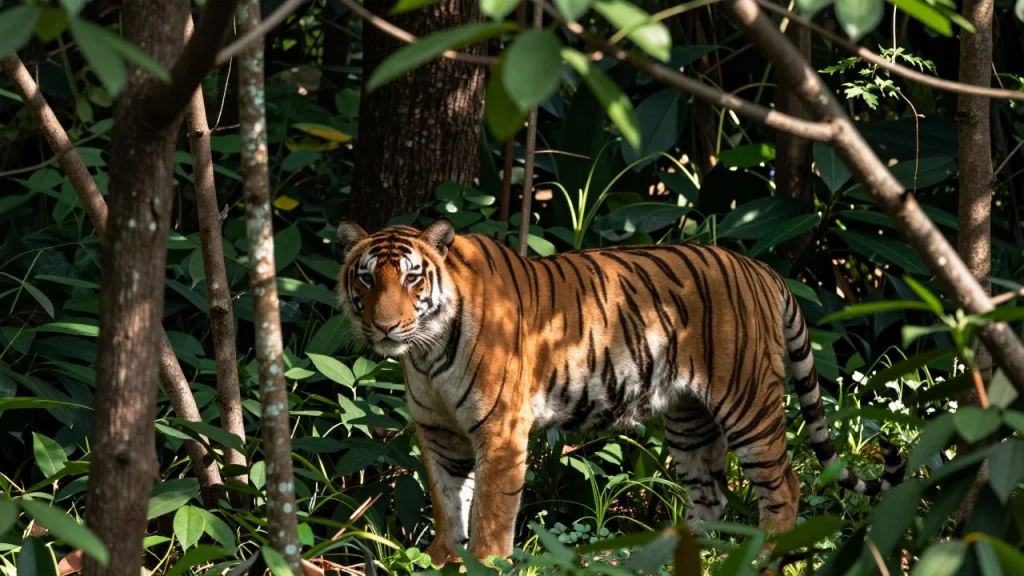
Understanding why tigers have stripes requires looking at how their primary prey perceives color. Tigers mostly hunt ungulates, or hoofed mammals, such as deer species (chital, sambar) and wild pigs.
Most ungulates possess dichromatic vision, meaning they only have two types of color-receptive cones in their eyes. Unlike humans and some other primates, which can have trichromatic vision, dichromatic animals perceive less contrast between mid- and long-wavelength colors.
To a deer or wild boar, a tiger’s bright orange coat does not stand out as a vivid signal. Instead, the orange fur appears as shades of green or brownish-tan, matching the surrounding foliage. When combined with dark vertical stripes, the tiger appears virtually invisible to its prey, blending directly into the natural environment.
Uniqueness of Individual Stripe Patterns
Just like human fingerprints, no two tigers have the exact same pattern of stripes. Every individual possesses a distinct arrangement of lines, varying in thickness, spacing, and branching.
These patterns are present not only on the tiger’s fur but also on its skin. If a tiger were shaved, the dark pigmentation of the stripes would still be visible on the surface of its hide, as the hair follicles themselves carry the dark pigment.
Researchers and wildlife biologists take advantage of these unique markings to monitor wild tiger populations. By placing camera traps throughout reserves and national parks, conservationists can identify specific individuals, track their movements, monitor population density, and assess the overall health of tiger habitats without capturing or disturbing the animals.
Camouflage Across Different Tiger Subspecies
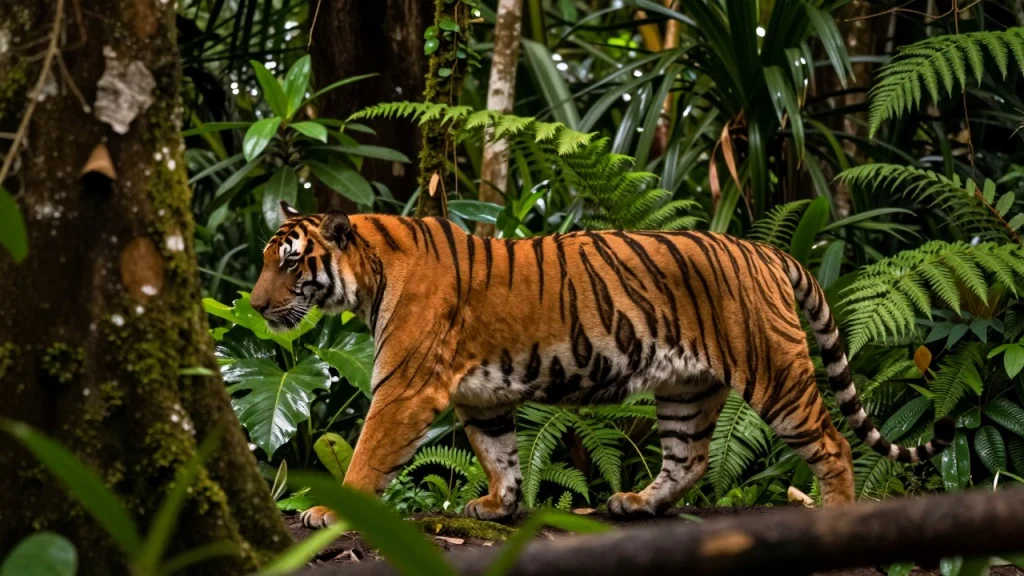
Striping patterns vary somewhat depending on the tiger subspecies and its specific habitat. These natural variations demonstrate how camouflage adapts to different environmental conditions across Asia.
- Sumatran tigers, native to dark jungle habitats on Sumatra, have darker orange coats with many dark stripes.
- Amur (Siberian) tigers: Inhabiting the cooler, snowier forests of the Russian Far East, Amur tigers often have paler coats with fewer, lighter brown stripes, helping them blend into snow-dusted, sparsely wooded landscapes.
- Bengal tigers: Living in diverse habitats across India, Nepal, and Bhutan (ranging from tall grasslands to dry forests), Bengal tigers typically display well-defined, dark stripes over a rich orange coat.
These subtle differences highlight how natural selection refines physical traits over generations to maximize hunting efficiency within specific ecosystems.
The Role of Stripes in Tiger Survival
The evolutionary advantages of stripes extend directly to the long-term survival of tigers as top predators. Because hunting requires enormous amounts of energy and carries a risk of injury, efficiency is critical.
A tiger may attempt many stalks before successfully capturing a prey animal. Effective camouflage directly increases the odds of securing a meal. Adequate nutrition is especially vital for females raising cubs, as nursing and providing meat for growing offspring demands significant energy.
As human expansion reduces wild habitats and decreases prey availability, the ability to hunt effectively within remaining forest patches remains essential for wild tiger conservation. Understanding these physical adaptations underscores why preserving large, contiguous blocks of natural habitat is vital for safeguarding the future of wild tigers.