
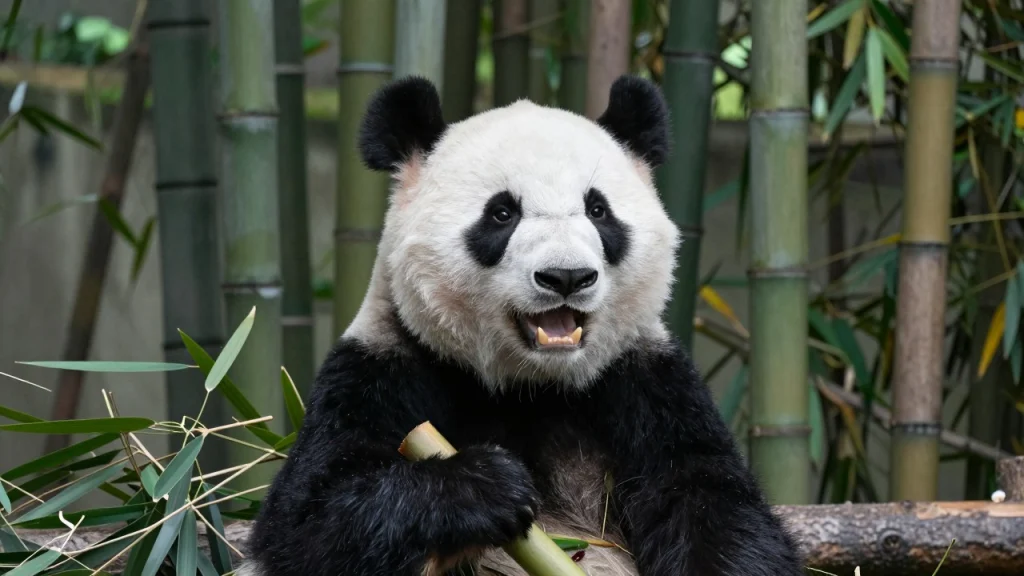
Within the broader bear family Ursidae, the standard dental formula records 3/3 incisors, 1/1 canines, 3-4/4 premolars, and 2/3 molars, indicating that bears possess 40-42 teeth overall. For the giant panda (Ailuropoda melanoleuca), anatomical examinations reveal that their dental count fits squarely within this ursid blueprint. Rather than possessing a static carnassial apparatus, their skull and tooth structure has undergone dramatic evolutionary specialization to cope with a fibrous, herbivorous diet. Direct examination of the giant panda mandible shows three incisors, one canine, three premolars, and three molars situated on each side of the lower jaw.
This lower jaw layout demonstrates that an adult giant panda maintains twenty teeth across its mandible. When paired with their upper jaw arrangement, the overall dentition reflects the classic caniform ancestral pattern. Members of the bear lineage possess massive cranial structures characterized by relatively simple incisors, elongate canines, reduced premolars, and rounded bunodont cheek teeth. Understanding whether a panda has 42 teeth requires examining how their unique premolars, incisors, and crushing molars evolved to process fibrous bamboo.
Dental formula and anatomy in the bear family
Modern ursids have largely transitioned away from strictly carnivorous predation toward plant-focused foraging. Across ursids, the incisors remain unspecialized, while their elongate canines appear slightly hooked, and the initial three premolars are diminutive and weakly developed whenever present. This reduction in anterior premolars highlights a functional shift away from capturing active prey.
Rather than retaining blade-like secodont edges for slicing flesh, their carnassials have flattened chewing surfaces specialized for crushing tough vegetation. These bunodont molars provide broad grinding platforms with low, rounded cusps that pulverize fibrous plant tissue. While standard bears display variability in the retention of their first three premolars, giant pandas enlarge specific cheek teeth rather than letting them regress into functionless pegs.
Comparing the giant panda with its closest living relatives underscores these unique dental divergence patterns. By comparison, the mandibular arches of both the polar bear and brown bear feature three incisors, one canine, two premolars, and three molars. Giant pandas diverge sharply from polar bears and brown bears because their premolars, especially P3 and P4, are substantially enlarged and elongated mesio-distally. These enlarged dental units provide the mechanical foundation for processing bamboo.
Specialized premolars and the mechanics of peeling bamboo
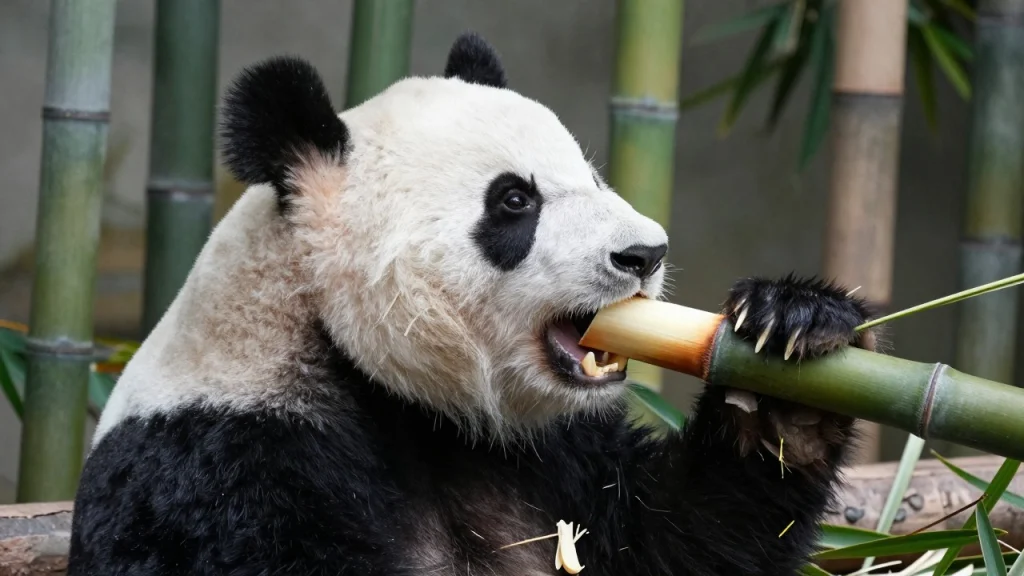
Unlike other bear species, the giant panda relies on its premolars for a delicate task: skimming and stripping the tough culm of bamboo. These premolar crowns, P3 and P4, display a more conical profile than crushing molars and exhibit noticeable horizontal wear facets on their buccal cusps. These specialized teeth function as cutting instruments that engage the woody stalk.
To achieve this peeling action, the bear relies on an intricate occlusal scheme that requires coordinated movement. Pandas place their premolars into a cusp-to-cusp position to skim bamboo culms, an action requiring sideways travel of the lower jaw. In standard resting occlusion, the upper and lower premolars do not contact each other in this manner. Before ingesting a stem, the animal strips away the woody exterior layer with its teeth to expose the softer internal tissue.
This peeling behavior is not merely a matter of feeding preference; it represents a vital protective adaptation. Because abrasive silica phytoliths severely erode molar enamel, the structural remodeling of the premolars represents perhaps the most critical evolutionary factor enabling the panda lineage to thrive on bamboo. By stripping away the silica-loaded outer layer before chewing, the panda preserves the integrity of its rear crushing teeth.
Guiding incisors, passive canines, and the temporomandibular joint
The lateral jaw movement required to position the premolars demands a specialized joint architecture and a precise dental guiding system. Incisor dimensions expand progressively from the first tooth to the third across all three bear species. Among these compared animals, the giant panda developed the largest third incisors. These anterior teeth have evolved far beyond the simple grooming role seen in other carnivores.
Under close morphological examination, the third incisors reveal intense physical engagement during chewing cycles. These third incisors exhibit distinctive vertical wear facets produced by the sliding excursion of the lower jaw. When the mandible executes a sideways movement, the upper third incisor and the lower canine glide against each other to direct jaw motion. This intimate contact steers the lateral shift and ensures that the premolars align properly.
This repetitive guiding motion leaves prominent abrasions on the lingual surface of the lower canines. While prominent upper canines direct lateral bites in many omnivores, the robust upper canines of the giant panda perform no active role during the masticatory cycle. Instead, they primarily serve ancestral social and defensive functions.
Underpinning this entire guiding system is a uniquely adapted temporomandibular joint (TMJ). In strict carnivores, the jaw joint acts as a tight hinge, preventing sideways slipping. To facilitate this lateral shift during each bite, the condylar head of the temporomandibular joint possesses an expansive, flattened lateral extension. This structural modification allows the condyle to slide sideways, granting the panda both hinge power and lateral grinding mobility.
Crushing power, diet, and the demands of bamboo digestion
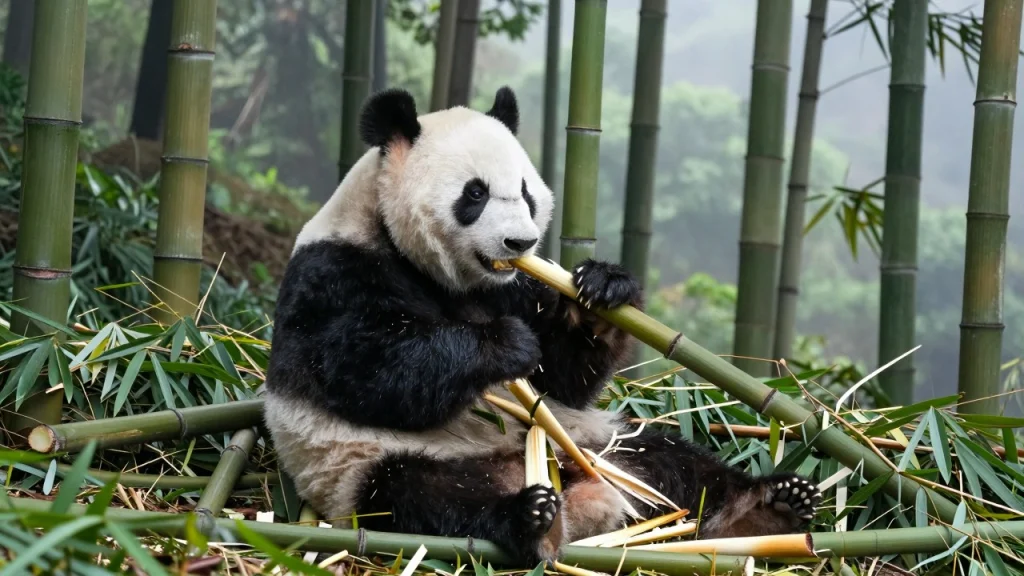
Once the outer bark of the bamboo culm has been peeled away, the panda deploys immense crushing force to reduce the fibrous stalks to digestible fragments. Their cranial architecture features an enlarged sagittal crest that has broadened and deepened over evolutionary time, resulting in remarkably powerful jaws. This deep bony ridge running along the top of the skull provides an extensive attachment surface for massive temporalis muscles.
The sheer force produced by these skull adaptations distinguishes the giant panda from all other living ursids. Due to the continuous mechanical demands of processing fibrous stalks, pandas generate the greatest jaw strength observed in any bear. Robust jawbones work alongside substantial cheek musculature, empowering the bear to pulverize and grind dense bamboo culms using its flattened posterior teeth. Giant pandas rely on oversized molar teeth together with potent cranial musculature to shatter resilient bamboo.
To withstand these unrelenting crushing forces, the cheek teeth themselves have evolved specialized topography. Compared to other bears, giant pandas possess premolars and molars that are broader and flatter, equipped with complex ridges and cusps designed to pulverize woody bamboo. These ridges act as multi-directional grinding basins, ensuring that tough plant fibers are thoroughly broken down into digestible mash.
Why must a panda chew so persistently every day? The answer lies within its internal anatomy. Because its gastrointestinal tract resembles that of a carnivore rather than a true herbivore, a substantial proportion of consumed plant matter is excreted as waste. Giant pandas lack the multi-chambered stomachs found in ruminants, causing bamboo to pass rapidly through their gut with only a fraction of its nutrients absorbed.
To survive on such an inefficient digestive setup, the animal must consume vast quantities of food. To compensate for this poor digestive efficiency, an individual must consume from 70 up to 100 pounds of bamboo daily to extract adequate nourishment. Harvesting such immense quantities of vegetation forces the animal to dedicate between 10 and 16 hours every day to searching for food and chewing. This schedule explains why pandas spend nearly their entire waking lives eating.
While giant pandas are capable of feeding on 25 different varieties of bamboo, individuals typically target just the 4 or 5 kinds present within their local territory. Although bamboo comprises approximately 99% of their nutritional intake, pandas also eat grasses, bulbs, fruits, certain insects, and occasionally rodents or carrion. Their robust dentition remains capable of processing these diverse foods.
Growth of teeth from vulnerable cubs to mature adults
The journey toward developing this formidable 40- to 42-tooth chewing system begins in extreme vulnerability. At birth, helpless newborn panda cubs weigh merely 85 to 140 grams. A newborn cub is utterly reliant on its mother for warmth, milk, and protection. At this early developmental stage, cubs possess no erupted teeth.
Over the initial months of life, rapid physiological changes transform the young cub into an active juvenile. Cub dentition begins erupting around 14 weeks of age, prompting the mother and offspring to drastically reduce their reliance on the natal den. As their initial deciduous teeth emerge, young pandas begin practicing the mouth movements necessary for chewing solid bamboo.
By the time permanent adult teeth replace the deciduous set, the young bear has acquired the complete set of 40 to 42 teeth characteristic of the Ursidae family. Equipped with heavy enamel, specialized peeling premolars, guiding third incisors, and massive crushing molars, the mature giant panda possesses a chewing apparatus tailored with precision to thrive in mountain bamboo forests.
Sources
- Smithsonian’s National Zoo and Conservation Biology Institute: Giant panda | Smithsonian’s National Zoo and Conservation Biology Institute
- San Diego Zoo Wildlife Alliance: Giant Panda | San Diego Zoo Animals & Plants
- Animal Diversity Web: Ursidae (bears) | INFORMATION | Animal Diversity Web
- Animal Diversity Web: Ailuropoda melanoleuca (giant panda) | INFORMATION | Animal Diversity Web
- Scientific Reports: Temporomandibular joint and Giant Panda’s (Ailuropoda melanoleuca) adaptation to bamboo diet