
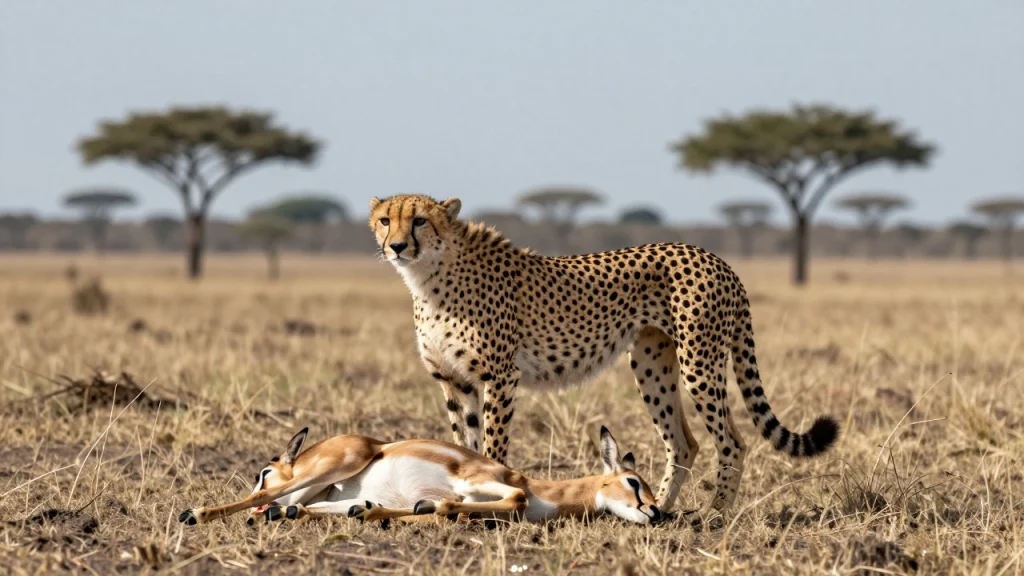
Cheetahs eat meat, and almost all of it comes from hooved mammals they can run down across open ground. The core of the menu is antelope in the small to medium range, with fieldwork on wild cheetahs pointing to wild ungulates of 23 to 56 kg as the usual target because anything heavier usually outlasts a sprint. Ungulates of one kind or another make up much of what a cheetah kills.
The rest of the diet is opportunistic rather than planned. Hares and birds turn up when larger prey is hard to find, and in some rangelands cheetahs have been confirmed to kill domestic animals. Almost no scavenging takes place, and a kill that cannot be finished on the spot is left where it falls.
Why antelope fill most of the plate
80 to 112 kilometers per hour is the reported maximum speed of the species, and a sprint is the whole strategy. That pace cannot last beyond a few hundred meters, by which point the animal is overheating, which puts a hard ceiling on the size of prey a cheetah can bring down. With teeth too short for a bone-crushing bite, a catch has to be finished by suffocation instead.
That method scales down to tiny meals, so a hare is dealt with by a single bite through the skull rather than a strangling grip.
Which animals show up on the plate
Impalas turn up regularly, along with other ungulates of modest size and the young of much larger species. One zoo account gives the named prey as a good cross section of what is on offer:
- Small antelope: springbok, steenbok, duikers, impala and gazelles
- Young of larger animals: warthog, kudu, hartebeest, oryx, roan and sable
- Other flesh: game birds and rabbits, plus ground-dwelling birds, porcupines and ostriches
Behind that list sits a clear preference for gazelles, with the Thomson’s gazelle singled out as the most important single prey animal.
A menu that shifts with the landscape
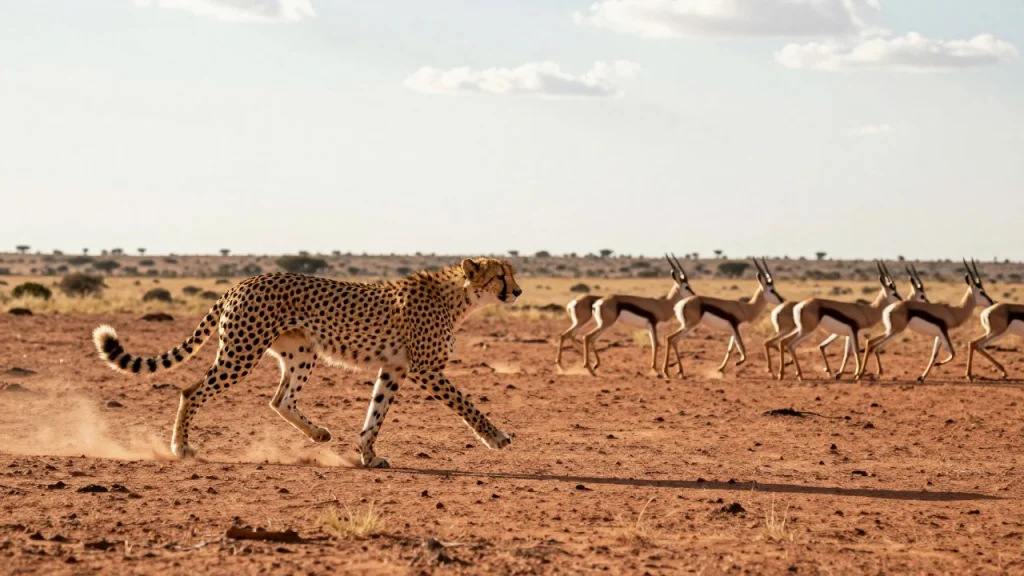
The diet is a snapshot of what is walking around locally, so the same species can be a staple in one place and a rarity in the next. In Kruger National Park, impala accounts for 65.0% of the prey recorded, with greater kudu at 6.8% and waterbuck at 6.7%. In the Kalahari, springbok makes up 86.9%, leaving only small shares for wildebeest and ostrich.
Those differences do not track raw abundance. In ranchlands in south-eastern Kenya, Grant’s gazelle made up the largest share of the diet even though Thomson’s gazelle was by far the most common medium sized ungulate there, and the researchers concluded that how plentiful a species is does not shape the cheetah’s choice.
The Asian population on a different menu
Iranian cheetahs take urial above all, appearing in 46.6% of the faecal samples analysed, ahead of bezoar goat at 24.9%, and the same study confirmed urial as the current main prey in Iran. The two gazelle species living in those habitats together reached only 13.2, with the Cape hare close behind at 11.0%. These figures count how often a prey item turned up in droppings rather than how much meat it supplied, so they describe what is caught rather than how large each animal is.
The unusual items on the list
Smaller prey fills the gaps when the preferred species are missing, and a scat study in Kenya also recorded yellow baboon, vervet monkey and rock hyrax. Iranian work goes further still, listing 11 different species killed by cheetahs there, ranging from rodents to dromedary camels.
Domestic animals tell a mixed story. The Kenyan rangeland study documented livestock as potential prey, while in Iran livestock depredation was uncommon, at a 3.6% frequency of occurrence. The adaptability is real, yet bounded: a cheetah will switch to whatever is on offer, but wild antelope still carry the bulk of the intake.
From chase to carcass
How the catch is made
A cheetah skips the creeping stalk that other cats rely on. It runs its prey down from roughly 70 to 100 meters away, and success rates fall off badly when a charge starts from beyond 200 m. About half of a cheetah’s prey chases end in a kill, so every failed sprint is an expensive loss of energy.
Once the sprint stops, the cat is nearly spent. About 20 minutes pass before its breathing and body temperature return to normal, which is the same span the prey needs to suffocate. There is no time to be careful, because lions, hyenas and sometimes vultures can take the catch away, and 50 percent of the food is lost that way. That constant loss is why they must hunt more often than other big cats, expending more energy in the process.
How much a cheetah eats
The meal starts at the abdomen, opened with the teeth, and the big muscle groups of the limbs, back and neck are eaten first. Skin and bone are normally left behind.
A single sitting can amount to 14 kg, and four cheetahs can strip an impala clean in 15 minutes. Captive feeding looks nothing like that: an adult cheetah in managed care averages 1.3 kg a day, with frozen rabbits and beef femurs handed over as enrichment.
What cubs learn about food
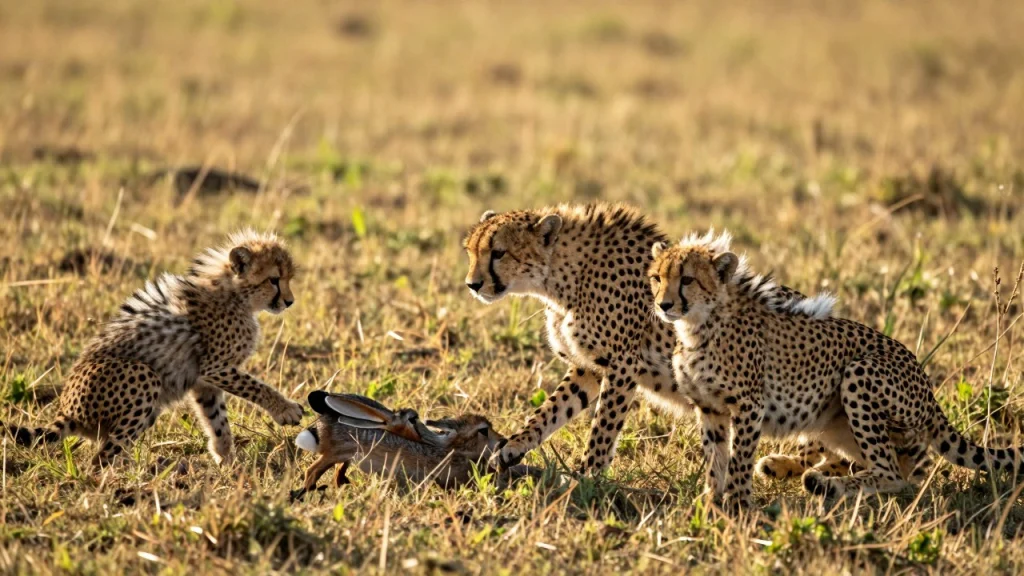
At six weeks the cubs are strong enough to follow a hunt, and by roughly six months the mother starts catching live animals for them to kill as practice. A mother with cubs is also the one case where a cheetah comes back to a carcass, covering it with earth or grass and returning with her young.
Why the menu decides how many cheetahs survive
Because the diet rests on wild antelope, losing antelope is a direct hit to cheetah numbers. More than 80% of Kenya’s cheetah population lives on community and private land outside protected areas, where densities of wild ungulate prey have fallen sharply over recent decades. Safeguarding the prey base, not only the cats, is what keeps this menu available.
Sources
- Animal Diversity Web, University of Michigan: Acinonyx jubatus (cheetah)
- Smithsonian’s National Zoo and Conservation Biology Institute: Cheetah
- San Diego Zoo Wildlife Alliance: Cheetah
- San Diego Zoo Wildlife Alliance Library: Cheetah (Acinonyx jubatus) Fact Sheet: Diet & Feeding
- Ecology and Evolution (Wiley), via PubMed Central: Dietary preference of cheetahs (Acinonyx jubatus) in south-eastern Kenya
- PLOS ONE, via PubMed Central: Animal behavior informed by history: Was the Asiatic cheetah an obligate gazelle hunter?