
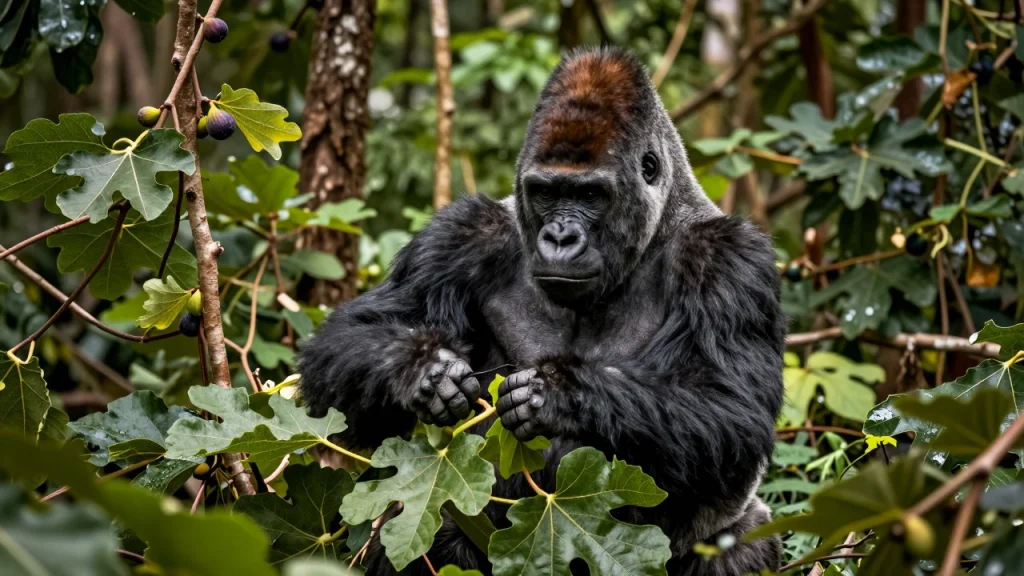
Gorillas are plant eaters, and the parts they favour are the tender ones. Primarily herbivorous, they take the leafy tops of herbs, shrubs and vines, and western populations live on juicy stemmed plants, adding berries, ferns, rough bark and plenty of foliage on top. Fruit supplies the sugar, and a small serving of animal protein comes along for the ride in the form of invertebrates found on leaves and fruit.
The answer shifts with geography, because gorilla habitats do not all produce the same larder. Mountain gorillas are primarily folivores, living off the herbs, creepers, shrubs and bamboo of their high-altitude forest, where fruiting trees are scarce. Lowland western gorillas fare better: tree parts and herbs combined take about 50% of their feeding time, and fruit takes about 35%. So one question has two quite different answers depending on which gorilla you ask about.
The bulk of the plate: green growth and woody fibre
Reaching it can mean climbing, since western gorillas climb as high as 15 meters to find food.
Mountain gorillas run a narrower list. Their staples are the leafy parts, stem cores and roots of the herbs, creepers, shrubs and bamboo that fill their forest, and their priority plant parts are leafy growth, stem pith and shoots. Everything else is a garnish, and researchers have recorded a strikingly odd set of extras in their diet:
- tree bark and dead wood
- flowers and fungi
- galls, the swellings insects build on plants
- the thin outer layer stripped from roots
- invertebrates
- gorilla dung
Concentration is the other striking feature. Almost 90% of the studied mountain gorilla diet comes from just six key plant species, out of 54 species recorded in total, mostly perennial herbs, vines and shrubs.
Fruit follows the forest calendar
Fruit is the part of the menu that moves with the seasons. Gorillas strip the pulpy flesh from close to a hundred kinds of tree that fruit in turn, and at every site researchers examined, the time spent eating fruit tracked how much fruit was available. They also feed selectively, choosing ripe pieces over unripe ones, so a fruiting month can redraw a group’s whole daily routine.
Related subspecies, though, put noticeably smaller amounts of fruit on the plate, and the contrast is sharpest at altitude. Bamboo shoots are the one item in the highland diet with a timetable: apart from the shoots, which appear biannually with the rainy seasons, the menu barely changes from month to month.
What a year of records shows
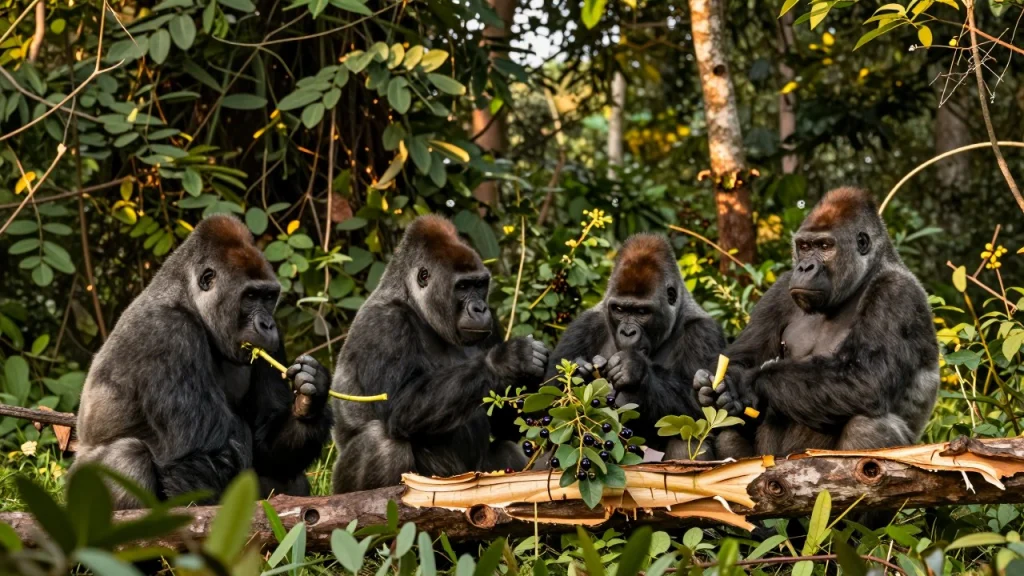
A study that followed one habituated western gorilla group at Bai-Hokou in the Central African Republic logged 132 separate food items across 98 kinds of plant and insect. The shape of that list is the useful part. As fruit intake went up, leaf intake went down, while stems and insects shifted on a shorter cycle within the year.
That flip explains a lot about gorilla feeding. Ripe fruit makes a richer, more digestible meal than the rest of the year offers, yet the gain shows up in calories rather than in protein, fat or other nutrients, so a fruiting period is an energy windfall rather than a complete diet. Leaves, both young and mature, carry more protein than fruit, which is why they matter most when fruit is scarce.
Why so much of it: fermentation and body size
The key to the whole menu is that gorillas are hind-gut fermenters. Fibrous plants travel largely undigested, because microbes in the hindgut do the fermenting rather than the gorilla itself, and that partnership is what lets a gorilla build a diet on protein-rich leaves.
Drawing out a large share of its daily calories by fermentation is how a gorilla pays its bills during the months when fruit is gone. In the fruit-poor part of the year, western lowland groups get most of their daily energy from increased amounts of protein, fat and fibre in leaves and bark, and their large body size is what makes that strategy possible.
That last point is what separates gorillas from other apes with less scope for fermenting tough food, such as orangutans.
The animal protein in the diet
Invertebrates are the one animal item on the sheet. In the wild that largely means termites, and at two of the three sites followed, insects took about 5% of feeding time. Loango, the third site, was the exception, where gorillas only rarely ate termites, and the gap was filled with nuts instead: nuts took about 10% of feeding time there, while the other two sites recorded none at all.
Diet breadth is not uniform either. One group at Loango National Park worked through 61 different food items, including 35 fruits, 4 herbs and 16 tree foods. Which plants those were changed from forest to forest, yet the nutrients they delivered barely moved, meaning gorillas reach for different plants in different places but land on similar nutrition.
How much a gorilla eats in a day
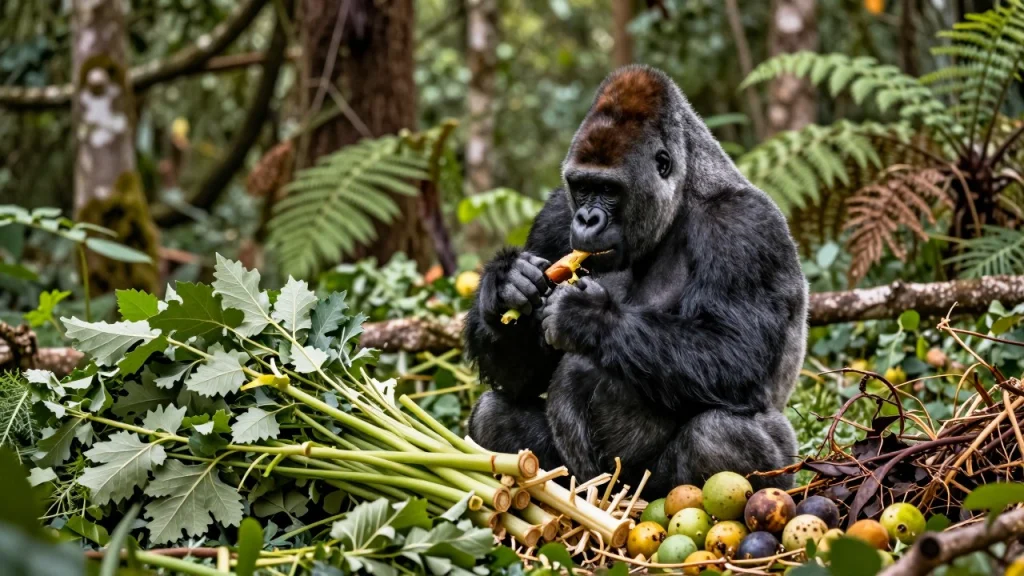
A grown male downs 45 pounds (32 kilograms) of vegetation a day, and females get through around two-thirds as much. The volume reflects how much low-energy foliage a body that size needs, and gorillas spread it across the day, feeding in the morning and again in the afternoon rather than sitting down to one enormous meal.
They are also careful not to exhaust a patch. A foraging troop never wipes out one spot entirely, and because the plants they favour grow back fast, a group can work the same fairly compact home range year after year. A gorilla troop is a gardener as much as a browser.
Why gorillas eat what comes out
Because that digestion is inefficient, gorillas re-eat what passes through. One of these habits is eating your own droppings, a behaviour known as coprophagy, and wild gorillas do it as well. The reason is an inefficient gut: high-fibre food passes through in bulk, so plenty of edible material leaves the body only partly processed, and a second pass lets the animal salvage value from a meal the gut could not finish.
Caretakers also see regurgitation and reingestion, where food is brought back up and swallowed again. Nobody has settled on a firm explanation for why these habits show up under human care, though suggested explanations involve how sweet or starchy the food is, whether the behaviour recaptures minerals, and simple taste.
What a managed diet looks like
Zoo diets echo the wild pattern rather than replacing it. At the Smithsonian’s National Zoo, breakfast and dinner cover chow alongside greens and cut-up fruit and vegetables, with items spread over a wide area so the troop feeds together. Hay hides smaller items, including popcorn, sunflower seeds, peanuts, beans and diced fruit, and fresh tree trimmings arrive every day, with browse drawn from trees such as willow, mulberry and maple.
Reading a diet as a habitat signal
Researchers in the Virunga Massif of Rwanda compared mountain gorilla groups living in two very different parts of the park, the southwest and the northeast. The two regions worked from different vegetation zones, and the diets of their groups varied a lot while overlapping little, yet the key foods, making up about 80% of the diet, carried comparable nutrient concentrations in the southwest and in the northeast. For anyone managing gorilla habitat, the message is that a forest full of edible plants is not the same thing as a forest supplying what a particular group actually needs.
Sources
- Animal Diversity Web, University of Michigan: Gorilla gorilla (western gorilla)
- Animal Diversity Web, University of Michigan: Gorilla beringei (eastern gorilla)
- Smithsonian’s National Zoo and Conservation Biology Institute: Western lowland gorilla
- PLOS ONE: Dietary variability of western gorillas (Gorilla gorilla gorilla)
- PLOS ONE: The Influence of Seasonal Frugivory on Nutrient and Energy Intake in Wild Western Gorillas
- Ecology and Evolution (Wiley) via PubMed Central: Dietary Variability Among Mountain Gorilla Groups Across Volcanoes National Park, Rwanda