
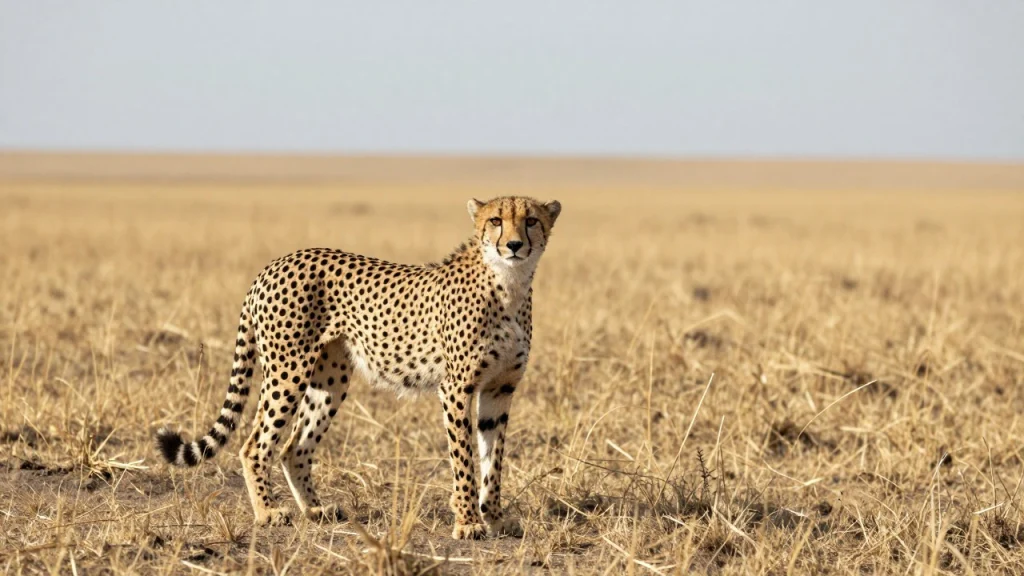
How high can a cheetah jump when navigating open landscapes or facing obstacles? Unlike arboreal big cats that launch themselves high into trees or vertical leapers that vault into the air to seize birds, cheetahs are not built for extreme vertical elevation. To secure enclosures safely, containment fencing using mesh or vertical masonry must reach at least 2.5 m in height, supplemented by an inward 60 cm mesh overhang pitched at a 45-degree angle. Such inward-slanted roof sections provide essential security and require construction from wire mesh or chain-link. Records show instances of individuals scaling 3 m solid walls that lacked barriers, while young juveniles climb adeptly and can leap across a 3.5-m moat. Wildlife managers note that mature cheetahs typically display limited climbing aptitude.
The physical reasons behind these vertical boundaries stem directly from specialized evolutionary engineering. Biomechanical analyses demonstrate that high-speed running involves minimal vertical displacement of the center of mass, restricted pitching along the torso, and extensive bending throughout the spine. Preserving a level head position enables the hunter to hold unbroken visual focus on fleeing targets. By keeping upward body movement minimal, the cat converts explosive muscular force into pure horizontal propulsion across the savanna rather than wasting momentum on high vertical leaps.
Vertical jumping limits and barrier heights
In zoological parks and wildlife sanctuaries, understanding vertical reach is essential for designing safe containment areas. A standard vertical fence without barriers presents potential vulnerabilities because an athletic felid can scramble or scale vertical surfaces when pressed. While predominantly ground-dwelling predators, cheetahs occasionally ascend trees. Their anatomy remains tailored for open ground rather than vertical gymnastics, which explains why specialized fences prevent escapes without requiring extreme vertical walls.
Containment standards reflect differences between mature cats and growing youngsters. Juvenile cheetahs possess greater relative climbing agility, testing boundaries by scaling ledges and bounding over ground gaps. These behavioral patterns guide wildlife parks when constructing naturalistic enclosures that keep animals secure.
Biomechanics of horizontal propulsion over vertical height
The cheetah’s entire musculoskeletal system prioritizes forward propulsion over upward jumping. During an all-out sprint, upward movement would introduce instability and slow down forward pursuit. Sprinting capacity originates in a pliable vertebral column that permits the forelimbs to reach far ahead during forward strides. The vertebral column functions like a loaded mechanical spring for muscular hind legs to lengthen stride distance, although this biomechanical compression demands heavy metabolic expenditure.
Specialized skeletal architecture
Several unique skeletal adaptations support this spring-loaded forward propulsion. Their skeletal architecture features reduced clavicles, vertically oriented scapulae unfastened to collarbones, and pelvic girdles that pivot smoothly across the flexible back. These skeletal specializations elongate horizontal reach while maximizing explosive forward acceleration. Without rigid bone attachments restricting the shoulders, the forequarters extend broadly, turning each forward stride into an elongated horizontal bound.
Rotary galloping and dual flight phases
High-speed locomotion relies on a distinctive rotary gallop that keeps the cat airborne for extended intervals. Dynamic vertebral flexion drives two distinct airborne phases across each gallop cycle, alternating between extended and gathered suspension. During the extended suspension phase, the body stretches fully flat above the ground, while the gathered phase pulls all four limbs together beneath the chest. During maximum velocity sprints, the animal actually remains suspended in midair for over half of its stride duration.
Airborne stride dynamics during high-speed sprints
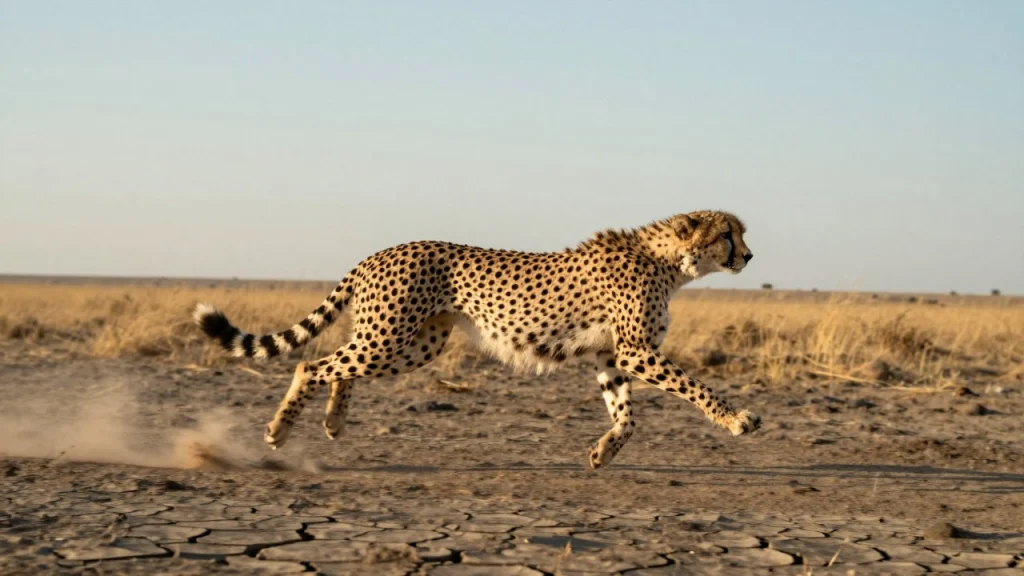
While a cheetah does not leap high vertically, its horizontal leaping capability during a sprint is extraordinary. During a gallop, each stride carries an adult across 20 to 22 feet, matching the ground covered by a racehorse. When pushing full throttle, individual bounds lengthen to 23 feet (7 meters) while cycling through four complete strides every second. These immense bounds allow the predator to chew up ground at astonishing rates across open grasslands.
Turning in midair with a caudal rudder
Sprinting at high velocity requires exceptional steering control to match erratic prey maneuvers. Among all living felids, they alone possess the agility to pivot their bodies mid-flight during flat-out sprints to track prey swerves. A muscular tail serves as a counterbalancing rudder during sudden steering maneuvers, stabilizing the animal against its own momentum. Along with an orienting caudal rudder, massive internal lungs, an expanded heart, and broad nostrils deliver immense oxygen flows for rapid energy surges.
Skeletal adaptations for traction and braking
High-velocity ground pursuit requires specialized contact points with the earth. The overall silhouette combines a slender build and elongated limbs with blunt, semi-retractable claws. Tough, pointed claws grip the substrate like athletic cleats to provide dependable traction across open terrain. Although capable of slight claw retraction, cheetahs lack the protective cutaneous sheaths seen in other cats. A conical patch of hairless skin positioned behind each front limb acts as a friction brake when arresting sudden motion.
Hunting strategy: open pursuit versus springing ambush
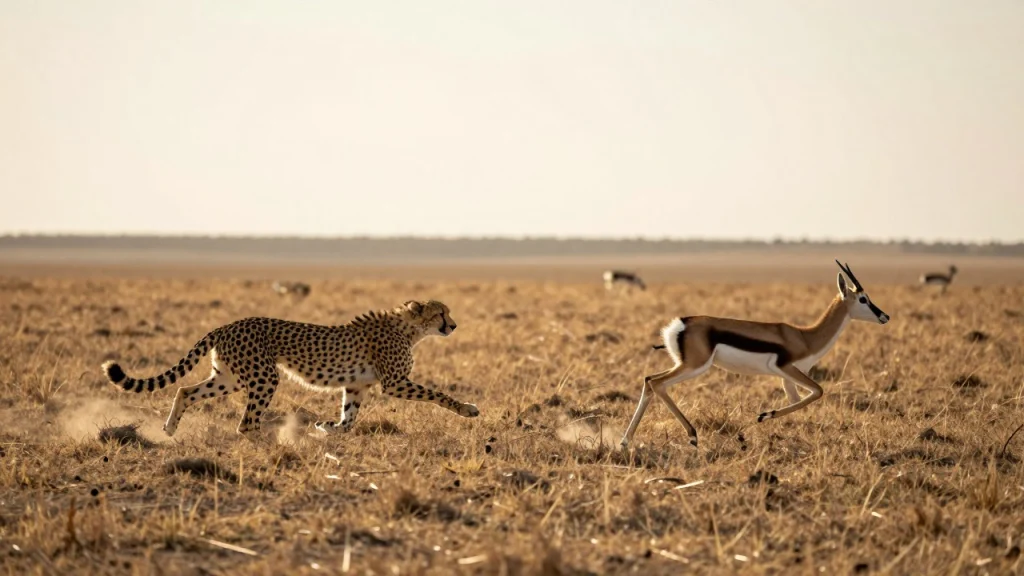
Predatory tactics mirror these biomechanical specializations. In contrast to felids that creep within leaping range before pouncing, cheetahs initiate their charges from an open distance of 70 to 100 meters. Upon overtaking an animal, the runner trips the quarry to the turf using its forepaws before clamping down on the throat.
Rapid bursts of speed define these open charges. Sprinting individuals can accelerate up to 45 miles per hour from zero within 2.5 seconds. Velocities average from 60 to 70 miles per hour, though exhaustion limits sprints to roughly 300 yards. Spacious respiratory airways leave little room for the long roots that big teeth would need, so a cheetah’s teeth stay comparatively short. Following a capture, the cat secures its kill by compressing the trachea to induce suffocation.
Physical dimensions and predatory demands
The animal’s physical proportions explain why horizontal velocity takes priority over vertical jumping. Adults typically weigh 75 to 140 pounds, standing about 30 inches tall at the shoulder with a head-and-body length of 44 to 56 inches and another 26 to 33 inches of tail. Wild diets center on small antelopes like gazelles, impala, springbok, steenbok, and duikers, alongside juveniles of large herbivores. Pursuing swift savanna herbivores demands explosive horizontal coverage rather than high vertical clearance.
Understanding the cheetah’s specialized athletic niche
Cheetahs represent an extraordinary evolutionary dedication to horizontal speed. Rather than developing high vertical jumping to scale trees or pounce from ambush, their physical form channels every ounce of energy into forward propulsion. Care facilities provide physical exercise by deploying automated coursing equipment that sweeps a target across tracks at 80 kph. Recognizing the distinction between vertical jumping and horizontal sprinting highlights why the cheetah remains unmatched as the premier runner of the natural world.
Sources
- National Center for Biotechnology Information: Clinical Management of Captive Cheetahs
- Frontiers in Bioengineering and Biotechnology: Three Characteristics of Cheetah Galloping Improve Running Performance Through Spinal Movement: A Modeling Study
- Smithsonian’s National Zoo & Conservation Biology Institute: Cheetah
- San Diego Zoo Wildlife Alliance: Cheetah
- Animal Diversity Web: Acinonyx jubatus (cheetah)