
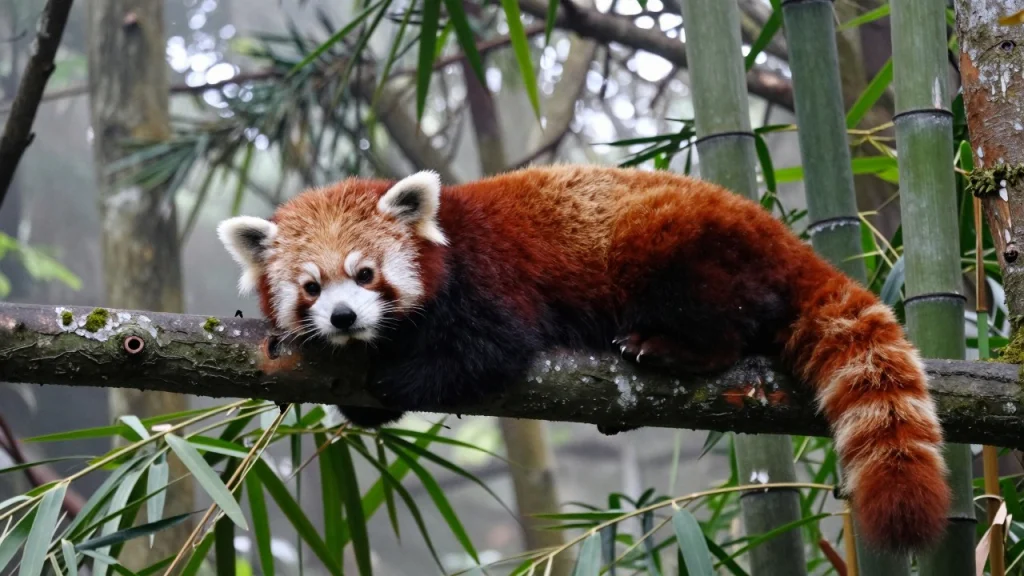
Fewer than 10,000 red pandas are thought to survive in the wild, and that is the figure supported by the most recent assessment on the IUCN Red List, published in 2015. A peer-reviewed study of red panda habitat in Nepal put the figure differently: about 10,000 mature animals are thought to survive in the wild, though dependable figures on abundance are not available.
Two qualifiers matter more than the digits. That total counts mature individuals, not every red panda alive in the mountains, and the species is listed as Endangered with a decreasing trend, including a possible decline of as much as 50% over a 20-year period. Roughly half of those individuals live in China, with the remainder in the other range countries.
What the headline number covers
Wild red pandas survive in just five countries: Nepal, China, India, Bhutan and Myanmar. Because they naturally live at low densities, the total is spread thinly across whole mountain ranges rather than concentrated in a few large groups. An adult weighs 8 to 17 pounds (3.6 to 7.7 kilograms), and its fluffy tail adds 14.6 to 18.6 inches, or 37 to 47.2 centimeters, of extra length.
Two layers of law sit behind the count. The species has legal protection in all five range countries, and international trade is restricted under CITES Appendix I, a listing it moved up from Appendix II in 1994 for the strictest protection from commercial trade.
Why the count is an estimate and not a census
Nobody walks the mountains counting red pandas. Population estimates are assembled from indirect evidence, above all fresh droppings, tracks and signs of feeding, because the animal is genuinely hard to see, and the reasons are consistent:
- Nocturnal and arboreal habits. Red pandas are often up and active after dark, they pass much of the day high in the trees, and they keep to remote, steep mountain terrain.
- Solitary behaviour. Red pandas are largely solitary and pass information to each other through scent, so a good forest holds scattered individuals rather than countable groups.
- A narrow activity window. Most movement happens at dawn and dusk, with the hottest hours of the day spent asleep.
- Few chance encounters. People rarely meet wild red pandas, and those meetings come about when ecotourism deliberately brings visitors into their habitat.
Where the remaining red pandas are found
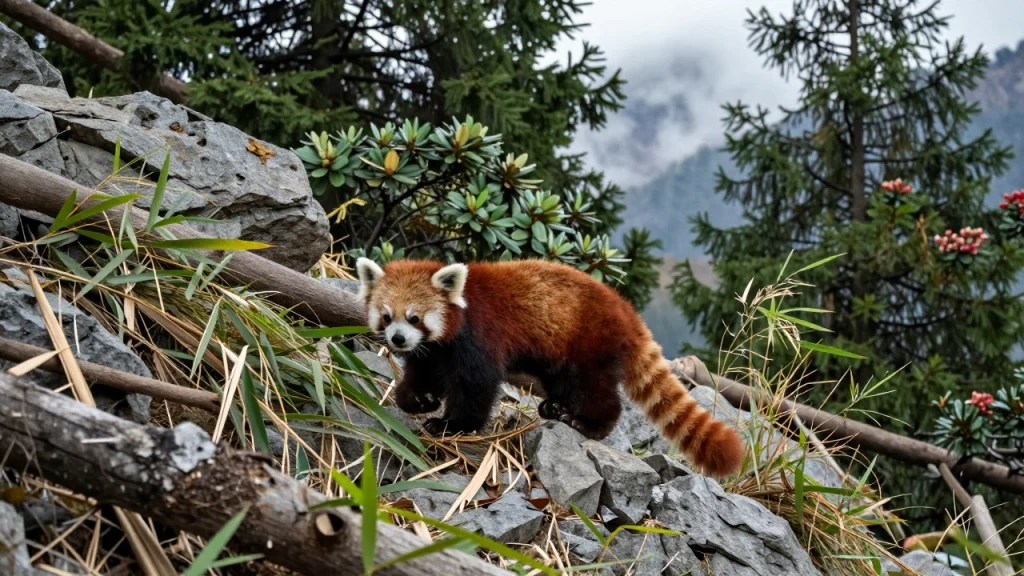
Red pandas are now found only in small, isolated mountain territories, and most of that range sits high: 2,500 to 4,000 m is the typical elevation band, with some records from 2,200 m to nearly 5,000 m in summer, at the edge of the snowline. Narrow altitude zones matter here, because the animal occupies tight bands tied to cool temperate climates and particular plant communities.
Forest type matters as much as height. The animal is at home in high mountain forest with a thick bamboo understory. It also favors habitat holding fallen logs, stumps and shrubs.
Two named forms divide that range. The Himalayan form, Ailurus fulgens fulgens, is centered on Nepal, with records from India and Bhutan, while the Chinese form, Ailurus fulgens styani, occurs mainly in China and Myanmar. Within China, some places inside the former range no longer hold any red pandas at all.
Survival depends on a short list of conditions: proximity to water, the right forest cover and altitude, and enough bamboo to eat.
The bamboo habit behind every threat
About 95% of what a red panda eats is bamboo, and the animal must eat 20 to 30 percent of its body weight in food every day. The trouble is the return on all that bamboo: about 24% of it is digested and the rest passes through, and one study put the daily total for a single female at roughly 20,000 leaves.
A habitat may offer 40 kinds of bamboo, yet each animal favors one or two. Being an obligate bamboo eater leaves the red panda on a tight energy budget nearly all year, so it cannot make up for poor foraging by switching to richer food.
What is pushing the numbers down
The primary dangers are the loss and degradation of habitat, interference from people and poaching. The assessment behind the count expects the decline to continue, driven by ongoing loss of forest habitat and of bamboo as food and by the animal’s susceptibility to disease, with canine distemper the example given. Domestic dogs are one route for that disease: they can hunt red pandas or transmit distemper to them, while livestock herds compete for the same bamboo leaves and degrade the habitat beneath them.
Clearing forest does more than remove animals: it cuts what is left into separate pieces. Isolation then brings inbreeding, because the surviving groups are cut off from one another. A warming climate adds pressure from another direction, since forest loss could split some habitat areas and isolate some populations, restricting movements and gene flow.
Two names for one uncertain total
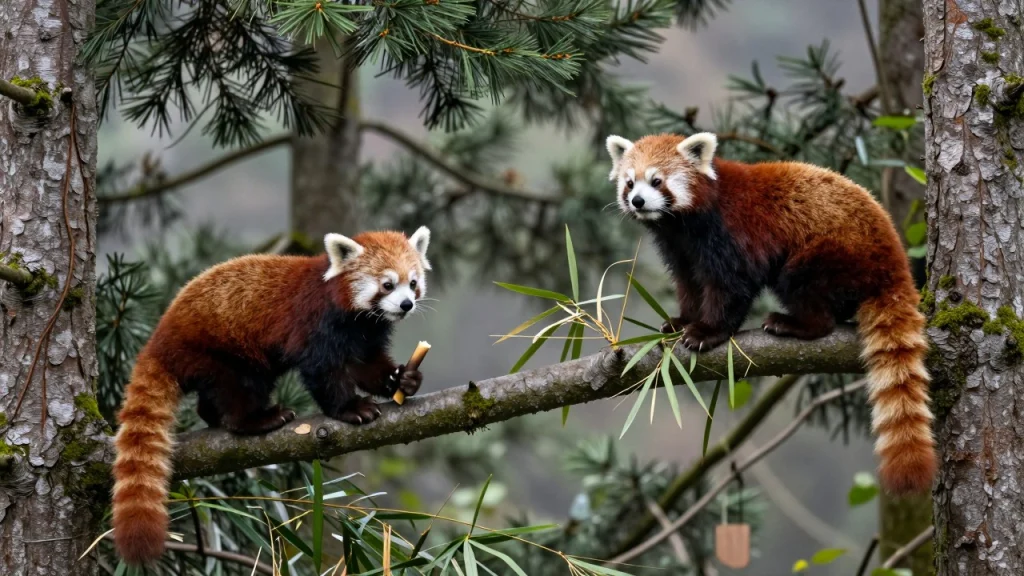
Recent genetic evidence supports one species with two subspecies, but the arrangement is still contested and more genetic, reproductive and ecological work is needed to settle it. The disagreement matters for counting, because the two forms do not face identical odds: apart from Bhutan, Himalayan red panda habitat is more fragmented than that of the Chinese red panda, and both subspecies are found in China. The red panda is also the sole living representative of its own taxonomic family, and despite the shared name it is not closely related to the giant panda.
Protection that works, and the gap that does not
Protected areas in reserves and national parks across India, Nepal, China and Bhutan prevent habitat destruction and shelter red pandas alongside other endangered animals, and locally run projects are among the things helping the species. A large share of usable forest falls outside those boundaries, though, so a park network by itself cannot hold a scattered population together.
Why a depleted population refills slowly
Sexual maturity arrives at roughly 18 months of age, and a typical litter is two cubs, born in the Northern Hemisphere between May and July and arriving when bamboo shoots are at their most tender and digestible. That is a slow replacement rate for a species under pressure from disease, dogs and habitat loss, and it is one reason a depleted population does not refill quickly on its own.
So the answer to how many are left is fewer than 10,000, a figure built from droppings and tracks rather than from sightings, and it is still falling. The uncertainty belongs to the count, not to the trend: the assessment that produced the number also recorded a decline that is projected to continue.
Sources
- San Diego Zoo Wildlife Alliance Library: Red Panda (Ailurus fulgens) Fact Sheet: Population & Conservation Status
- San Diego Zoo Wildlife Alliance Library: Red Panda (Ailurus fulgens) Fact Sheet: Distribution
- San Diego Zoo Wildlife Alliance Library: Red Panda (Ailurus fulgens) Fact Sheet: Taxonomy & History
- San Diego Zoo: Red Panda | San Diego Zoo Animals & Plants
- Smithsonian’s National Zoo and Conservation Biology Institute: Red panda | Smithsonian’s National Zoo and Conservation Biology Institute
- PLOS ONE: Large anthropogenic impacts on a charismatic small carnivore: Insights from distribution surveys of red panda Ailurus fulgens in Nepal