
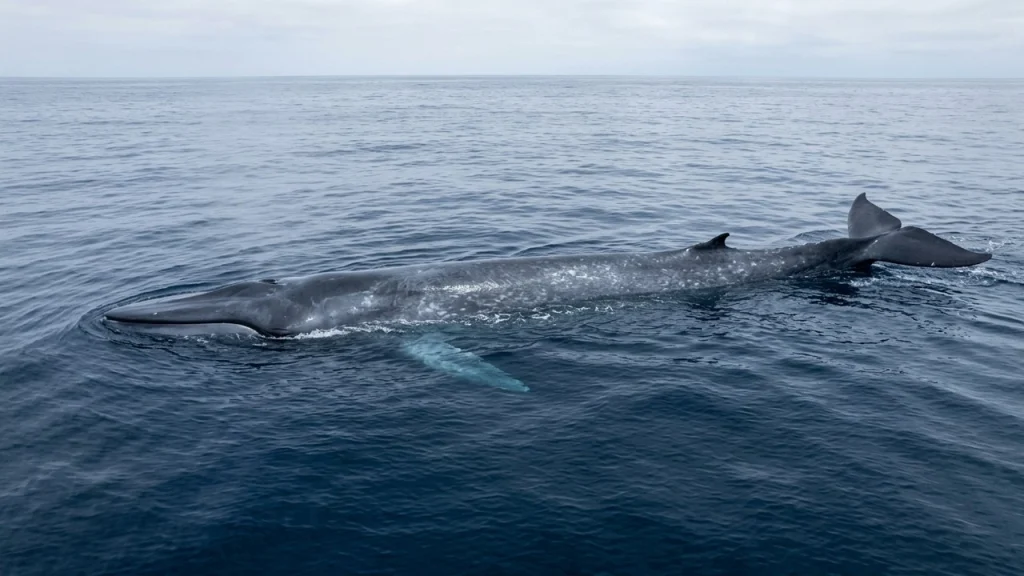
The blue whale is the heaviest animal that has ever lived, and its dimensions are best given as a range rather than as a single figure. The longest blue whale ever reliably measured came in at 33.26 m, and published species profiles list a size of 82 to 105 feet with a weight of up to 200 tons.
Nobody has ever weighed the largest blue whale, so the biggest masses on record come from statistical models and from animals that were cut into sections and weighed part by part.
Typical adults against the record holder
Most of the distance between an average blue whale and an extreme one comes down to sex and ocean, not to variation between individuals. Animal Diversity Web gives an average head-body length of 25 m for adult males and 27 m for adult females, and females are generally the larger sex. Researchers compiling the weighing record therefore worked from Southern Hemisphere females, because sex and geography bias the biggest records.
Why the weight figures disagree
Documented weights sit at the lower end of the estimates. A 27.1 m female weighed in sections in 1950 was at least 136.4 tons, and other records put blue whales at between 140 tons and 160.4 tons. Animal Diversity Web lists the heaviest specimen at 190,000 kg, and a recent study pushes further, estimating the mass of the largest known blue whales at roughly 270 tons.
The spread is mostly an artefact of how whales get weighed. The carcasses behind those records were cut up, which led to blood and fluid loss even when crews tried to keep it in the animal, so the same whale weighs less after processing than it did alive. Treat the biggest figures as estimates of a living animal and the smaller ones as post-mortem measurements.
Even so, the largest fossil whale known did not match them: the same analysis put Perucetus below today’s blue whales in mass.
Where the biggest blues live
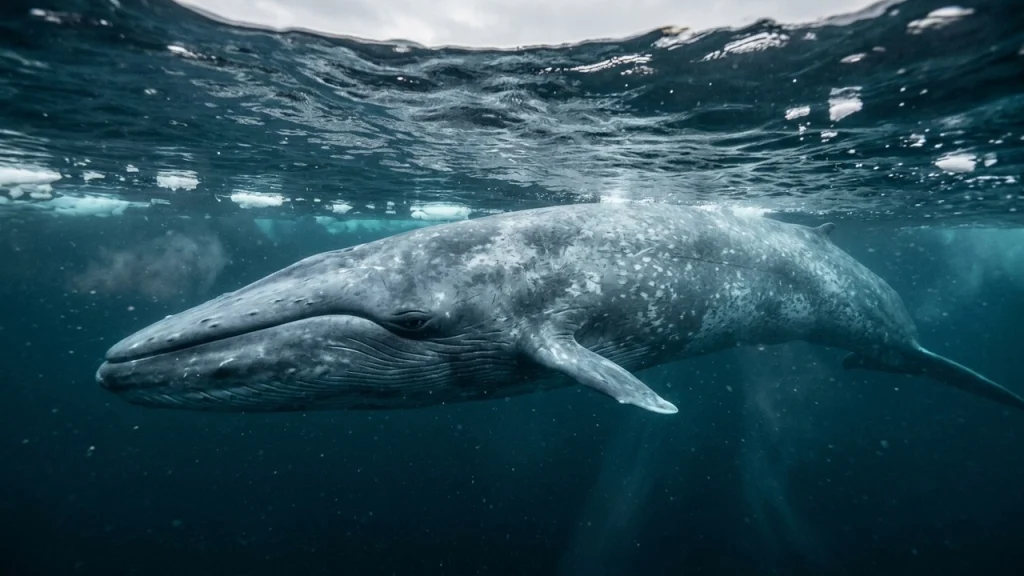
Size is also geographic. The form B. m. intermedia, with an Antarctic distribution, sets the top of the size range, and that is why the largest measured blues come from the south. The smaller B. m. brevicauda, the pygmy blue whale, carries its own set of morphological features, and blues in the southeastern Pacific fall between the two in size. Blue whales are cosmopolitan, present in all oceans but missing from the Mediterranean, the Okhotsk and the Bering seas.
The equipment inside a body that size
The head is broad and U-shaped when seen from above, and the feeding mechanism starts there. The animal gulps a huge mouthful of water, the pleated skin on its throat and belly expanding to take it in, and the tongue then pushes that water back out through thin, overlapping baleen plates, leaving the krill behind. Nothing has to be chewed, because a whale this size filters instead.
Most of the headline measurements are organ-level rather than whole-animal:
- Heart: about the size of a small car, pumping 10 tons of blood
- Aorta: wide enough for a person to crawl through
- Stomach: 2,200 lbs of food in a single fill
- Throat pleats: 55 to 88, reaching to or near the navel
- Baleen plates: 270 to 395 pairs, each under 3 feet long
- Dorsal fin: a stub of roughly 35 cm
That last figure fits the animal’s overall shape: like all rorquals, the blue whale is slender and streamlined rather than bulky.
A whale that eats almost nothing but krill
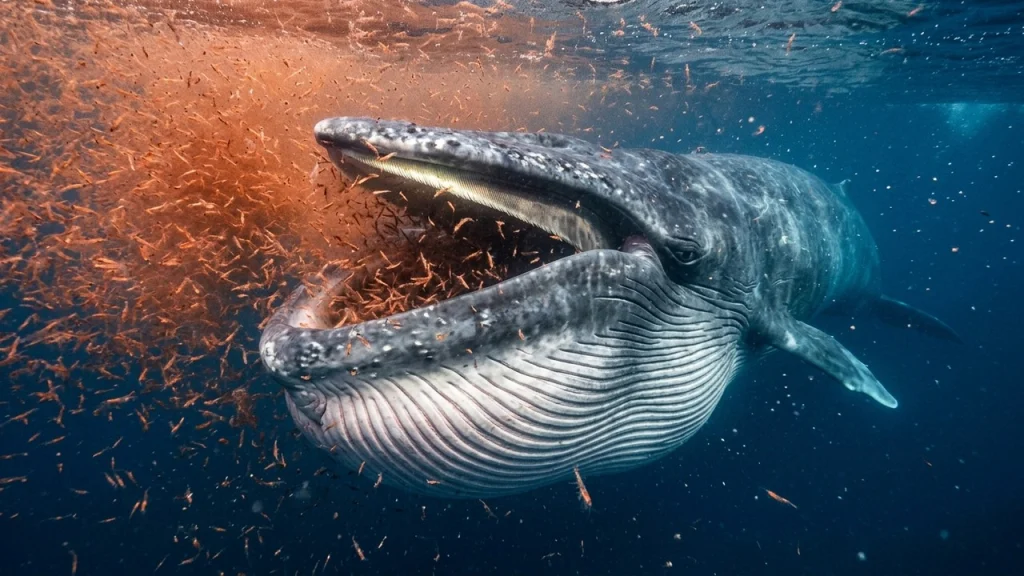
Almost the entire diet is one shrimplike animal, krill, and in feeding season one adult takes about 4 tons of krill every day. Blue whales feed at depths less than 100 m, though harpooned animals have been recorded at 500 m.
Each dive runs 10-20 minutes, after which the animal surfaces 8-15 times before going down again, and the blow that marks each surfacing rises about 30 feet high. Cruising speed sits near 22 km/hr, and a frightened animal reaches 48 km/hr.
Size also buys range and safety. In good conditions two blue whales can be 1,000 miles apart and still hear each other, and blue whales have virtually no natural predators. Calves are the exception, and may be taken by orcas and large sharks.
Starting life nearly whale-sized
A blue whale calf is born at 7-8 m long, already ranking among the largest newborns of any animal, and while nursing it can put on up to 90 kg of body weight a day. Weaning comes at seven or eight months, usually once the calf has reached 16 m.
Growth at that rate is what makes the adult figures possible, and blue whales are long-lived: age estimates put wild lifespan at 80 to 90 years, and the oldest whale dated by its earplug layers was around 110 years old.
How many blue whales are left
Whaling is the reason this is a conservation question. The Red List category is Endangered, assessed under criteria A1abd, and around 140,000 mature animals were probably alive globally in 1926.
Today’s estimate is far lower and genuinely uncertain: the current global mature population is likely in the range 5,000-15,000, a drop the assessment calculates at 89%-97%.
Recovery is real but uneven. The current population trend is increasing, and the assessment credits that to Antarctic and North Atlantic numbers, where the species had been most depleted. The Antarctic subspecies is separately listed as Critically Endangered.
Their size is also why whalers left them alone at first: their size, speed and remote habitat kept them off the early list of targets. New technology from 1860-1920 changed that, and roughly 350,000 blue whales were killed in the 20th century. By the 1960’s the species was on the edge of extinction. Protection finally arrived after the 1965/66 whaling season.
Sources
- Animal Diversity Web, University of Michigan Museum of Zoology: Balaenoptera musculus (blue whale) | INFORMATION | Animal Diversity Web
- IUCN Red List: Blue Whale, Balaenoptera musculus | The IUCN Red List of Threatened Species
- U.S. National Park Service: Blue Whale | U.S. National Park Service
- National Geographic: Blue whale, facts and photos | National Geographic Animals Reference
- PeerJ (Motani and Pyenson, 2024): Downsizing a heavyweight: factors and methods that revise weight estimates of the giant fossil whale Perucetus colossus