
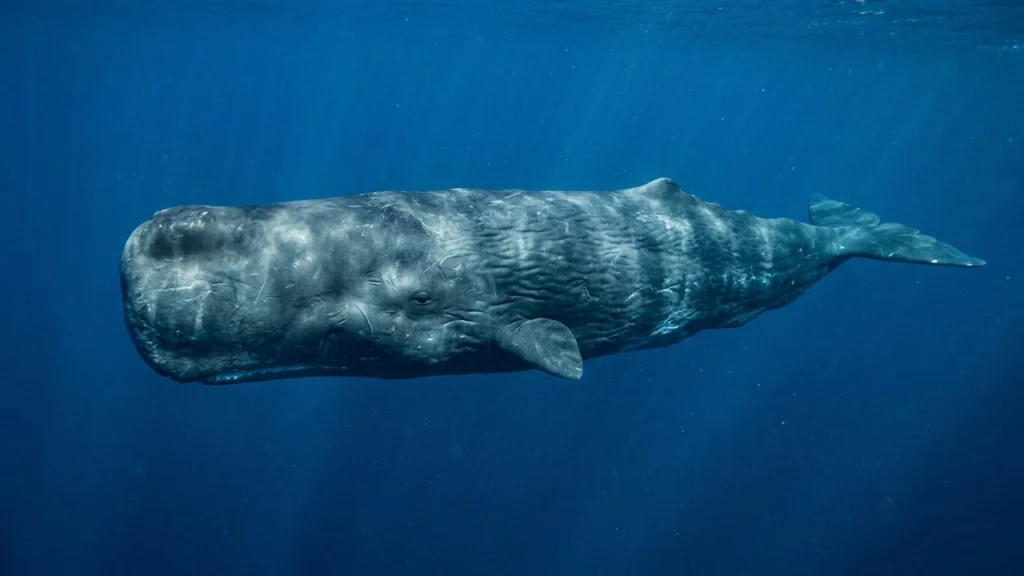
Sperm whales are named for what sits inside their heads, not for anything they do. The common name comes from spermaceti, a waxy substance packed into the animal’s enormous forehead, and the label stuck because the whalers who first cracked those heads open took the pale, oily fluid for the whale’s seed.
The error outlived the men who made it. What they had in their hands was a specialized organ that helps the animal hunt in permanent darkness, and the whale carrying it is the largest of the toothed whales. The formal scientific name points somewhere else entirely, at a blowing spout and a row of lower teeth.
A whaler’s word, not a zoological one
The name describes the cargo rather than the creature, and it was the cargo the whalers came for. Some have floated a second, more cheeky explanation: the term may be a nod to the male’s retractable penis, which reaches approximately 2 m.
The scientific label runs on completely different lines. Its genus name translates from the Greek as a word for blower, a reference to the vapor spout the animal throws up when it exhales at the surface. In the older species name catodon, the epithet points at the row of teeth lined along the bottom jaw.
What spermaceti is and how much of it there is
The head is the animal’s defining feature. For Physeter the head takes up 35% of the animal’s total length, and a deepened hollow in the front of the skull holds the spermaceti organ. A single head carries 3-4 tons of spermaceti, once prized as a lubricant for delicate machinery and as a component of automatic transmission fluid.
That much oil behaves in two different ways, and whalers used both. Sperm oil, drawn both from that organ and from the blubber, stays liquid even at low temperatures, which made it a fine industrial lubricant. Cooled down, the substance turns into a wax that whalers shaped into candles and ointments.
The sound lens in the forehead
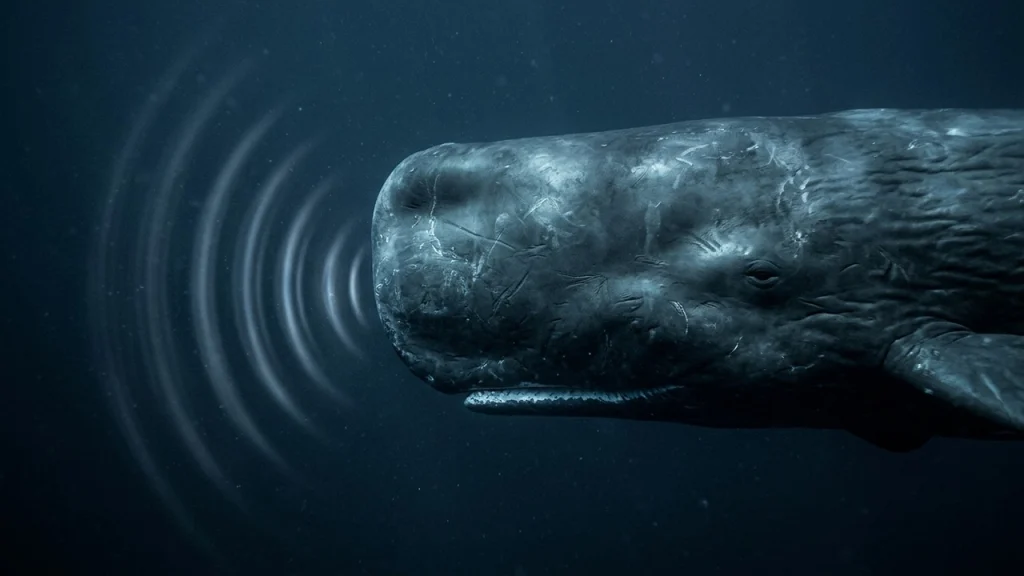
The organ is a sound device first, and it appears to work as an acoustic lens, much like the melon that other toothed whales carry, from which it is derived. Sperm whales hunt and steer by clicks that travel underwater until they strike an object and bounce back to the sender, giving away the target’s location, size and shape.
Diving with a head full of wax
The same fluid may also solve a diving problem. A widely held idea is that this fluid, which hardens to wax when cold, lets the whale change how it floats, so it can drop away and climb back to the surface. A competing proposal treats the organ as a cooling device, one that would shrink the animal’s volume and lift its buoyancy during long dives.
They hunt squid at depths of 3,280 feet, and a dive that deep can keep them under for up to 90 minutes. The brain sitting in that head is bigger than any ever recorded in a living or extinct animal. The blowhole, oddly enough, is not centered: the slit is S-shaped and offset to the left of the crown.
Small relatives with a big-sounding name
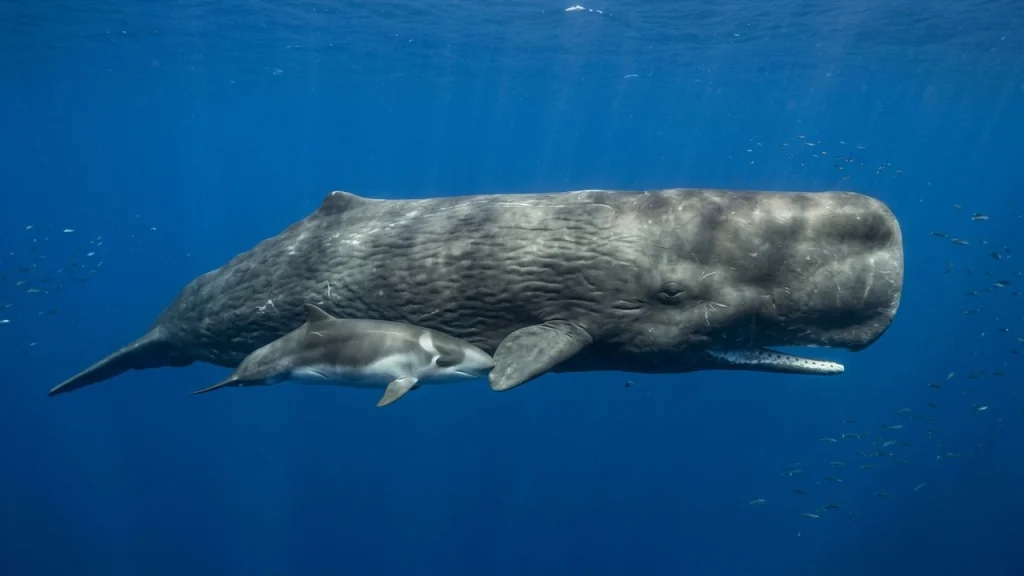
Sperm whales are not one animal but a small family. Three species in 2 genera make up the family, Physeter, the giant sperm whale, and Kogia, which holds the pygmy and dwarf sperm whales.
The smaller species inherit the name without earning it, because Kogia also carries spermaceti organs, just far too small to be of commercial interest. The pygmy sperm whale, by contrast, tops out at a length of 4 m and a weight of 320 kg.
Size shows the family gap best: females measure 40 feet and 52 feet goes to the males, while adults weigh 15 tons for a female and 45 tons for a male, with a lifespan of up to 60 years. As for range: every ocean’s deep water is fair game, though they keep clear of the polar ice and turn up most often in temperate and tropical latitudes.
What whalers took from a head full of oil
The oil made the animal worth chasing, and the chase nearly finished it. From 1800 to 1987 they were the chief quarry of the commercial whaling industry, a hunt that came close to wiping out every population.
Little of the animal itself was used: the meat is not generally eaten, the teeth get carved into the engraving art known as scrimshaw, and the real prize is scooped out of the skull. A gummy material called ambergris builds up in the gut, floats on the sea surface, and washes ashore once expelled. The whales were hunted for oil and ambergris alike, and one real animal whalers called Mocha Dick seems to lie behind Ahab’s nemesis in Moby Dick. International law now shields the species from any hunting at all.
Where the population stands now
The species is a long way from recovered. The sperm whale was last assessed in 2008 and remains Vulnerable. In the United States the Endangered Species Act lists it as endangered, and the Marine Mammal Protection Act lists it as depleted.
The numbers show the scale of the loss. A published population model puts today’s total at roughly 850,000 animals, against something like two million before whaling began in 1712. That is a fall of approximately 57% over 310 years. A moratorium on commercial whaling came in 1986, and NOAA reports the species is still recovering, with its numbers likely increasing.
So the name survives as a piece of maritime history. The animal is called a sperm whale because a valuable waxy oil once came out of its head, and because the people who first handled that oil believed, wrongly and for a long time, exactly what it was.
Sources
- Animal Diversity Web: Physeter catodon (sperm whale)
- Animal Diversity Web: Physeteridae (sperm whales)
- NOAA Fisheries: Sperm Whale
- National Geographic: Sperm Whale
- IUCN SSC Cetacean Specialist Group: Red List Updates Published for Sperm Whales and Lahille’s Bottlenose Dolphins
- Scientific Reports: Current global population size, post-whaling trend and historical trajectory of sperm whales