
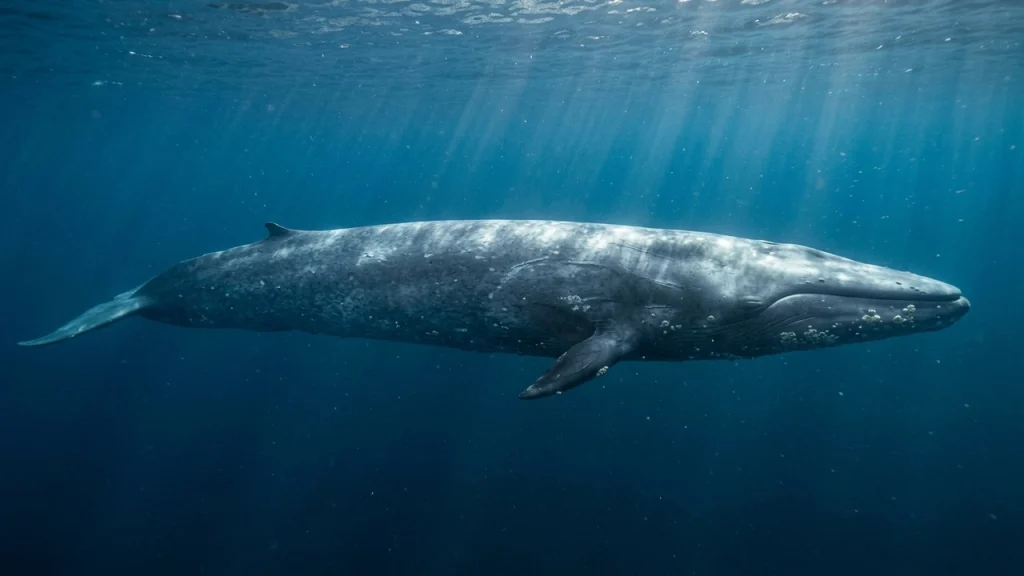
Blue whales live in every ocean except the Arctic, and they are the biggest animals known to have ever existed. Their range touches most of the world’s water, yet nothing about it is evenly spread. They bunch up in a limited set of highly productive places, and that pattern repeats in every basin.
What decides where they settle is food. Krill, tiny shrimp-like crustaceans, make up almost the whole menu, and blue whales show up precisely where those krill pile into dense clouds. That one link explains the odd geography of the species, from Antarctic ice edges to the dry coast of western Australia.
A range shaped by prey rather than by coastline
Blue whales keep to the open sea, and they are usually met on their own rather than in a group. Counting them is awkward too, because no two animals wear the same pattern. Those mottled gray-blue markings vary from whale to whale, and researchers have spent decades building catalogues of the individuals they can pick out.
Five subspecies are currently recognized, and each one holds a different ocean basin. That matters, because the movements of a group in one basin reveal almost nothing about its relatives elsewhere.
The five regions blue whales occupy
- North Pacific. Summer feeding along the United States West Coast, plus scattered use of Alaskan and central North Pacific water.
- North Atlantic. Everything from subtropical water up to the Greenland Sea, including sightings off eastern Canada and the continental shelf of the eastern United States.
- Southern Ocean. Far south of the Antarctic Convergence, pressed against the sea ice in high summer.
- Indian Ocean. A year-round group in the north, and smaller pygmy whales sitting north of the convergence, thickest around Australia, Madagascar and New Zealand.
- Southeast Pacific. An as yet unnamed form centered on the Chiloense Ecoregion off Chile, shifting toward the Galapagos and the eastern tropical Pacific.
Summer feeding grounds and winter nurseries
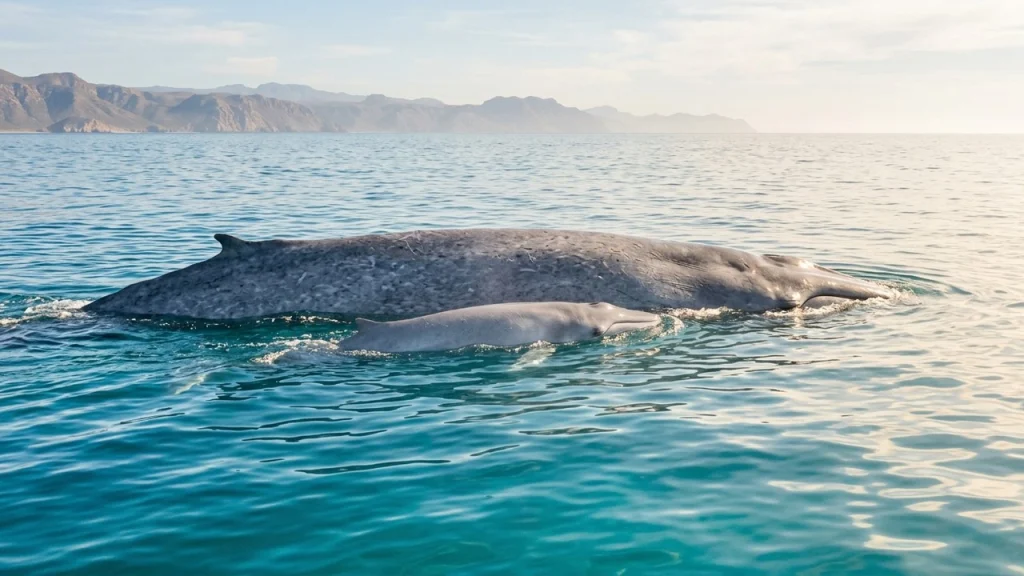
The North Pacific makes the pattern easy to see. Eastern North Pacific animals head south for the winter, spending those months off Mexico and Central America, then come back north to feed along the United States West Coast, dipping into the Gulf of Alaska and out into the central North Pacific on a smaller scale. In the Gulf of California, also called the Sea of Cortez, mothers and calves turn up regularly from December through March, and researchers treat those waters as a place where the species calves and nurses.
Antarctic animals are the biggest of the subspecies, and they behave like their prey. A survey that paired passive acoustic listening with echosounders found them packed into aggregations that carried from hundreds of kilometers away, and sitting generally near the ice edge. Even so, they stay scattered thinly across the Southern Ocean through the summer, which is exactly why they remain so hard to study.
Australia shows how local oceanography builds hotspots inside a huge range. Field studies there turned up two main feeding areas. One is the Perth Canyon off Western Australia, where sightings run from March to May; the other is the Bonney Upwelling off southern Australia, where whales appear between November and May and have been watched feeding at the surface on krill swarms. The Bonney Upwelling is the strongest center in the Great Southern Australian Coastal Upwelling System, one of the biggest of the world’s seasonal coastal upwelling systems, and tagged animals spent most of their hours above the continental shelf inside it. Searching there also turned up a thermal signal, with foraging behavior concentrated in water between 14 and 17 degrees Celsius.
How the range moves with the seasons
Most of the year is spent moving: they shift from summer feeding areas to winter breeding areas, though in some places certain individuals never migrate at all. That makes the phrase “home range” a moving target, with a population spread across half an ocean at one time of year and squeezed into a handful of coastal pockets at another.
The Australian tracks show the route. Tagged animals headed west and then north along the coast, reaching West Timor and Indonesia, where their paths pointed to breeding or foraging. Genetic work confirms the connection, placing the animals that use Perth Canyon, Geographe Bay and the Bonney Upwelling into a single breeding stock of the pygmy subspecies. Separate feeding grounds, one connected population.
The variety of local patterns is why blue whale distribution is mapped with tags and hydrophones rather than by eye. Northern Indian Ocean animals are a special case. Records come from the Gulf of Aden, the Arabian Sea, and from points across the Bay of Bengal, and their movements may be tied to the oceanographic changes associated with monsoons.
Population size and conservation status
The species is listed as endangered, and the cause is almost entirely human. Better equipment between 1860 and 1920 put whalers onto a population that had previously been out of their reach. Around 350,000 animals were killed during the 20th century, and by the 1960s the species stood on the edge of extinction. Protection followed the 1965/66 whaling season, and numbers are now rising globally.
Recovery is uneven, and the Antarctic group is the exception. Their count dropped to less than 1% of the pre-whaling abundance, estimated at 239,000, a population so small that recovery takes generations. That shortfall carries extra weight, because nearly every predator in those waters depends on Antarctic krill, which anchors the entire Southern Ocean food web.
Having so few natural predators, thanks to sheer size, has not protected them. Blue whales rank among the longest-lived animals, with a typical lifespan of roughly 80 to 90 years, and the oldest individual ever aged came in at around 110 years using the waxlike earplugs recovered from dead whales.
Threats that follow blue whales into their habitat
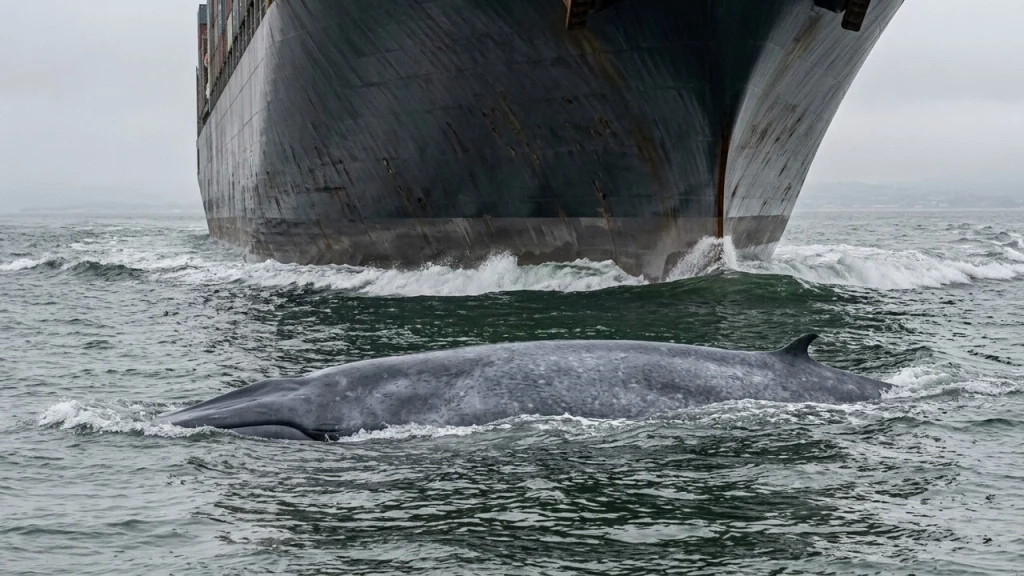
Nobody hunts blue whales today, but the waters where they feed and breed are heavily used by people. Because they move freely across international borders, both recovery and risk ignore national boundaries. The biggest dangers are collisions with ships and whales caught in fishing gear.
Entanglement is the trouble that follows an animal home. Once caught in nets, traps or pots, a whale can be forced to carry the gear for long distances, and the resulting fatigue, injury and reduced feeding ability lower its chances of surviving and reproducing. Collisions have killed blue whales throughout their range, yet danger rises sharply near coasts that see heavy shipping, including ports and busy shipping lanes, and it grows again with bigger boats and faster ones.
This is the uncomfortable overlap of blue whale biology. The richest feeding and calving grounds sit in coastal and shelf waters, the same places shipping lanes and fishing fleets occupy. NOAA’s WhaleWatch project answers that overlap by combining satellite tracking with habitat models to forecast, almost instantly, where the animals turn up along the United States West Coast.
Why a global species is so rarely seen
A whale spanning most of the world’s oceans is almost never encountered. Blue whales keep far offshore, their numbers are still a small fraction of what they once were, and they gather in only a few places at a time. An ocean full of blue whale habitat therefore holds a modest number of actual blue whale hotspots.
Sound partly solves the problem. A blue whale call can carry so that other whales pick it up from up to 1,000 miles off, which is why acoustic monitoring has mapped their distribution better than almost anything else. Scientists also build habitat models that merge satellite tracking with information on the environment, turning scattered sightings into maps that show where animals are likely to be, and therefore where they are most exposed to ships, nets and noise.
The real habitat is the krill field
Strip the story back and the answer to where blue whales live is straightforward: wherever enough krill can be gathered to feed animals of this size. The biggest animals may eat as much as 6 tons of krill a day, and no ocean supports that unless the prey is concentrated into a few dense, shallow swarms. Protecting the upwelling systems and the krill inside them is therefore central to blue whale conservation rather than a side benefit, because a growing krill fishery puts the species’ recovery at risk.
Sources
- NOAA Fisheries: Blue Whale | NOAA Fisheries
- NOAA Fisheries: Blue Whale: Science | NOAA Fisheries
- Animal Diversity Web, University of Michigan: Blue whale (Balaenoptera musculus) | Animal Diversity Web
- National Geographic: Blue whale, facts and photos | National Geographic
- Scientific Reports (Nature Publishing Group): The characteristics of krill swarms in relation to aggregating Antarctic blue whales
- Scientific Reports (Nature Publishing Group): Movements and behaviour of blue whales satellite tagged in an Australian upwelling system