
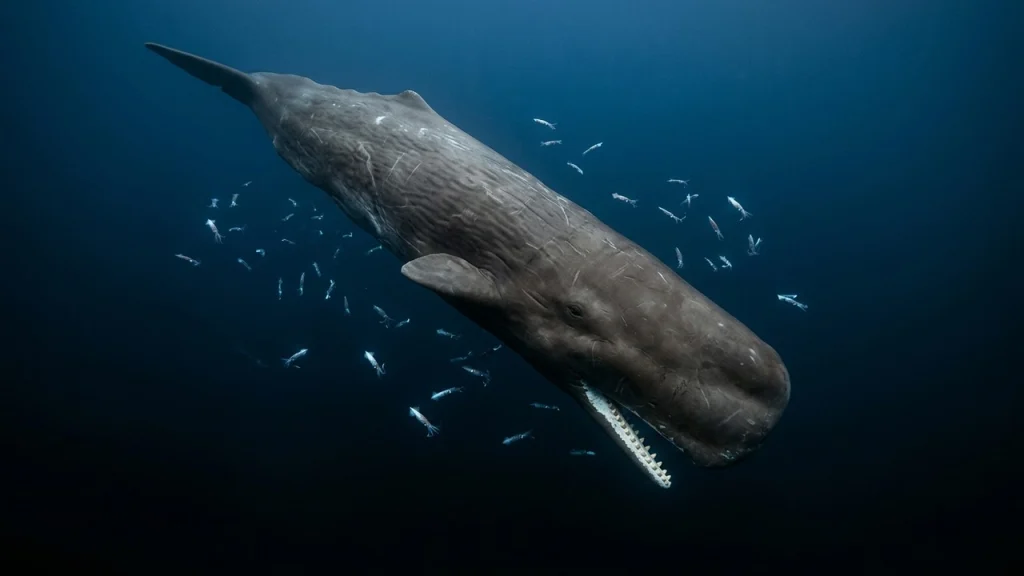
Sperm whales have no teeth-bearing rival in size, and their menu is dominated by one thing: squid. Alongside squid, NOAA lists sharks, skates and fish that live in deep ocean water. They live mostly in deep water themselves, so what they eat is built from the animals found there with them.
The short answer is a diet of mostly small to medium-sized squids, topped up with deep-sea fish and a few larger predators such as sharks and skates. Almost all of that feeding happens in water too dark for sunlight to reach, which is why the menu looks so strange from above the surface.
Why squid dominate the plate
Finding food is a deep-sea job. Typical hunting dives reach 2,000 feet and run about 45 minutes, after which the whale comes up to breathe and recover for several minutes before going back down.
A female that died in Singapore waters gave researchers a full menu to examine. Her stomach held remains of at least 28 prey species, and most of them were cephalopods. Squids made up over 97% of the total by number, and the researchers concluded that the animal was mainly a predator of small to medium-sized squids, while other invertebrates and fish formed a much smaller share.
Four mesopelagic species accounted for over 65% of everything she had eaten:
- Taonius pavo, the single most important prey item, at 31.4% of the total and about 1.11 kg per animal
- Histioteuthis pacifica, 19.1%
- Chiroteuthis imperator, 8.34%
- Ancistrocheirus lesueurii, 7.07%
Prey turned out to be modest in size. With no fresh tissue left to measure, scientists used squid beaks and conversion formulas to rebuild mantle lengths that ran from 11.5 to 63.9 cm. A whale of this size is living off a menu of small, abundant animals rather than a few large ones.
Following the glow in the dark
Sperm whales hunt in the mid-water dark zone, far below the reach of sunlight, and they use sound to find prey there. Most of the squid species in that sample were small to medium-sized, on the order of 1 to 6% of the whale’s length, and they carried bioluminescent organs.
One explanation is that the whales take much of their food by eye as much as by ear, moving through dense clouds of slow, glowing squid rather than chasing them. The same idea may account for a glowing colonial tunicate, Pyrosoma atlanticum, turning up in her stomach, since it occupies the same mid-water niche as the squid.
Fish, skates and sharks in the mix
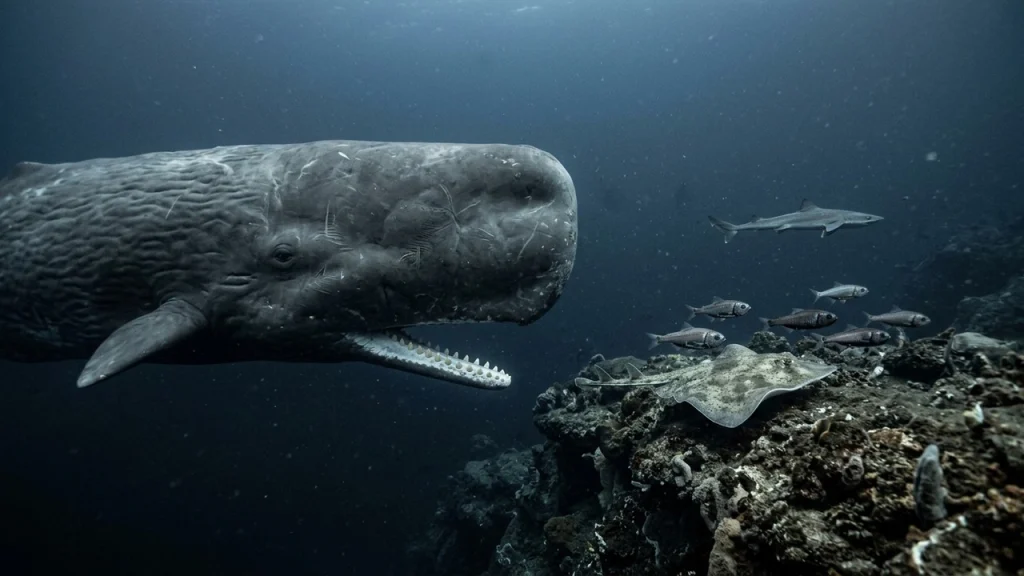
Which prey dominates shifts from place to place, and the rule behind it is simple: sperm whales go where the food is. Where they feed depends on their food source and on suitable breeding conditions, and it changes according to the sex and age of the animals in a group. Males make long migrations into temperate waters, while females and young stay in tropical waters year-round.
Even the fishing fleet supplies meals. Longline-caught fish also end up in their stomachs, a habit scientists call depredation. The whale grips the line with that long jaw and pulls until the hook or bait comes free.
How a sperm whale actually takes a squid
Sperm whales are toothed whales rather than baleen whales, so the catch is seized rather than filtered. Each side of the narrow lower jaw carries 20 to 26 large teeth, teeth in the upper jaw seldom push through the gums at all, and the mouth lining is often bright white.
The head is built around sound. Their heads account for about one-third of total body length, and sound does the finding, but the hunt itself is a pursuit. In the final buzz phase a whale shortens the gap between its clicks and cuts its output level by 1 to 2 orders of magnitude. Levels reaching the prey then stay far below what would be needed to stun them, which rules out the old idea that the clicks knock squid senseless. Tag recordings show that capture usually means chasing prey over tens of metres, not intercepting an animal already stunned into stillness.
Prey met in shallower water can force a long pursuit, producing a buzz that stretches on at above-average swimming speeds. Sudden jolts in acceleration at the end of a buzz point to suction feeding, the whale drawing prey in with a gulp rather than seizing it with the teeth.
How much a sperm whale eats
A whale can consume about 3 to 3.5 percent of its body weight per day. Females weigh 15 tons and males 45 tons, and length runs from 40 feet in females to 52 feet in males, so the biggest animals need the biggest meals. Lifespan is up to 60 years.
Reproduction stretches the demand further. A female produces a calf roughly every five to seven years, following a 14 to 16-month gestation, and calves begin taking solid food before their first birthday while continuing to nurse for several years.
What else turns up in the stomach
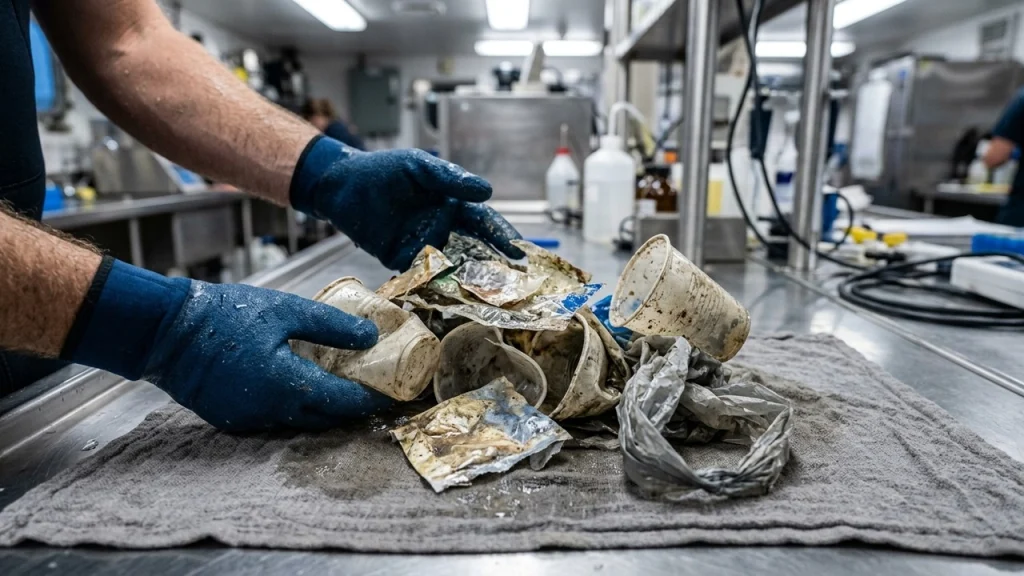
Not everything swallowed is food. The Singapore whale had plastic debris inside her, among it drinking cups, food wrappers and a plastic bag. Similar debris has been reported in sperm whales across the world’s oceans since the 1970s, and swallowing enough of it can kill an animal by blocking or rupturing the stomach.
A menu spread across every ocean
No other marine mammal is distributed as widely across the planet. NOAA records the species in all deep oceans worldwide, from the equator to the pack ice in both polar regions, and no other species is thought to have a wider feeding range. Currents and water temperature influence where whales feed and breed, so when the squid layer moves, the whales move with it.
A recovering population that must keep eating
A population model estimates about 850,000 sperm whales worldwide, against roughly two million before whaling began in 1712, a fall of approximately 57% in 310 years. Commercial whaling ran from 1800 to 1987 and took a devastating toll, nearly decimating every population.
On the IUCN Red List the species remains Vulnerable, a status confirmed in the 2025 re-assessment. United States law protects it under two federal statutes, the Endangered Species Act listing it as endangered and the Marine Mammal Protection Act designating it depleted. NOAA names the main threats as:
- Ocean noise
- Entanglement in fishing gear
- Vessel strikes
- Marine debris
- Oil spills and contaminants
- Changing environmental conditions
Entanglement touches the diet directly, because gear can drag behind a whale for long distances, leading to fatigue, compromised feeding ability and reduced reproductive success. Between dives the animals raft at the surface for up to about 10 minutes, which is exactly when they are most exposed to ship strikes.
A population recovering from whaling still has to find a deep-sea meal every day, and the mesopelagic zone where that meal lives is the whole basis of the hunt. Protecting that prey layer, and keeping whales free of gear and noise, is what allows a decimated species to feed itself back up.
Sources
- NOAA Fisheries: Sperm Whale: Science | NOAA Fisheries
- NOAA Fisheries: Sperm Whale | NOAA Fisheries
- PeerJ (via PubMed Central): Diet and mitochondrial DNA haplotype of a sperm whale (Physeter macrocephalus) found dead off Jurong Island, Singapore
- Scientific Reports (via PubMed Central): Sperm whale predator-prey interactions involve chasing and buzzing, but no acoustic stunning
- Scientific Reports: Current global population size, post-whaling trend and historical trajectory of sperm whales
- IUCN SSC Cetacean Specialist Group: Red List Updates Published for Sperm Whales and Lahille’s Bottlenose Dolphins