
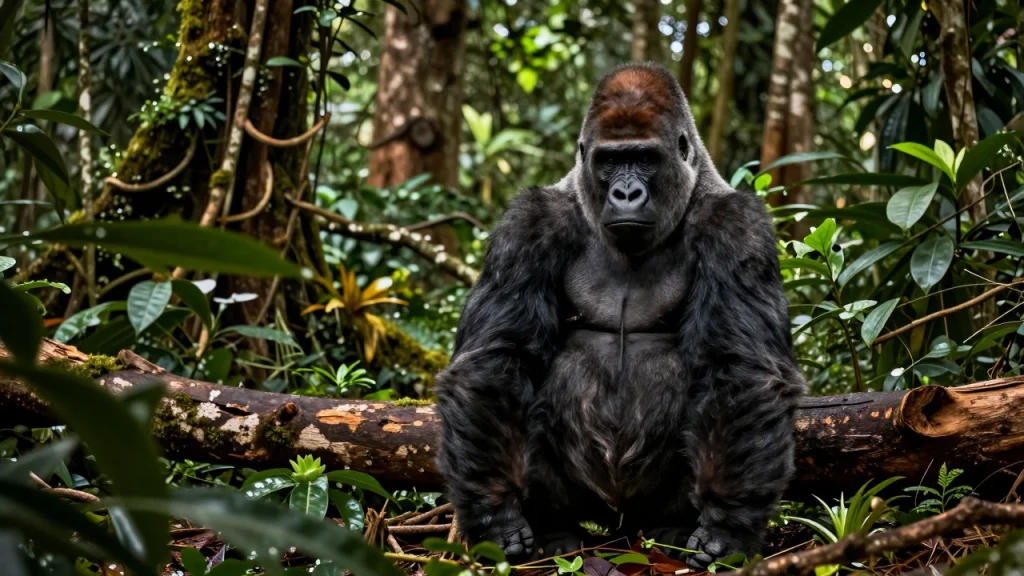
Gorillas live across the equatorial belt of Africa, where wild populations inhabit diverse tropical forest ecosystems. Modern biological taxonomy classifies all gorillas into two separate living species: the western gorilla (Gorilla gorilla) and the eastern gorilla (Gorilla beringei). Each species occupies a distinct geographic territory separated by extensive river systems and differing elevations.
The largest concentration of wild apes resides in central and western Africa throughout the expansive Congo Basin. In this region, western lowland gorillas maintain a widespread, virtually unbroken presence throughout the Congo Basin, occupying Angola, Cameroon, Equatorial Guinea, Gabon, Congo, and the Central Africa Republic. Further east along the Albertine Rift, mountain gorillas, representing the eastern species Gorilla beringei, reside on the Virunga volcanoes where the borders of Rwanda, Uganda, and the Democratic Republic of Congo meet. These contrasting habitats range from sea-level swamp forests to freezing volcanic ridges.
Geographic ranges of western gorillas in the Congo Basin
Western lowland gorillas occupy the vast lowland wilderness of western equatorial Africa. Although historical documentation placed western lowland gorillas in the Democratic Republic of Congo, specialists now consider them likely extinct there. Today, their primary strongholds extend through the dense evergreen and semi-evergreen canopies of west-central countries.
Population densities vary significantly across this geographic footprint. Field surveys indicate that western lowland gorillas reach peak population numbers across northern Congo as well as southern Cameroon. These remote river basins offer vast expanses of contiguous tree cover and lower levels of human disruption, making them vital sanctuaries for regional biodiversity.
To the northwest, an isolated population of western apes inhabits the rugged hill forests straddling the border of Nigeria and Cameroon. Intense poaching alongside rapid forest conversion has severely depleted Cross River gorillas, leaving their surviving numbers small and fragmented.
Lowland forest habitats and daily movements
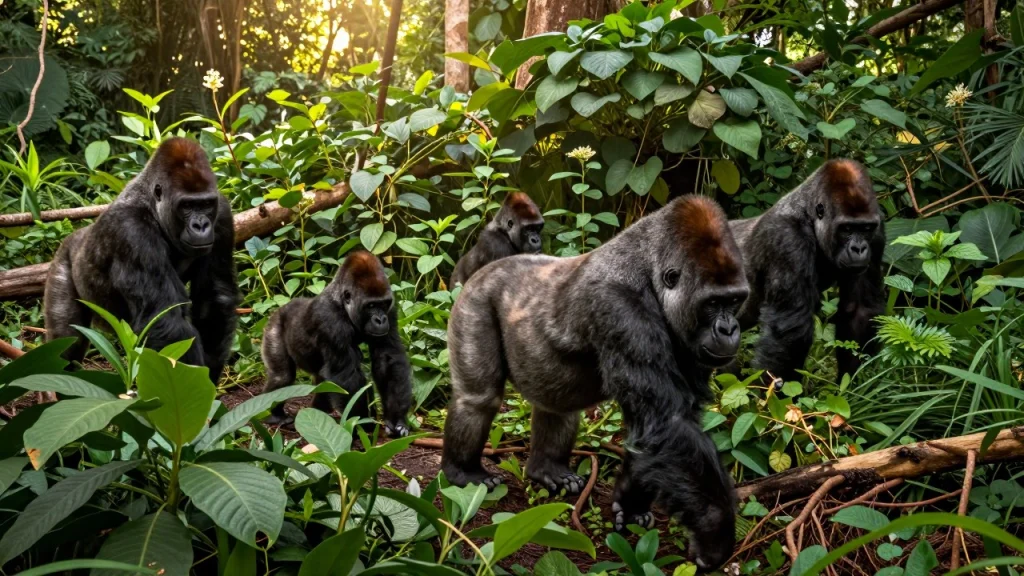
Within their equatorial range, western lowland gorillas display strong preferences for particular forest structures. Tropical secondary forests where open canopy allows sunlight to penetrate to the understory provide the finest habitat for western gorillas. The increased illumination reaching the forest floor stimulates lush carpets of tender terrestrial herbs, herbaceous vines, and succulent shrubs that supply the apes with abundant nourishment.
A family troop organizes its daily life within a defined home range:
- Territories occupied by western lowland gorillas span from 9 to 14 square miles (equivalent to 14.5 up to 22.5 square kilometers), while separate bands rarely overlap.
- Each day, the average distance traveled typically remains below 1 mile (or 1.6 kilometers), though journeys stretch longer when fruit is abundant.
- These journeys grow longer during fruit season.
Due to their heavy body mass, these apes remain on the ground for most of their daily time. However, their physical anatomy remains remarkably agile. Anatomically, opposable big toes function like thumbs, enabling apes to grasp stems and climb trees. When canopy fruits ripen, western gorillas ascend into trees reaching up to 15 meters in height while seeking nutritious food.
Feeding ecology dictates both movement patterns and landscape impact. Wild gorillas forage as strict herbivores, consuming predominantly juicy stemmed plants. In addition to herbaceous stems, these forest primates regularly eat leaves, berries, ferns and fibrous bark. When browsing leafy shrubs, troops avoid stripping all vegetation completely from a single area. Consequently, because consumed foliage regenerates rapidly, troops can remain inside a reasonably confined territory across extended stretches of time.
Montane cloud forests and volcanic slopes of eastern gorillas
Eastern gorillas dwell far inland within the elevated landscapes of east-central Africa. Mountain gorillas reside across mist-shrouded montane cloud forests throughout the steep Virunga range.
Elevation plays a defining role in shaping the daily routine and habitat limits of eastern mountain gorillas:
- Most of their time is spent within the montane cloud forest itself.
- Troops occasionally make brief ascents into afro-alpine meadows (4,000 m) where subfreezing nighttime conditions prevail and little edible vegetation grows.
- Their documented vertical limit reaches a high range elevation of 4000 m (13123.36 ft high) across the mountains.
Because high mountain elevations inhibit the growth of abundant fruit trees, mountain gorillas exhibit specialized dietary adaptations. Although mountain gorillas occasionally ingest small invertebrates, they are primarily folivorous. Their mountain diet centers on roots, leaves, and green stems, alongside the inner pith of bamboo, vines, and shrubs. Bamboo shoots in particular offer seasonal nutrition when new culms sprout along lower montane borders.
Troop structure and ecological roles in African forests
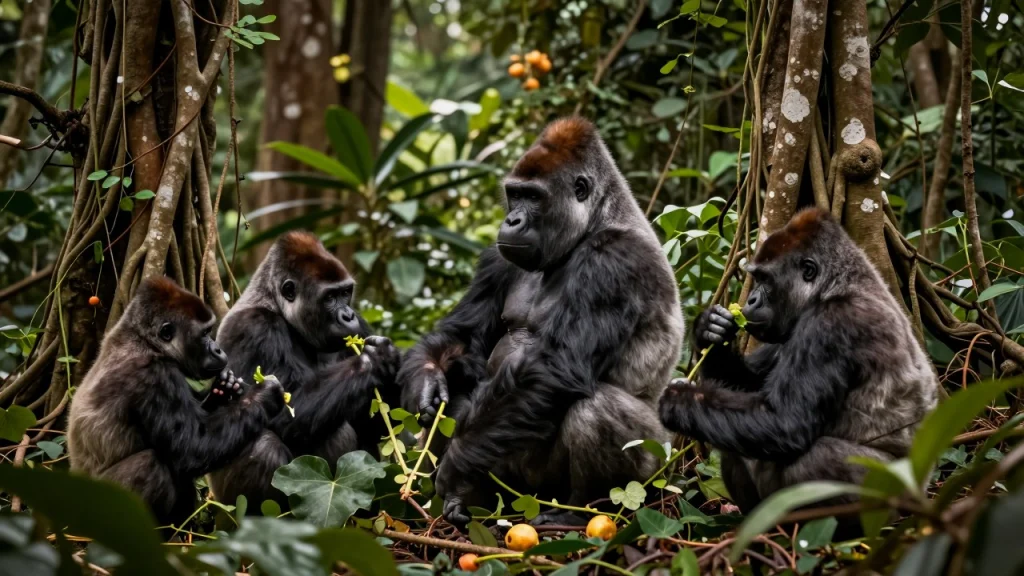
Gorillas are intensely social animals that move through the forest within well-structured social groups. A cohesive social band living together is formally termed a troop. A typical group contains 5 to 30 gorillas, commanded by an older, powerful male recognized as a silverback. The silverback directs daily travel, selects nesting sites, mediates disputes among group members, and defends the unit against outside danger.
Troops live without strictly defended borders, yet severe intergroup conflicts can erupt during accidental meetings or when an outside bachelor male approaches. When two family groups cross paths, especially if a lone male approaches, these encounters can turn into severe intergroup conflict.
Much like other apes, gorillas require tropical rainforests to make a living, while the forest ecosystem depends equally upon them. A fully grown male eats up to 40 pounds of food, or 18 kilograms, each day. This gargantuan consumption of botanical biomass makes gorillas key ecological architects of the African jungle.
As they travel across extensive territories, gorillas process enormous quantities of seeds and fibrous foliage. Heavy fibrous droppings serve as organic manure across the forest, allowing seeds to germinate quickly and making gorillas important forest regenerators. By dispersing seeds across vast distances and fertilizing the forest floor, these animals ensure the continuing regeneration of tropical hardwoods. When undisturbed in the wild, gorillas typically live for 30 or 40 years.
Habitat loss, population trends, and conservation pressures
Wild gorillas have no natural predators in the forest, yet human interference creates urgent existential risks. Poachers kill gorillas for food called bushmeat, while encroaching timber extraction and mining operations steadily destroy gorilla habitat. Furthermore, coltan deposits occur in central Africa, where expanding mining camps trigger severe deforestation and heavy hunting pressure on gorillas.
A comprehensive rangewide census estimated that wild gorillas numbered 361,919 weaned individuals across Western Equatorial Africa in 2013. Despite this population size, populations face severe downward trajectories across their entire geographic range:
- Regional ape populations experienced a decline of 19.4% between 2005 and 2013, suffering an estimated annual loss of ca. 2.7%.
- Although more than 360,000 gorillas inhabit Western Equatorial Africa, approximately 80 percent of the population lives outside protected habitat.
- In stark contrast, the other three gorilla subspecies combined number fewer than 5000 individuals, inhabiting far smaller geographic ranges.
Because four out of every five western gorillas dwell in unprotected concessions and community forests, they remain exceptionally vulnerable to road construction, industrial expansion, and commercial logging.
Sources
- Smithsonian’s National Zoo and Conservation Biology Institute: Western lowland gorilla
- San Diego Zoo Wildlife Alliance: Gorilla
- Animal Diversity Web: Gorilla gorilla (western gorilla)
- Animal Diversity Web: Gorilla beringei (eastern gorilla)
- Science Advances: Guns, germs, and trees determine density and distribution of gorillas and chimpanzees in Western Equatorial Africa