
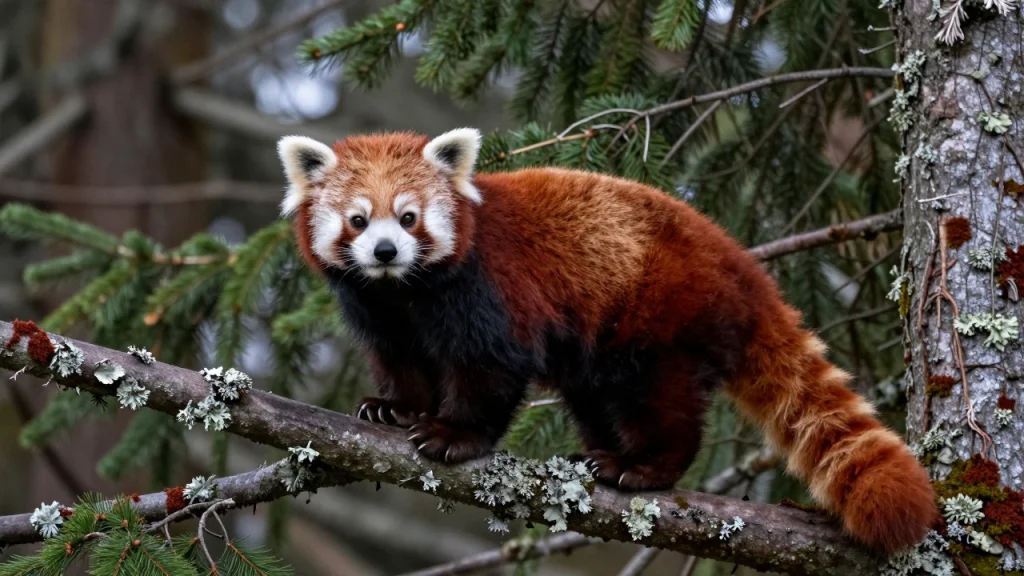
A casual glance at a red panda reveals a mammal with a remarkably vibrant exterior, blending cat-like agility with distinctive woodland camouflage. Thick rust-red fur carpets its upper body, contrasted sharply against dark undersides and a round, expressive face marked with bright white accents. A massive, ringed plume trails behind, adding striking visual balance to its compact silhouette. In mountain tree canopies, these chromatic patterns allow the animal to vanish into its mossy surroundings with deceptive ease.
From nose to tail, the red panda displays an adaptable build designed specifically for high-altitude tree life. In head-and-body length, specimens span approximately 560 to 625 mm, backed by furry tails measuring 370 to 472 mm. Without factoring in its plume, the torso extends 20 to 25 inches, which corresponds to 51 to 64 centimeters in length. Females maintain an adult weight of 6 to 10 pounds, translating to 3 to 4.5 kilograms, while males typically carry 10 to 14 pounds, equaling 4.5 to 6.2 kilograms. Specialized wrist structures, sharp curved claws, and flexible joints complete a silhouette uniquely suited for climbing dense foliage.
Facial features and head architecture
The facial anatomy of the red panda balances visual warmth with specialized arboreal functionality. The skull displays a circular outline with an abbreviated rostrum alongside tall, upright ears. These animals display prominent rounded skulls, brief muzzles, and tall pointed ears.
White fur covers large portions of the muzzle, cheeks, and ear margins, creating high visual contrast against the surrounding red coat. Pale facial hair contrasts with reddish-brown tear streaks that descend from each eye toward the corners of the mouth. Researchers suggest these dark ocular stripes may shield their eyes from intense highland sunlight.
Beneath this expressive visage sits a surprisingly powerful masticatory system. Compared to other carnivorans of similar physical dimensions, they possess exceptionally heavy, robust teeth. To manipulate and chew bamboo culms, these unusual carnivores rely on formidable teeth together with an opposable pseudo thumb.
Pelage colors and camouflage mechanics
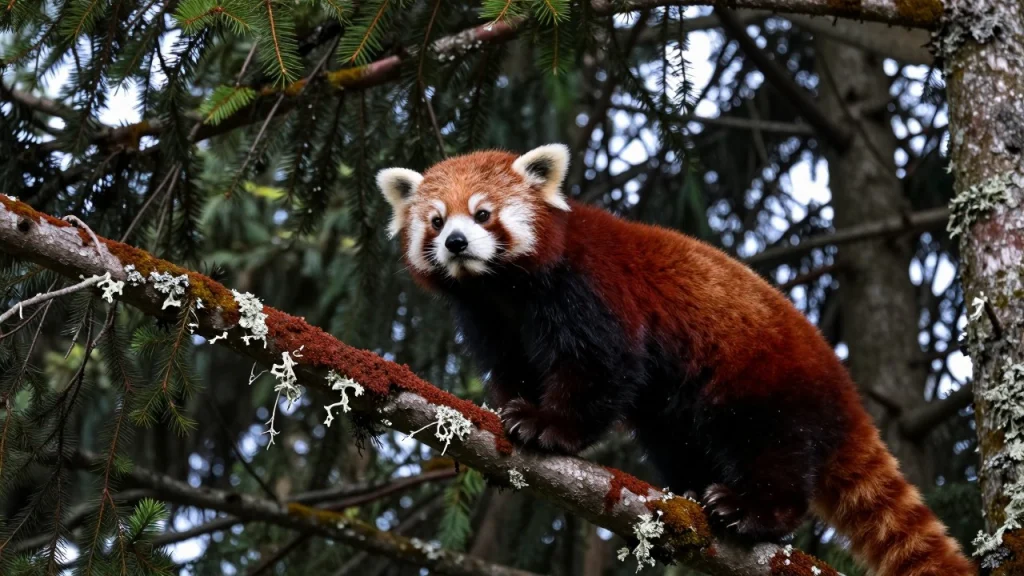
The red panda’s thick coat functions simultaneously as protective weatherproofing and intricate visual disguise. Rich reddish-brown fur blankets the upper body, whereas the underside is covered in lustrous, glossy black hair. Dark black legs terminate in paws whose bottom surfaces are cushioned by dense, white hair. This striking distribution of pigments creates countershading.
- Dorsal camouflage: Their distinctive reddish pelage provides natural camouflage among high fir branches draped in reddish-brown moss and pale lichens.
- Ventral shading: The underside is black, in contrast to the reddish-brown fur on the back.
- Facial disguise: White fur marks much of the face, standing out against the reddish-brown coat.
Living at freezing elevations demands rigorous thermal defense. A thick undercoat of plush wool sits beneath an exterior layer of long, coarse guard hairs. Males and females share the same coloration and body size without noticeable sexual dimorphism.
The ringed tail and its multifaceted roles
Perhaps the most recognizable hallmark of the red panda is its expansive, heavily furred plume. Roughly 12 alternating rings of red and buff encircle the tail, which cannot grasp branches because it is not prehensile. These warm, muted bands repeat rhythmically along the entire appendage. A remarkably large proportion of the animal, nearly half of its overall body length, consists of the plush tail.
This substantial structure fulfills critical physical functions rather than serving merely decorative ends:
- Dynamic counterbalance: Their bushy tails provide vital balance during tree travel and serve as insulating wraps against severe cold and wind.
- Thermal barrier: The bushy tail also helps keep the animal warm during freezing nights.
- Visual signaling: Alternating red and buff rings mark the tail along its length.
Because the tail remains muscular yet non-gripping, the red panda uses it primarily like a gymnast’s balance pole while traversing slick, moss-covered branches high above the forest floor.
Limb anatomy, paw insulation and climbing adaptations
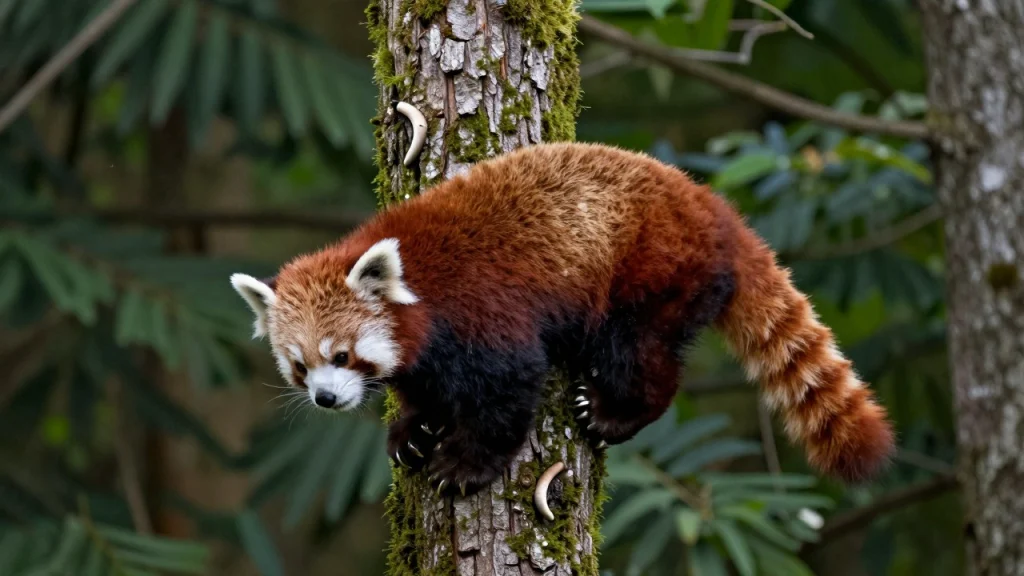
Navigating high canopy branches requires specialized musculoskeletal modifications in both forepaws and hind limbs. Thick fur envelops each foot, which features five well-separated digits ending in curved, semi-retractable claws.
Tree descents showcase an even rarer anatomical marvel. Their ankle joints possess exceptional mobility because the fibula rotates around its axis where it connects with the tibia. This unique skeletal mobility allows them to scramble headfirst down vertical tree trunks with confidence.
Ground movement reveals another distinctive structural consequence of their climbing specialization:
- Inward forelimb alignment: Because their front forelimbs tilt inward, they display an endearing, rolling waddle across level ground.
- Flat footfall: They walk with a plantigrade stance, placing their soles flat upon the surface.
- Grasping ability: An enlarged radial sesamoid bone provides manual dexterity comparable to an opposable digit.
These anatomical traits emphasize that while the red panda moves cautiously along the ground, its limbs operate with peerless mastery within complex three-dimensional canopies.
Physical variations between the two recognized species
Taxonomic assessments demonstrate clear physical differences between regional populations across the Asian highlands. Modern zoological consensus increasingly divides these animals into two recognized species. These distinct species occupy separate geographic ranges and present observable variations in body mass and pelage saturation.
- Himalayan red panda: Himalayan red pandas, classified as ailurus fulgens, inhabit a western range across India, Nepal, and Myanmar, displaying smaller bodies with lighter fur.
- Chinese red panda: Chinese red pandas, known as ailurus styani, occupy an eastern range in China, possessing larger frames and noticeably darker fur.
Taxonomic identity and historical discovery
The physical appearance of the red panda baffled European naturalists for decades, prompting prolonged classification disputes. In 1825, French zoologist Frédéric Cuvier introduced the western subspecies, Ailurus fulgens fulgens, decades before the giant panda gained scientific recognition. Cuvier regarded the creature as extraordinarily beautiful, selecting the generic name Ailurus from the Greek term for cat, paired with fulgens to mean fire-colored or shining.
Decades later, field researchers uncovered further anatomical diversity across eastern populations. Explorer F. W. Styan documented a second form of the animal in 1897, designated as Ailurus fulgens styani. Long before Western taxonomy cataloged these creatures, local communities recognized their incandescent visual profile. In China, traditional folklore refers to the creature as “hun-ho,” which translates to fire fox.
They survive today as the sole living representatives of the family Ailuridae after extensive taxonomic debate. Sadly, these unique forest inhabitants face severe ecological pressures throughout their native habitats. Because numbers dropped by about 50% across the last 20 years, they hold an endangered species status.
Sources
- Smithsonian’s National Zoo and Conservation Biology Institute: Red panda | Smithsonian’s National Zoo and Conservation Biology Institute
- Animal Diversity Web: Ailurus fulgens (red panda) | INFORMATION | Animal Diversity Web
- San Diego Zoo Wildlife Alliance: Red Panda | San Diego Zoo Animals & Plants
- Oregon Zoo: Red panda | Oregon Zoo