
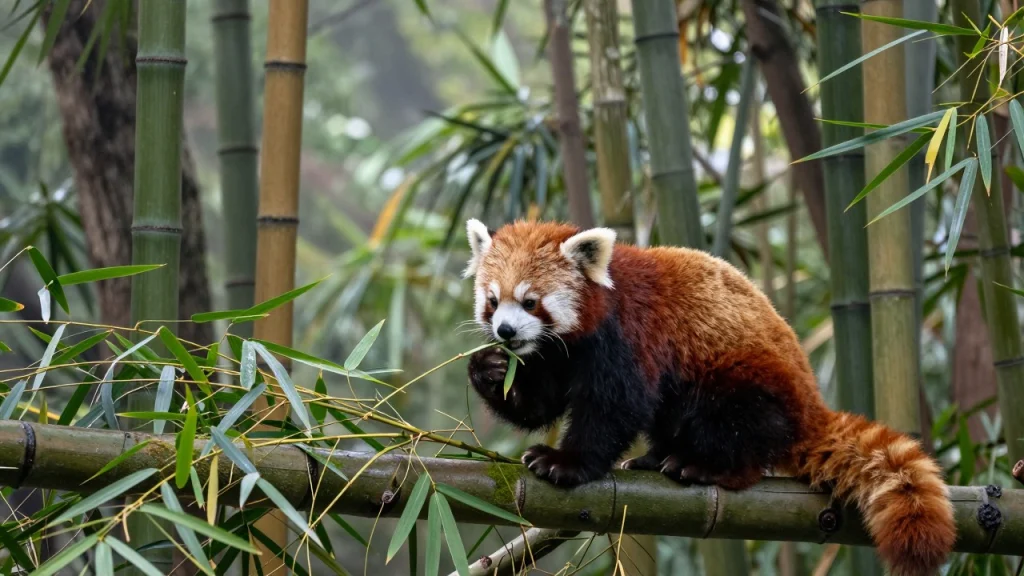
The red panda lives primarily as a herbivorous mammal despite belonging phylogenetically to the mammalian order Carnivora. Bamboo foliage makes up approximately 95% of the red panda’s total wild nourishment. Unlike giant pandas that consume nearly all aerial plant structures including woody culms, red pandas forage selectively for nutritious leaf tips alongside tender spring shoots. These arboreal mammals retain a simple carnivore stomach even though their sustenance consists predominantly of leaves.
To sustain basic energy needs, an individual consumes 20 to 30 percent of its body mass daily, taking in about 2 to 4 pounds, roughly 1 to 2 kilograms, composed of tender shoots and green foliage. Their digestive efficiency remains remarkably low because red pandas process only about 24 percent of ingested bamboo. Field observations documented that female red pandas consumed approximately 20,000 bamboo leaves during one single day.
Seasonal shifts and opportunistic foods
While bamboo foliage supplies reliable year-round bulk, wild animals adjust their foraging routines as the seasons rotate. Seasonal changes alter their feeding choices, as bamboo stalks are consumed during spring while ripe fruit provides summer refreshment.
Forest foraging also incorporates other plant tissues across the canopy and forest floor. Wild red pandas feed primarily on bamboo leaves, acorns, tender shoots, and flowers. Their broader omnivorous intake includes wild berries, floral blossoms, and the delicate leaves of non-bamboo plants.
Small animal prey and nutrient-dense forage provide occasional protein supplements throughout the active months. Red pandas gather food through tree crowns and underbrush:
- Foragers search for subterranean roots, succulent grasses, seasonal fruits, insects, and grubs, occasionally killing small mammals along forest branches.
- Opportunistic predatory foraging yields bird eggs, small rodents, and occasional small birds.
Bamboo species and feeding selectivity
Temperate mountain forests feature rich vegetative understories, yet red pandas exhibit strict feeding preferences. Although a home territory may contain up to 40 kinds of bamboo, the resident chooses only one or two top nutritional varieties.
Geographic surveys across Chinese mountain ranges illustrate this species-specific focus. Wild bamboo-eating pandas consume over 40 bamboo species across native ranges, utilizing Bashania spanostachya and Yushania lineolata in the Xiaoxiangling Mountains alongside Chimonobambusa szechuanensis within the Daxiangling Mountains.
Their delicate consumption style mirrors this intense discrimination. Unlike giant pandas ripping through large culm sections in single bites, red pandas carefully harvest and nibble one chosen leaf at a time.
Anatomical adaptations for harvesting

Feeding among flexible mountain bamboo stalks demands precise physical coordination. To grip smooth stalks securely, red pandas utilize a specialized pseudo-thumb derived from an enlarged radial wrist bone. This false digit acts as an opposable thumb, helping forepaws clasp slender stems firmly during leaf harvesting.
Evolutionary genetics clarifies the biological origins of this unique hand structure. Genomic researchers discovered that limb development genes DYNC2H1 and PCNT experienced adaptive convergence, serving as key candidate drivers for pseudo-thumb morphology. This skeletal adaptation independently appeared in both red pandas and giant pandas to solve identical foraging challenges.
The physical choreography of eating follows a regular motor pattern:
- When reaching higher foliage, the animal bends resilient bamboo stalks downward so leaves sit conveniently near its mouth.
- The animal grasps plant cuttings with a forepaw to feed while sitting, standing upright, or resting on its back.
- It directs harvested foliage into the side of the mouth, slicing the vegetation before extensive chewing precedes swallowing.
Oral structures reflect this demanding mechanical lifestyle. When compared against similar-sized members of the order Carnivora, red pandas display exceptionally robust dentition. Broad flattened teeth and powerful chewing muscles provide the mechanical force needed to grind fibrous bamboo into fine mash.
Metabolic downregulation and genetic evolution
Subsisting on low-calorie foliage imposes harsh metabolic challenges on a carnivore physiology. Living as obligate bamboo consumers forces these animals to operate within a strict energy budget across most months.
Thermal extremes provoke specialized physiological mechanisms to conserve scarce energy. During severe winter conditions, red pandas enter temporary dormancy, dropping their metabolic rate and elevating it periodically when waking up to search for food. This physiological slowdown enables individuals to expend nearly as little daily energy as tree sloths, an essential survival tactic given the nutrient-poor nature of bamboo foliage.
Genomic adaptations parallel these physiological responses to folivory. Evolutionary sequencing shows pseudogenization of TAS1R1, the gene encoding the umami taste receptor, in both red and giant pandas. Furthermore, genetic adaptation also drove evolutionary convergence in pathways responsible for extracting vitamins, fatty acids, and essential amino acids from fibrous bamboo.
Microbial breakdown of plant toxins

Beyond mechanical toughness, mountain bamboo presents formidable chemical defenses. Biochemical tests identified substantial concentrations of cyanogenic glycosides like linamarin and lotaustralin, alongside total cyanide compounds, inside Xiaoxiangling Mountain bamboo leaves and stems from Bashania spanostachya and Yushania lineolata.
The animal relies on specialized intestinal microorganisms to neutralize these toxic secondary metabolites. Intestinal assays revealed that wild red panda and giant panda digestive microbiomes harbor elevated proportions of Pseudomonas bacteria, a microbial genus rarely detected in other Carnivora species. These bacterial symbionts express enzymes that degrade cyanide compounds, converting lethal chemical defenses into harmless byproducts.
Developmental transitions and captive feeding
Feeding habits develop in parallel with seasonal changes in maternal habitat. Reproductive timing matches forest phenology, as birthing in late spring coincides with newly sprouted bamboo shoots and tender, easily digestible leaves.
Young cubs transition gradually from mother’s milk to fibrous solid food. Developing young begin testing their teeth on bamboo twigs carried to the den by their mother, though cubs only consume solid food consistently once reaching four months of age.
In accredited zoological facilities, professional nutritionists replicate wild nutritional balance with carefully tested diets:
- Animals housed at the Smithsonian’s National Zoo receive fresh bamboo stalks, seasonal shoots, and specialized manufactured leafeater biscuits.
- Daily menus for red pandas at the San Diego Zoo feature fresh bamboo, leaf eater biscuits, commercial dry dog food, yams, apples, and sweet grapes.
- Care specialists also provide enrichment treats such as bananas and blueberries alongside seasonal produce.
Habitat protection for food resources
Maintaining stable bamboo forests is essential for the long-term survival of wild populations. In fragmented ranges, grazing livestock herds deplete accessible bamboo foliage and degrade delicate forest understories, threatening wild feeding territories.
Sources
- Smithsonian’s National Zoo: Red panda
- San Diego Zoo Wildlife Alliance: Red Panda
- Animal Diversity Web: Ailurus fulgens (red panda)
- Proceedings of the National Academy of Sciences: Comparative genomics reveals convergent evolution between the bamboo-eating giant and red pandas
- mSphere: Potential Mechanism of Detoxification of Cyanide Compounds by Gut Microbiomes of Bamboo-Eating Pandas