
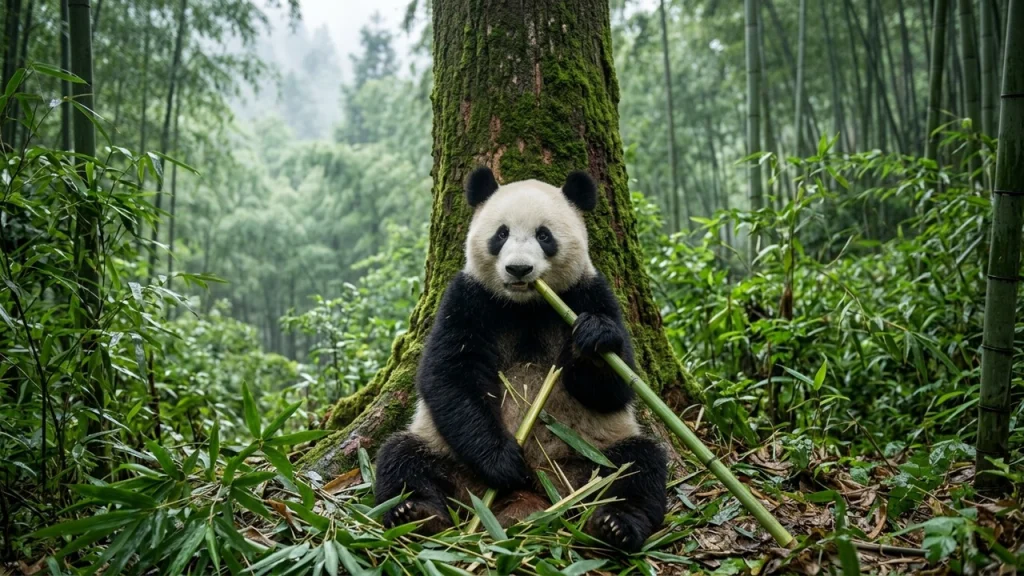
The Smithsonian’s National Zoo estimates that giant pandas live about 15 to 20 years in the wild and about 30 years in human care. The Zoo adds that scientists do not know exactly how long wild giant pandas live, only that wild lifespans are shorter than those in zoos.
Other sources give different numbers. Animal Diversity Web lists a typical wild lifespan of 10 to 15 years, while National Geographic lists an average of 20 years in the wild. For captivity, Animal Diversity Web gives a normal maximum life expectancy of 26 years, sometimes as much as 30.
What the wild estimates say
Animal Diversity Web states that lifespan in the wild is not known. National Geographic notes that much of what is known about giant pandas comes from studying zoo animals, because wild ones are so rare and elusive.
Two peer-reviewed studies give further wild figures. A study on recognizing giant panda age from facial images, published in Ecology and Evolution, states a life expectancy of 20 years in the wild. A study of gut microbiota in super-geriatric captive giant pandas, published in Animals, says wild giant pandas typically live approximately 18 to 20 years.
How long giant pandas live in human care
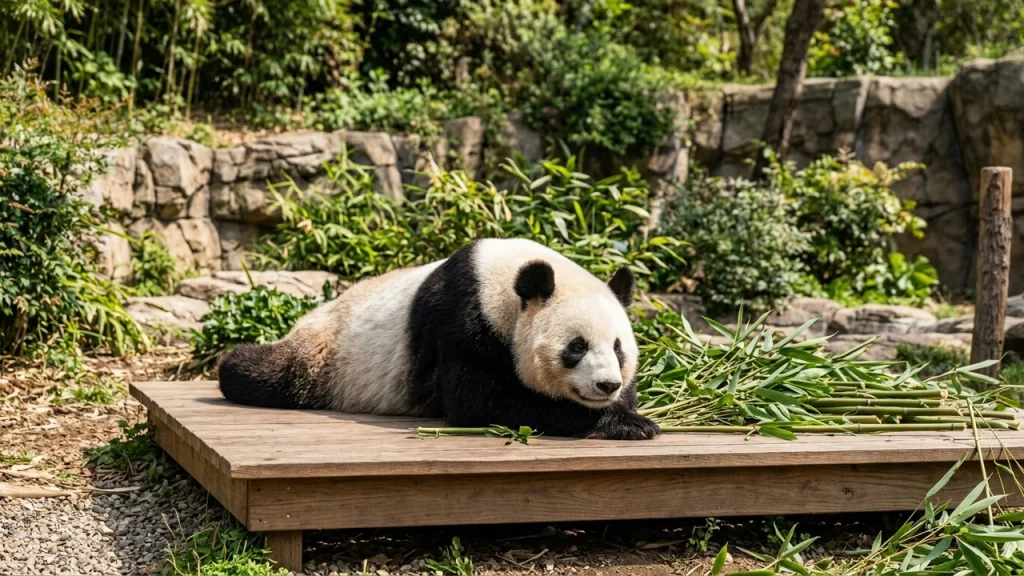
The Animals study says captive giant pandas may live up to 25 to 30 years. The Zoo’s giant panda Hsing-Hsing died at age 28 in 1999.
A few individuals have lived longer. Chinese scientists have reported zoo giant pandas as old as 35, according to the Zoo. Animal Diversity Web notes that one giant panda lived to about 34 years in captivity but calls that uncommon, and the Ecology and Evolution study mentions an oldest captive giant panda that reached 38. Those are outliers, not the typical lifespan.
The Animals study included super-geriatric captive giant pandas aged 28 to 32 and treats individuals over 20 as geriatric. Super-geriatric giant pandas often sleep more and eat less, and they are prone to problems with vision, teeth and joints, and with vital organs like the heart, liver and kidneys.
Growing up and breeding
The age-recognition study in Ecology and Evolution grouped giant pandas into juveniles (under 1.5 years), subadults (1.5 to 5.5 years), adults (5.5 to 20 years) and old giant pandas (20 to 27 years). The Smithsonian’s National Zoo dates breeding maturity to between 4 and 7 years of age, and says giant pandas may be reproductive into their 20s. Animal Diversity Web gives 5.5 to 6 years for female reproductive maturity.
A cub does not open its eyes until 6 to 8 weeks of age and cannot move around until it is 3 months old. Nursing may last eight to nine months, nutritional weaning comes at 1 year old, and social weaning can take up to two years. A cub may stay with its mother for up to three years before going off on its own.
Reproduction is slow. Female giant pandas ovulate only once a year, in the spring, and can conceive only during the two to three days around ovulation. A female may bear two young, but usually only one survives.
The Smithsonian’s National Zoo says a wild female can, at best, produce young only every other year, and that over a lifetime a giant panda may raise only five to eight cubs successfully. San Diego Zoo Wildlife Alliance says a mature female usually breeds only once every two or three years, and that in the native habitat a typical female may bear about five litters over her lifetime and raises her cubs alone.
Diet, habitat and threats
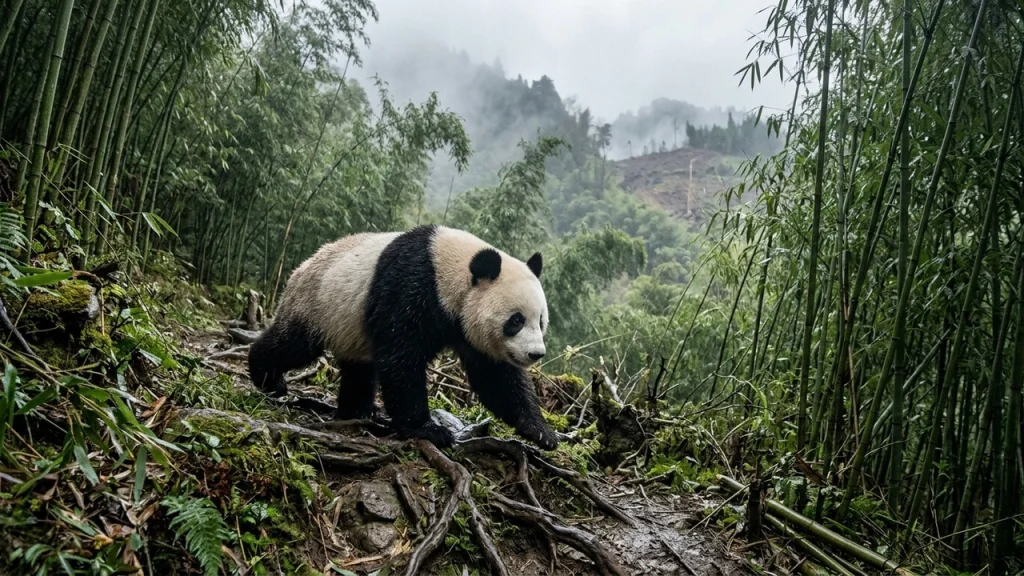
About 99% of a giant panda’s diet is bamboo, according to San Diego Zoo Wildlife Alliance. The Smithsonian’s National Zoo says a giant panda’s digestive system resembles a carnivore’s more than an herbivore’s, and much of what it eats is passed as waste. A giant panda must forage and eat for 10 to 16 hours a day.
Giant pandas can eat 25 types of bamboo, yet they typically rely on just the 4 or 5 varieties growing within their home range. San Diego Zoo Wildlife Alliance adds that every plant of one type in an area blooms and dies at the same time.
Giant pandas do not hibernate, unlike many other bears, and Animal Diversity Web says they descend to lower elevations during winter. National Geographic says giant pandas may climb as high as 13,000 feet in summer to feed on higher slopes.
Habitat destruction is the biggest threat to giant panda survival, the Smithsonian’s National Zoo says. Fieldwork shows the habitat is heavily fragmented, which the Zoo says makes it difficult for giant pandas to find a mate.
Conservation status and numbers
Until 2016, giant pandas were listed as Endangered on the IUCN Red List of Threatened Species. They are now listed as Vulnerable, which San Diego Zoo Wildlife Alliance credits to dedicated conservation efforts that have helped increase their population. Protection efforts for giant pandas in China began in 1957.
San Diego Zoo Wildlife Alliance counts only about 1,800 giant pandas still living in native habitats. The Smithsonian’s National Zoo gives a figure of as few as 1,864 in their native habitat, plus another 600 in zoos and breeding centers around the world. The Zoo adds that the species’ naturally slow breeding rate keeps a population from recovering quickly after illegal hunting, habitat loss and other human-caused deaths.
Sources
- Smithsonian’s National Zoo: Giant panda
- Animal Diversity Web, University of Michigan: Ailuropoda melanoleuca (Giant Panda)
- San Diego Zoo Wildlife Alliance: Giant Panda | San Diego Zoo Animals & Plants
- Ecology and Evolution (peer-reviewed), via PubMed Central: Giant panda age recognition based on a facial image deep learning system
- Animals (peer-reviewed), via PubMed Central: Metagenomic-Metabolomic Integration Reveals Gut Microbiota Dynamics and Metabolic Changes in Super-Geriatric Captive Giant Pandas
- National Geographic: Giant Panda