
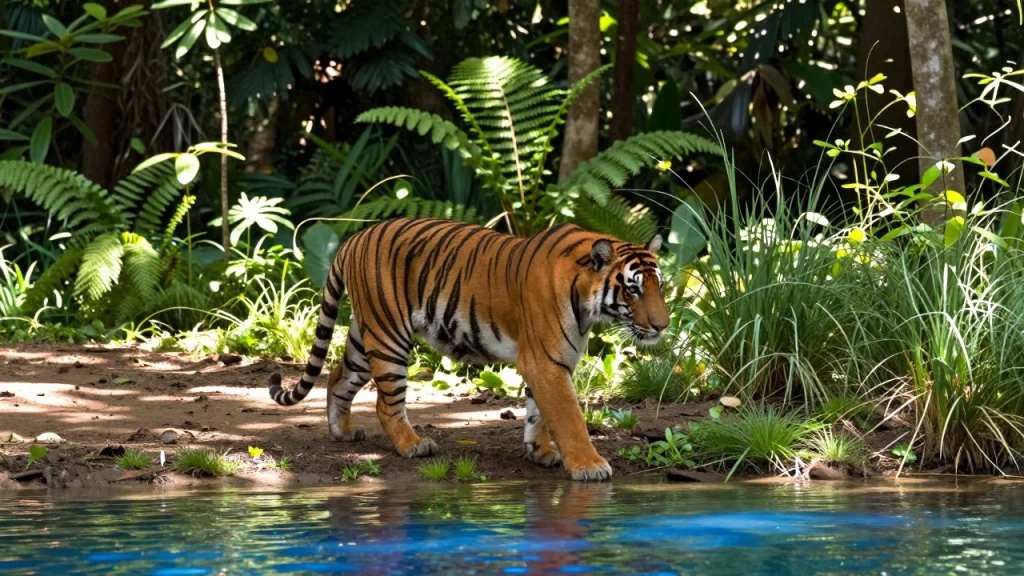
Wild tigers live only in Asia, where they survive in just ten countries. The IUCN SSC Cat Specialist Group lists them as India, Russia, China, Nepal, Bhutan, Bangladesh, Thailand, Malaysia, Indonesia and Myanmar. Their habitats range from tropical forests, grasslands and mangrove swamps to the taiga.
Wild tigers (Panthera tigris) are native exclusively to the continent of Asia. Once roaming across vast stretches of territory from eastern Turkey to the Russian Far East and south throughout the Indonesian archipelago, wild tigers are now confined to isolated pockets across 10 modern countries. Their primary strongholds are in South Asia, North East Asia, and Southeast Asia, with India harboring over 70 percent of the world’s remaining wild tiger population.
These solitary big cats inhabit a remarkably diverse array of ecosystems. Depending on the subspecies and region, wild tigers adapt to tropical rainforests, mangrove swamps, evergreen forests, tall grasslands, and frigid boreal forests. Despite their adaptability to varied climates, all wild tiger habitats require three essential elements: dense vegetation cover for stalking prey, access to abundant water sources, and a sufficient population of large ungulate prey.
Current Distribution of Tigers in the Wild
The modern geographic range of wild tigers has shrunk by over 93 percent compared to its historic extent, leaving less than 7 percent of its original range. Today, breeding populations are highly fragmented across Asia.
South Asia: The Primary Tiger Stronghold
South Asia serves as the global center for wild tiger conservation. India is home to the vast majority of wild tigers, managed within a network of designated tiger reserves such as Corbett, Ranthambore, and Kaziranga.
Nearby nations also support key populations of the Bengal tiger subspecies (Panthera tigris tigris):
- Nepal: Concentrated along the Terai Arc Landscape in protected spaces like Chitwan National Park.
- Bhutan: Tiger records span an extraordinary elevation range, from subtropical lowlands to more than 4,000 meters in the Himalayas.
- Bangladesh: Hosts tigers in the Sundarbans, the largest contiguous mangrove forest in the world.
Northeast Asia: Cold Climate Habitats
In Far Eastern Russia and northeastern China, the Amur tiger (Panthera tigris altaica), also known as the Siberian tiger, occupies a vastly different environment. These tigers inhabit the forests of the Sikhote-Alin mountain range in Russia’s Far East. They endure extreme winter temperatures and roam over massive territories to find prey in snow-covered landscapes.
Southeast Asia: Rainforests and Archipelagoes
Southeast Asia is home to remnant tiger populations living in dense tropical landscapes:
- Thailand and Malaysia: Retain critical breeding populations of Indochinese and Malayan tigers within expansive forest complexes.
- Indonesia: The Sumatran tiger (Panthera tigris sumatrae) is the only surviving island subspecies, residing exclusively in the rainforests, peatlands, and mountainous terrain of Sumatra.
- Myanmar: Maintains small, localized populations in remote forest reserves.
Essential Habitats and Ecosystem Features
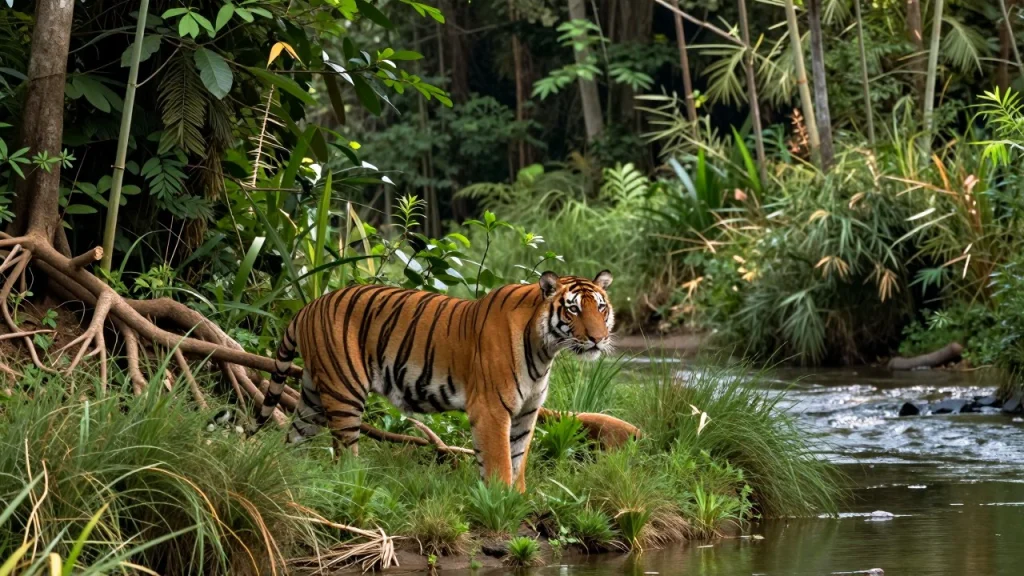
Tigers do not require a single specific ecosystem; instead, they thrive wherever environmental conditions meet their survival needs.
Water and Dense Cover
Unlike many other wild felines, tigers are exceptionally fond of water and are proficient swimmers. They frequently use rivers, ponds, and streams to cool off during hot periods and to hunt along waterlines. Consequently, river systems, wetlands, and coastal swamps are central features of prime tiger territory.
Additionally, tigers rely on camouflage rather than long-distance chasing to capture prey. Dense undergrowth, tall elephant grass, thick mangrove roots, or forest canopy provide the necessary cover to stalk within striking distance.
Land Area Requirements
Tigers are territorial apex predators that require expansive home ranges. A single male tiger’s territory can span from 30 square kilometers in prey-dense tropical forests to over 1,000 square kilometers in the snowbound regions of the Russian Far East. Their home ranges must overlap with several female territories and provide enough prey to sustain them year-round.
Historical Range vs. Modern Status
Historically, tigers ranged continuously across Southwest, Central, South, and East Asia, as well as the islands of Java, Bali, and Sumatra. Over the past century, agricultural expansion, infrastructure development, timber extraction, and poaching caused severe range contraction.
Three subspecies became extinct during the 20th century: the Caspian tiger, the Javan tiger, and the Balinese tiger. Today, intense conservation efforts focus on habitat corridors, anti-poaching patrols, and protected area management to stabilize and reconnect the remaining populations across Asia’s wild landscapes.
How many tigers are left in the wild?
The Smithsonian’s National Zoo and Conservation Biology Institute reports a generous estimate of only 3,900 tigers existing in the wild. The San Diego Zoo Wildlife Alliance reports that, according to conservation scientists, only about 3,000 tigers remain worldwide today. Furthermore, National Geographic reports that over the past century, hunting and forest destruction have dropped tiger numbers from hundreds of thousands to perhaps fewer than 2,500 animals.
Do tigers live in Africa?
No, wild tigers do not live in Africa; every wild tiger lives in Asia. The Smithsonian’s National Zoo and Conservation Biology Institute states that tigers are presently distributed across varied habitats in China, Eastern Russia, and South and Southeast Asia. According to the IUCN SSC Cat Specialist Group, the historic territory of the species stretched across Asia, reaching from eastern Turkey and the southern Caspian Sea to Russia’s Sea of Okhotsk. The San Diego Zoo Wildlife Alliance notes that individual tiger subspecies occupy small regions within Asia, India, and Russia.
What habitats do tigers live in?
The San Diego Zoo Wildlife Alliance states that there are currently six tiger subspecies, each occupying different environments including tropical forests, taiga, arid forests, and flooded mangrove forests. According to the Smithsonian’s National Zoo and Conservation Biology Institute, tigers thrive in grasslands, mangrove swamps, as well as temperate, tropical, or evergreen forests. Animal Diversity Web notes that they occur in monsoonal forest, tall grass jungles, dry thorn forest, scrub oak and birch woodlands, tropical lowland evergreen forest, and mangrove swamps. Regardless of the specific ecosystem, the IUCN SSC Cat Specialist Group states that tigers require access to water, an adequate prey base, and sufficient cover.
Sources
- IUCN SSC Cat Specialist Group: Living Species – Tiger | IUCN CatSG
- Smithsonian’s National Zoo and Conservation Biology Institute: Tiger | Smithsonian’s National Zoo and Conservation Biology Institute
- San Diego Zoo Wildlife Alliance: Tiger | San Diego Zoo Animals & Plants
- Press Information Bureau, Government of India: Press Release Page | Press Information Bureau
- PubMed Central: PubMed Central
- National Geographic: Bengal Tiger | National Geographic
- Animal Diversity Web: Panthera tigris (tiger) | INFORMATION | Animal Diversity Web