
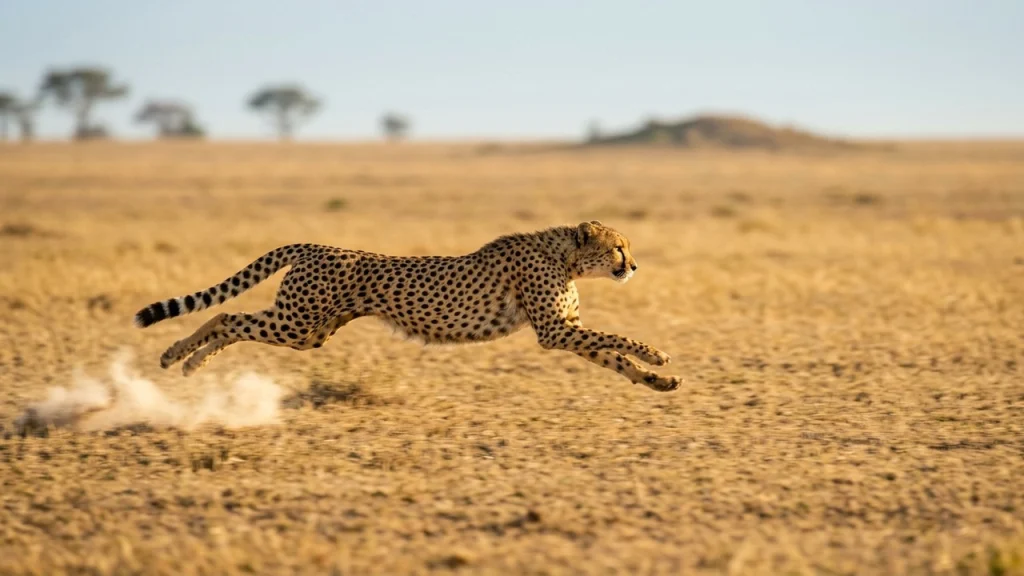
For short sprints, the cheetah tops the list of land mammals. The Smithsonian’s National Zoo and Conservation Biology Institute calls the cheetah the fastest land mammal and says no other land mammal surpasses cheetahs in short sprints. Top speed averages 60 to 70 miles per hour, put by the same institute at 96 and 112 kilometers per hour, and that top speed lasts for only about 300 yards (274 meters). The U.S. National Park Service, meanwhile, gives the pronghorn a top speed near 55 mph.
None of the zoo, wildlife agency or research sources behind this article records an animal beating a cheetah in a race.
The cheetah’s own burst is well documented, and it is short. The Smithsonian institute reports that a cheetah reaches 45 miles per hour (72 kilometers per hour) 2.5 seconds after a standing start, and that a full sprint lasts roughly 20 seconds. The San Diego Zoo Wildlife Alliance gives a ceiling of 70 miles per hour (112 kilometers per hour).
What the pronghorn brings to the start line
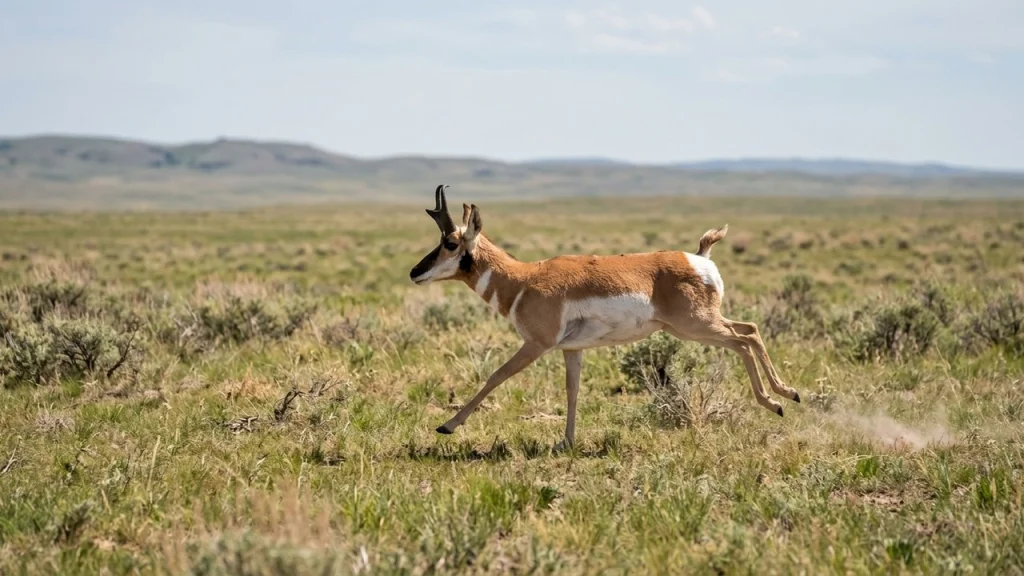
It can hold 55 mph across half a mile, an effort its long legs, light body, large windpipes and cushioned hooves make possible. The U.S. National Park Service says the pronghorn holds speeds approaching 45 mph for much longer distances.
What the National Park Service reports instead is that scientists think this pace arose as an escape strategy against the American cheetah, a fast ambush predator of North America that disappeared roughly 12,000 years ago and is not the sprinting cat discussed here. Across the pronghorn’s range, no predator comes close to matching its pace, a gap researchers still call a mystery.
Ostriches, racehorses and a lioness measured
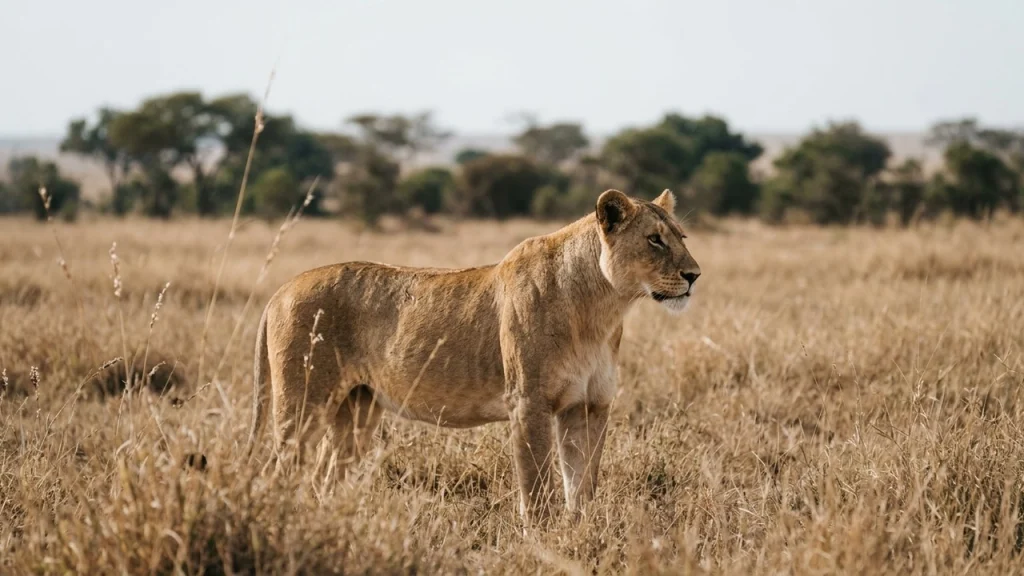
Other measured runners here include ostriches, the fastest racehorse and a lioness. The San Diego Zoo Wildlife Alliance puts an ostrich’s short-burst sprint at up to 43 mph (70 kilometers per hour) and its steady pace at 31 mph (50 kilometers per hour). The fastest racehorse on record is given as 43 mph, and a lioness at 33 mph. The same zoo describes a lion covering the length of a football field in six seconds while chasing prey.
The sprint and what follows it
A cheetah’s speed comes with a short clock. The San Diego Zoo Wildlife Alliance reports heavy panting after a run and body temperatures climbing as high as 105 degrees Fahrenheit (41 degrees Celsius), with roughly 20 minutes needed before breathing and temperature are normal again. The same zoo says the cheetah only catches roughly half of the hunts it attempts.
Field data shows the same brevity. In work done in Kgalagadi Transfrontier Park in southern Africa, wild cheetahs fitted with GPS and accelerometer loggers ran continuously in excess of 13.9 m/s for 23 s and covered 379 m, and every chase was brief, with the longest run lasting 59 s. Exhaustion and overheating were given as the reasons for failed hunts. The researchers also describe the cheetahs closing the gap to prey first, then easing off 5 to 8 s from the end of the hunt to make sharp turns that match how the prey tries to escape.
The build behind the burst
The Smithsonian institute notes small collarbones and vertical shoulder blades that are not joined to the collarbone, plus hips that swivel on a flexible spine. Running flat out, a cheetah covers 23 feet (7 meters) per stride and takes four strides each second, and it spends more than half of its running time off the ground. Its tail works like a rudder, countering the body’s weight in quick turns.
Cheetahs typically approach to within 100 yards (91.4 meters) of their target before the last acceleration, and they hunt alone rather than using the cooperative tactics a lion relies on. Their prey ranges from small antelope such as springbok and impala to the young of warthog and hartebeest. Most cats hunt at night, whereas cheetahs are mainly active in daylight, hunting in the early morning and late afternoon, and they rely on sight more than on smell, scanning the countryside from a kopje, the top of a termite mound.
Our estimate
This section is our own inference from the figures cited above. No source records this outcome directly.
On top speed alone, a cheetah’s peak of up to 70 mph is about 1.3 times the pronghorn’s top speed of around 55 mph, a difference of 15 mph. On those two figures, a cheetah would likely be the faster of the two in a short race. This is our own estimate, and it does not describe any race that has actually been run.
Sources
- Smithsonian’s National Zoo and Conservation Biology Institute: Cheetah
- San Diego Zoo Wildlife Alliance: Cheetah | San Diego Zoo Animals & Plants
- U.S. National Park Service: Pronghorn: Racers on the Great Plains
- Journal of Experimental Biology (via PubMed Central): Cheetahs, Acinonyx jubatus, balance turn capacity with pace when chasing prey
- San Diego Zoo Wildlife Alliance: Lion | San Diego Zoo Animals & Plants
- San Diego Zoo Wildlife Alliance: Ostrich | San Diego Zoo Animals & Plants