
Tigers (Panthera tigris) and lions (Panthera leo) are the two largest cat species on Earth. While both belong to the same genus and share the top tier of their respective ecosystems, they differ significantly in physical appearance, social behavior, natural habitats, and hunting strategies.
Understanding the contrast between these two majestic apex predators comes down to how they have adapted to their environments. From solitary jungle hunters with bold stripes to social savanna dwellers with pride dynamics, tigers and lions have evolved distinct traits that define their physical form and lifestyle in the wild.
Physical Differences: Coat Patterns, Size, and Features
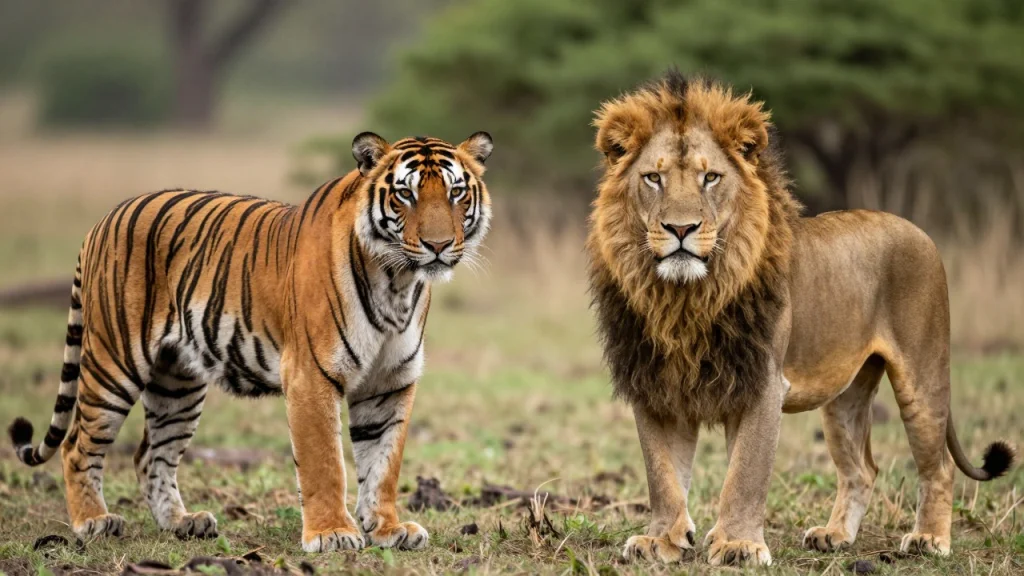
The most immediate distinction between tigers and lions lies in their coat patterns and sexual dimorphism. Tigers are famous for their dark vertical stripes over reddish-orange fur, which provide camouflage in dense vegetation. In contrast, lions feature a uniform tawny or golden coat designed to blend into dry grasslands and open savannas.
Size and male adornment also separate the species:
- Weight and Build: Tigers are generally the larger and heavier of the two species. Large Siberian and Bengal tiger males can weigh more than most adult male lions and typically possess a slightly more muscular build built for solitary overpowering of prey.
- Manes: Male lions are easily recognized by their prominent manes, which darken with age and health, serving as protection during fights and signaling fitness to females. Male tigers do not possess manes, though some subspecies feature longer fur around their neck and cheeks.
- Facial and Body Markings: Every tiger has a unique pattern of stripes, akin to human fingerprints, whereas lions maintain a plain coat with tufted tails and white underbellies.
Social Structure and Group Dynamics
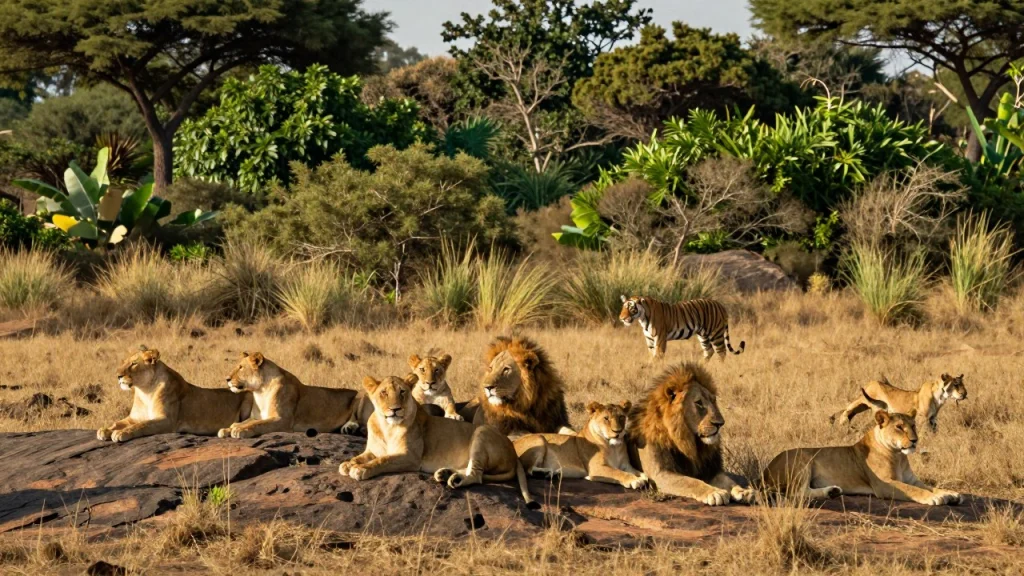
Perhaps the single biggest behavioral difference between tigers and lions is how they interact with members of their own species.
Solitary Tigers
Tigers are almost exclusively solitary animals. Adult tigers establish vast individual territories, marking their boundaries with scent markers, claw marks, and vocalizations. Male and female territories may overlap, but adult tigers generally avoid contact with one another except during the breeding season or when a female is raising cubs.
Social Lions
Lions are the only truly social big cats, living in structured family groups called prides. A typical pride consists of related females, their offspring, and a small coalition of male lions that protect the territory. Pride living allows lions to coordinate defense against rival coalitions, defend territory continuously, and share parental care.
Habitat and Geographic Range
Historical and modern ranges reflect different habitat preferences for these big cats.
Tigers are native exclusively to Asia. They inhabit a wide variety of environments, ranging from the freezing birch forests of the Russian Far East to tropical rainforests in Southeast Asia and mangrove swamps in the Sundarbans. Their survival relies on thick cover, ample prey, and access to water.
Lions primarily inhabit sub-Saharan Africa, occupying grasslands, open savannas, shrublands, and dry woodlands. A tiny remnant population of Asiatic lions, classified within the subspecies Panthera leo leo (formerly known as Panthera leo persica), also survives in India’s Gir Forest, though their habitat structure is historically and ecologically distinct from tiger strongholds across Asia.
Hunting Techniques and Water Preferences
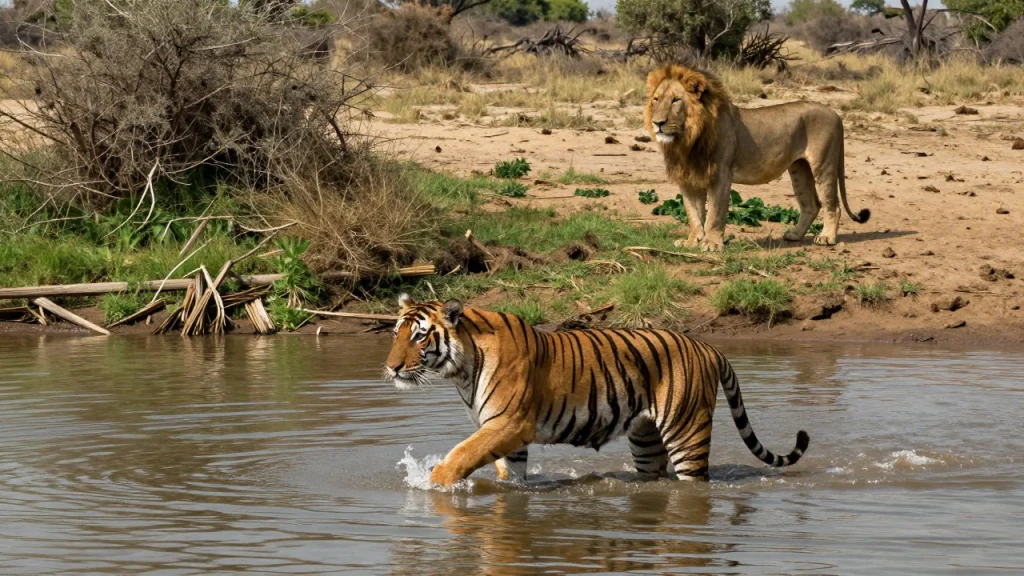
Their contrasting social lives directly shape how tigers and lions capture prey.
Because tigers hunt alone, they rely on stealth and ambushing. They stalk close to prey under cover of dense brush before launching a powerful leap. Tigers are also exceptional swimmers that routinely enter rivers and lakes to cool off, cross rivers, or hunt aquatic prey.
Lions utilize cooperative hunting strategy. Female lions perform the majority of the hunting for the pride, working in groups to flank, surround, and drive prey toward ambushers in open terrain. While lions can swim if necessary, they rarely enter deep water voluntarily and do not seek out water bodies for leisure like tigers do.
Conservation Status
Both tigers and lions face serious threats in the wild, primarily driven by habitat loss, human-wildlife conflict, and poaching. Both species are listed as vulnerable or endangered across their ranges, making global conservation efforts vital to securing the future of these iconic wild mammals.
Sources
- IUCN SSC Cat Specialist Group: Living Species – Tiger | IUCN CatSG
- IUCN SSC Cat Specialist Group: Living Species – Lions | IUCN CatSG
- Smithsonian’s National Zoo: Tiger | Smithsonian’s National Zoo and Conservation Biology Institute
- Smithsonian’s National Zoo: Lion | Smithsonian’s National Zoo and Conservation Biology Institute