
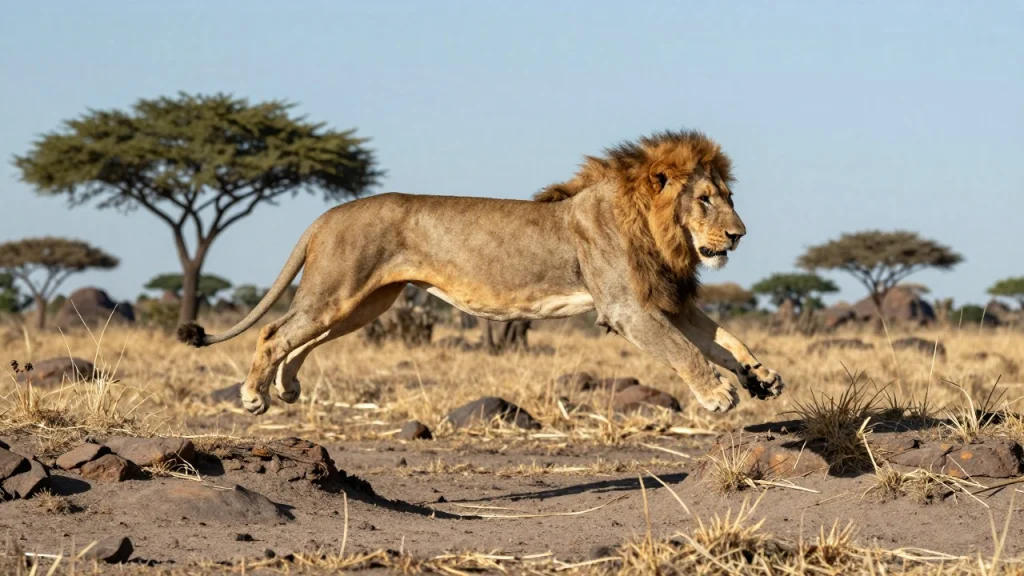
Reliable measurements of how far a lion can jump in a single bound are scarce. Zoo Zürich puts a lion’s long jump at about 4.5 meters (15 feet), roughly 2.5 times its body length. The 36-foot (11-meter) figure often repeated online is only an approximate popular claim and could not be verified, and the same goes for the 12-foot (3.6-meter) vertical leap often cited for lions.
This extraordinary jumping capability allows lions to leap over formidable environmental obstacles, ambush fast-moving prey, and launch sudden explosive attacks. Understanding the mechanics behind a lion’s leap reveals how specialized anatomical adaptations make the apex predator so effective in the wild.
Physical Adaptations Behind a Lion’s Powerful Leap
A lion’s ability to leap massive distances relies on a highly specialized muscular and skeletal structure built for quick bursts of power rather than long-distance endurance.
Key anatomical features that enable these impressive bounds include:
- Powerful Hind Legs: The lion is very muscular, and its body is designed for strength and short bursts of high speed.
- Flexible Spine: Like most felids, lions have a flexible spine that helps power quick, explosive movements.
- Strong Tendons and Ligaments: Lions have strong tendons and ligaments in their hind limbs that support powerful, explosive pushes off the ground.
- Grip: Lions have retractable claws and strong, wide paws that provide good traction on uneven ground during a takeoff.
Although lions are heavy mammals, with adult males weighing 330 to 550 pounds (150 to 250 kilograms) and females weighing between 265 and 395 pounds (about 120 to 179 kilograms), their high muscular density helps offset their bulk, contributing to powerful bursts of speed and strength.
How Lions Use Their Bound for Hunting
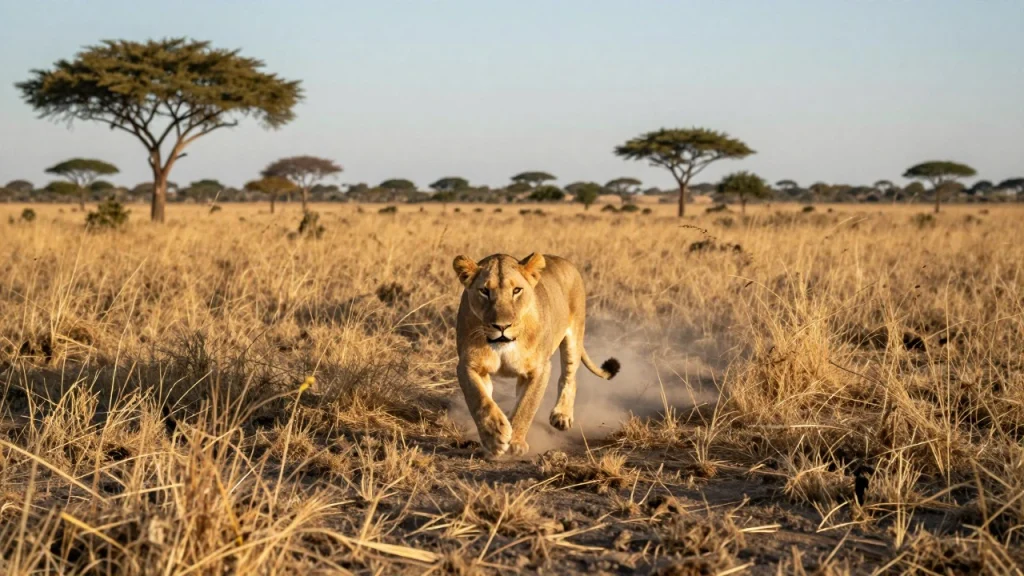
African lions inhabit savannas, scrubs, and forested or dry-forest environments. They rely on stalking and short, high-speed pounces.
Lions creep close to their target under the cover of vegetation, often stalking from different angles to reduce the distance to within 100 feet (30 meters) before exploding into action. In the final stalk, lions launch a short, explosive charge to close the gap on a zebra, wildebeest, or gazelle before it can react.
This leap is not just about covering distance; it is also crucial for maneuvering. Lions use powerful forelegs, teeth and jaws to pull down and kill large prey, including animals weighing 45 to 453 kilograms.
Horizontal vs. Vertical Jumping Capability
While horizontal jumping helps lions close distances during a hunt, vertical leaping serves distinct behavioral and survival functions.
| Leap Direction | Average Maximum Distance / Height | Primary Purpose in the Wild |
|---|---|---|
| Horizontal Bound | About 4.5 m (15 ft); the popular 36 ft (11 m) is unverified | Ambushing prey, clearing gullies, rapid acceleration |
| Vertical Leap | About 12 ft (3.6 m) often cited; unverified | Scaling rock formations, clearing fallen trees, defensive maneuvering |
Strong upward leaps allow lions to navigate rocky kopjes (granite outcrops) common in savannas and clear natural barriers while pursuing prey or fleeing danger.
How Lions Compare to Other Big Cats
While lions are powerful leapers, other big cats have better-documented jumping records.
For instance, snow leopards can jump 30 to 50 feet between mountain ledges, using their tails to balance. Similarly, the cougar (puma) can jump up to 40 feet horizontally and over 15 feet vertically. Tigers can leap from 8 to 10 meters, although leaps of half that distance are more typical.
Lions balance jumping power with immense upper-body strength suited for wrestling down heavy prey in open landscapes. Their leaping ability remains one of the most effective evolutionary tools keeping them at the top of the food chain.
Sources
- Zoo Zürich: Weitspringen
- Smithsonian’s National Zoo: Lion | Smithsonian’s National Zoo and Conservation Biology Institute
- IUCN/SSC Cat Specialist Group: Living Species – Lion | IUCN CatSG
- Los Angeles Zoo and Botanical Gardens: Snow Leopard – Los Angeles Zoo and Botanical Gardens
- Oregon Zoo: Cougar | Oregon Zoo
- Animal Diversity Web: Panthera tigris (tiger) | Animal Diversity Web