
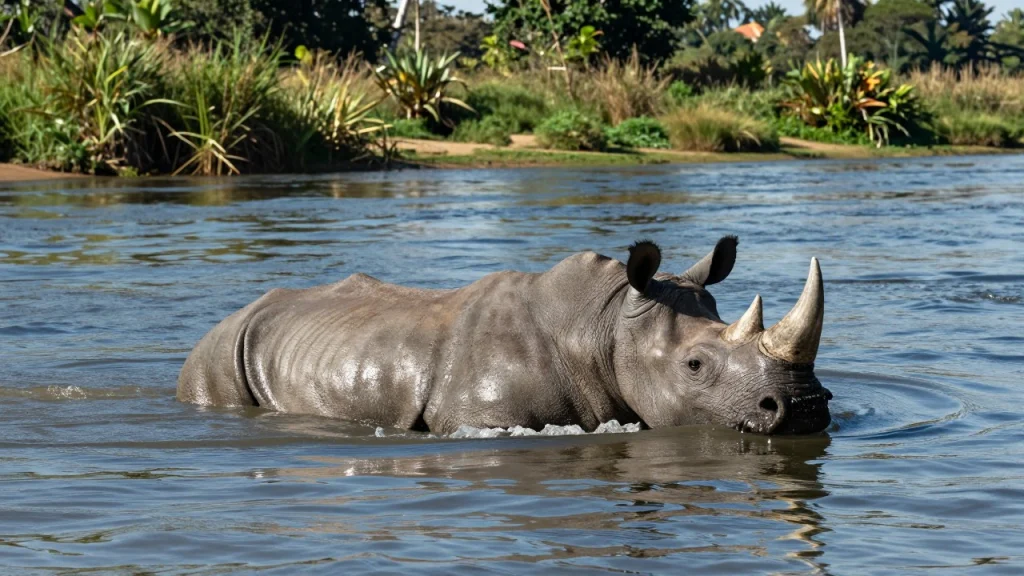
Yes, rhinoceroses can swim across deep water, though this varies by species. Asian rhino species are excellent swimmers, while the two African species, the white and the black rhinoceros, are very poor swimmers that can drown in deep water.
Understanding how rhinos interact with aquatic environments reveals fascinating evolutionary adaptations. Water plays a vital role in rhino survival, serving as a cooling mechanism, insect repellent, and navigational route through wild habitats.
How different rhino species navigate deep water
Not all rhinoceroses view water the same way. Evolutionary paths and habitat adaptations have created significant differences in aquatic abilities between Asian and African rhinos.
Asian rhinos: Strong and natural swimmers
The Greater One-horned rhino (Indian rhino), Javan rhino, and Sumatran rhino are remarkably comfortable in aquatic environments. These species make their homes in swamps and rainforest habitats.
- Greater One-horned rhino: Regularly swims across wide, deep rivers in India and Nepal, using body buoyancy and powerful leg movements to paddle through strong currents.
- Sumatran and Javan rhinos: Excellent swimmers.
Asian rhinos use swimming to access fresh vegetation, migrate across riverine islands, and escape high temperatures during hot seasons.
African rhinos: Poor swimmers
Africa has two rhinoceros species, the white rhinoceros and the black rhinoceros. White rhinos and black rhinos live in African grasslands and floodplains; documented habitats also include savannas and forests.
- White rhino: Drowning is one documented cause of death for this species.
African rhinos can wade into shallow rivers and wallow in mud, but drowning is a documented risk when they enter deep water.
Wallowing vs. swimming: Why rhinos enter the water
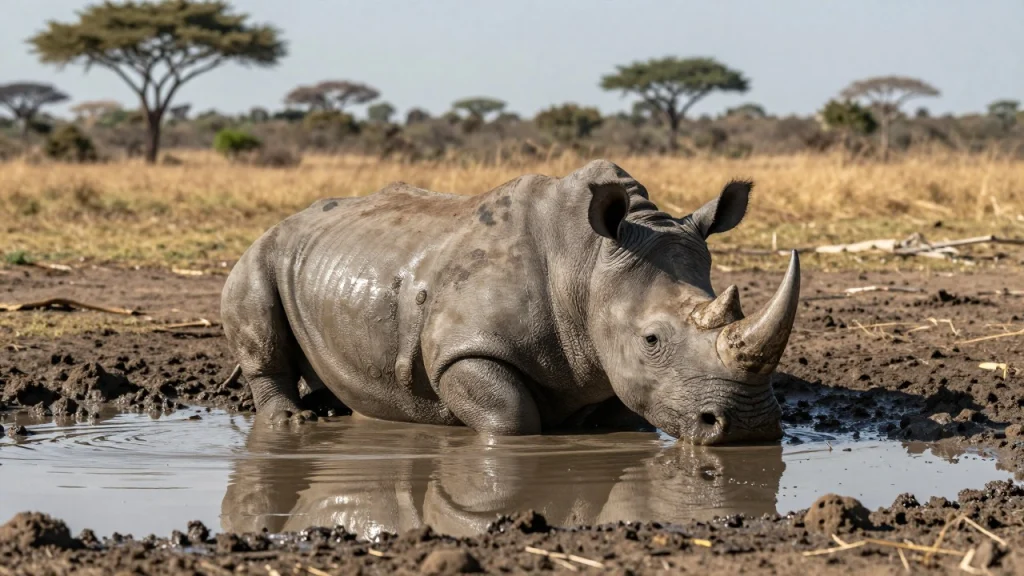
While not all rhinos swim across deep rivers, virtually all rhinoceroses spend time around water bodies for health and behavioral reasons. Wallowing in shallow water and mud serves essential physiological functions.
- Thermoregulation: Rhinos lack efficient sweat glands, so soaking in water helps regulate body temperature under intense tropical heat.
- Skin protection: Mud wallowing forms a protective barrier on their thick skin against parasite bites, biting flies, and sunburn.
- Social interaction: Water holes serve as central meeting points for rhinos to interact, scent-mark, and monitor local territories.
Physical factors affecting a rhino’s swimming ability
A rhino’s capability to swim across deep water comes down to a few anatomical features and ecological factors.
- Body density and fat distribution: The heavy bone structure of African rhinos makes buoyancy challenging, whereas Asian rhinos possess anatomical balances suited for flotation.
- Nostril positioning: To swim effectively without exhausting themselves, rhinos need to keep their nostrils comfortably above the water line while paddling.
- Leg strength and muscle propulsion: Rhinos rely on powerful limb movement to swim, though size varies widely by species: the greater one-horned rhino averages 4,000 to 6,000 pounds, while the Sumatran rhino averages around 1,765 pounds.
Aquatic safety and wild risks
Even for skilled Asian rhinos, swimming across deep water carries natural risks. Rapid floodwaters during monsoon seasons can sweep young calves away, and deep river crossings occasionally expose rhinos to aquatic predators like large crocodilians. Nevertheless, all Asian rhinos are excellent swimmers.
Sources
- WWF UK: Rhino facts
- San Diego Zoo Wildlife Alliance: Rhinoceros | San Diego Zoo Animals & Plants
- Animal Diversity Web, University of Michigan: Ceratotherium simum (white rhinoceros)
- Animal Diversity Web, University of Michigan: Diceros bicornis (black rhinoceros)
- Animal Diversity Web, University of Michigan: Dicerorhinus sumatrensis (Sumatran rhinoceros)
- Los Angeles Zoo and Botanical Gardens: Greater One-Horned Rhinoceros