
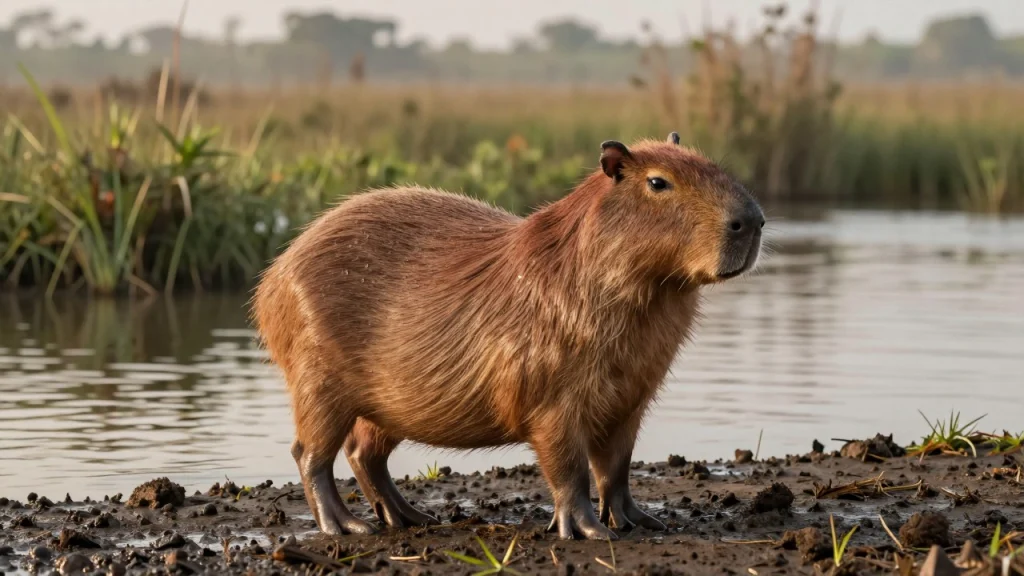
The capybara represents the largest of all rodents, reaching shoulder heights up to 0.6 meters, with about 1.2 meters in total length, and a mass from 35 to 66 kg. Its barrel-shaped body, dense musculoskeletal frame, and broad skull allow it to thrive along South American waterways. Observers frequently compare its impressive bulk to a medium-sized dog or a small hog, yet its closest biological kin are actually domestic guinea pigs and wild cavies.
Size varies noticeably across populations, sexes, and environments. Among these animals, females grow slightly larger than males. In addition, geographical location influences overall mass. Wild herds in the Llano region of Venezuela typically weigh 35 to 65.5 kg, which equals 77 lb to 144 lb, while an exceptional individual in southern Brazil reached as much as 91 kg (200 lb). Understanding these dimensions reveals how effectively the species balances substantial body mass with an amphibious lifestyle.
Dimensions and Weight Across Populations
The San Diego Zoo separately reports total body length from 3.2 to 4.2 feet, translating to 100 to 130 centimeters, shoulder height averaging 1.6 feet (or 50 centimeters), and weight ranging from 60 to 174 pounds, equivalent to 27 to 79 kilograms, varying depending upon sex. These ranges highlight the considerable diversity seen across various river systems and riverbanks throughout South America. A fully grown capybara easily exceeds all other living rodents in mass and volume.
Biological measurements record a head-body length of 1070-1340 mm, spanning roughly 3.5-4.4 ft, combined with a hindfoot length between 220-250 mm, measuring around 8.7-9.8 in. These skeletal proportions reflect an animal engineered for low-center-of-gravity stability rather than high-speed terrestrial sprinting. The elongated hindfeet provide expansive surface area for propulsion in water and balance on slippery wetland banks.
Field biologists note that an animal’s physical mass and total body size increases with greater geographic latitude for a population.
Environmental Diet and Massive Weight Records
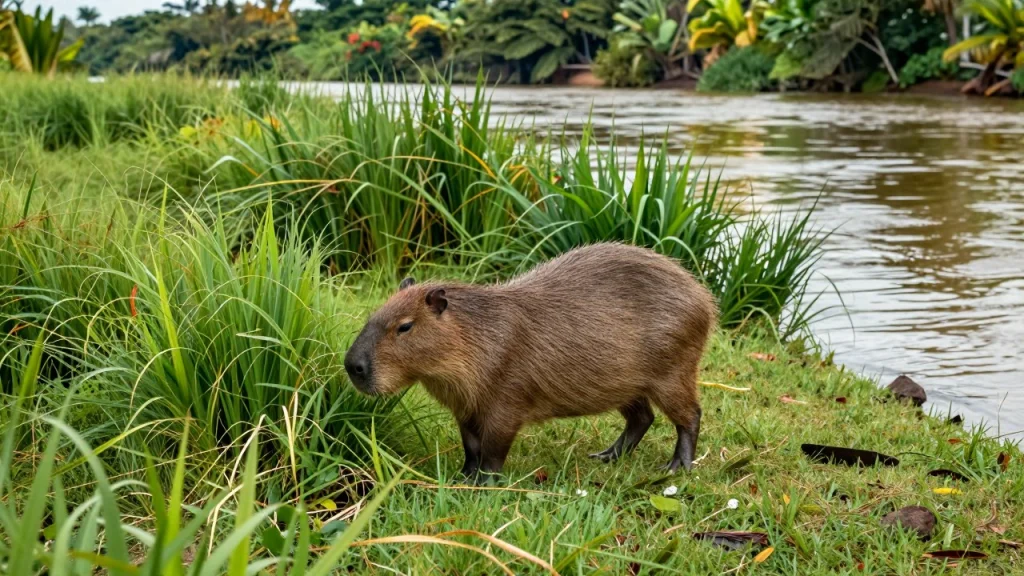
Habitat quality and human activity play major roles in determining how large capybaras grow in the modern wild. Field evaluations demonstrate that capybaras dwelling in human-modified landscapes are heavier with higher body mass than counterparts in natural landscapes, even though their body total length and height do not differ statistically. Agricultural landscapes and urban borders provide steady feeding opportunities that alter natural growth trajectories.
Because human-altered habitats provide greater access to energy-rich food sources, higher body mass among those rodents is linked to fat deposit rather than body length. When herds gain access to sugarcane fields, cultivated grains, and managed pastures, they ingest caloric densities far higher than native river vegetation offers. This chronic surplus leads to substantial fat storage, creating significantly heavier individuals without changing their skeletal framework.
Remarkably, research teams documented three individual capybaras that weighed more than 100 Kg, marking the greatest values reported for the species. These exceptional records show how much heavier a capybara can grow when abundant, high-calorie food removes normal seasonal shortages.
Anatomy and Physical Adaptations for Wetland Living
The physical build of the animal appears barrel-shaped, sturdy, and tailless. This compact, cylindrical body structure minimizes drag when swimming through dense river currents while protecting vital organs. Rising 2 feet (approximately 60 centimeters) at shoulder height, the animal displays long, shaggy hair of light brown coloring, paired with a facial profile that resembles a beaver.
Its front limbs are slightly shorter than the hind limbs, terminating in partially webbed feet. This asymmetrical leg length positions the pelvis slightly higher than the shoulders, providing powerful forward thrust when moving from riverbeds onto muddy shores. The creature navigates wetlands using feet configured with four toes upon each front foot and three upon each back foot, moving seamlessly between swimming and walking.
Much like a hippopotamus, the rodent features its eyes, ears, and nostrils situated near the highest point of its head. This cranial arrangement allows the mammal to float nearly completely concealed beneath the water surface while keeping all vital sensory organs exposed to detect incoming threats.
The coat consists of thin and coarse fur colored reddish brown across the majority of the torso, transitioning to yellowish brown along the belly and occasional black markings on the face. Such thin hair exposes the mammal to sunburn, prompting it to cake damp mud onto its coat for shielding protection.
Having a low number of sweat glands in the skin combined with considerable body bulk makes thermal stress an ongoing physiological hurdle. Because the animal cannot dissipate excess heat efficiently through sweating alone, access to standing water becomes indispensable for survival. Adult males carry a prominent, visible scent gland called a morrillo positioned right on top of the snout. They rub this oily structure against shrubs and branches to mark territorial boundaries and assert dominance within their home range.
Constant Dental Growth and High-Fiber Digestion
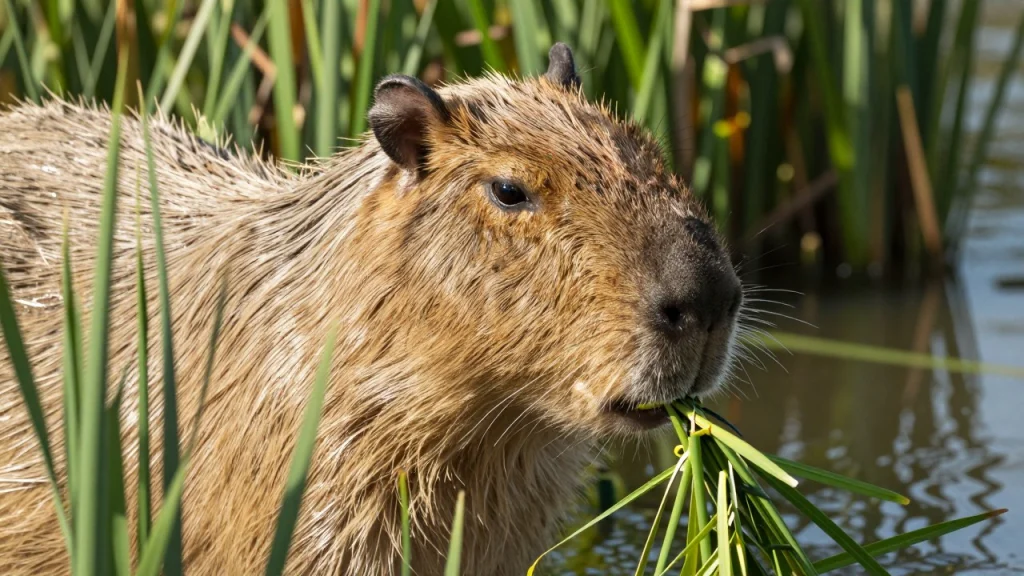
Sustaining such immense body volume demands exceptional specialized dentition. The teeth of the capybara continue to grow throughout life in all dimensions. Continuous wear from abrasive silica in wetland grasses would quickly erode standard enamel, so open-rooted incisors and cheek teeth grow perpetually to offset degradation.
As an individual matures, the cutting and grinding surfaces of the dentition become progressively more complex. These enamel ridges act as micro-shears that pulverize coarse cellular plant walls into digestible pulp. To break down coarse vegetation, capybaras process food from side to side much like a camel instead of chewing vertically up and down. This lateral milling motion efficiently processes durable fibrous stalks that would exhaust the jaw muscles of other mammals.
Maintaining a heavyweight metabolism requires vast nutritional intake:
- A mature adult capybara can consume between six to eight pounds of fresh grass each day to support its metabolism.
- Botanical research demonstrates that just three to six distinct plant species account for 75% of a herd’s wild diet.
- Dense seasonal grasses along riverbanks supply the majority of their essential carbohydrates and fiber.
Aquatic Agility, Predator Defense, and Behavior
Despite their heavy proportions, capybaras navigate aquatic ecosystems with remarkable agility. These mammals excel as strong swimmers because their physical density is only slightly denser than water. This near-neutral buoyancy allows them to glide effortlessly across deep river channels without expending excessive physical stamina.
Daily movement follows a primarily crepuscular rhythm, leaving the hottest part of the day to be spent resting in water. By feeding around dawn and dusk and lounging in river pools during midday heat peaks, the animals avoid heat exhaustion and reduce water loss. When dodging carnivores, capybaras submerge in aquatic hideaways where they can stay underwater and hold their breath up to five minutes.
Fully grown adults face one primary natural predator in the wild, the jaguar, although human hunting also exerts pressure. In modified habitats, pumas (Puma concolor) stalk waterways as natural predators. Extra bulk still helps an adult capybara resist some puma attacks, even though the added weight can slightly slow its escape.
Growth Rate, Social Structure, and Wild Lifespan
Capybara growth begins rapidly right from birth. Mothers give birth after 150 days of gestation, producing litters that range in size from 2 to 8 offspring. Pups are precocial, standing and eating soft grasses within their first week of life while remaining safely within the nursery group.
Nursing young drink milk from both their mother and related clan females until weaning occurs at about 3 months old. Communal suckling lets juveniles keep nursing even when their own mother is temporarily away foraging.
Social cohesion represents the foundation of capybara ecology:
- Herds typically include around 10 mature individuals of both sexes, though group numbers vary from 3 to 30 and gather into extensive bands near water during dry months.
- Group living provides cooperative vigilance against stealthy predators along riverbanks.
- Dominant males defend vital feeding territories that guarantee access to grazing fields and deep bathing ponds.
Wild capybaras survive about 6 years on average, occasionally reaching 10 years in native habitats and living up to 12 years when kept in captivity. Although conservation agencies do not classify the capybara as endangered, wild herds encounter localized challenges from deforestation, habitat destruction, and illegal poaching. Protecting intact wetlands ensures that these charismatic, heavyweight rodents continue to roam the rivers and marshes of South America.
Sources
- Animal Diversity Web: Hydrochoerus hydrochaeris (capybara)
- San Diego Zoo Wildlife Alliance: Capybara
- San Diego Zoo Wildlife Alliance Library: Capybaras (Hydrochoerus spp.) Fact Sheet: Physical Characteristics
- PubMed Central: Morphometric Patterns and Blood Biochemistry of Capybaras (Hydrochoerus hydrochaeris) from Human-Modified Landscapes and Natural Landscapes in Brazil
- Reid Park Zoo: Capybara