
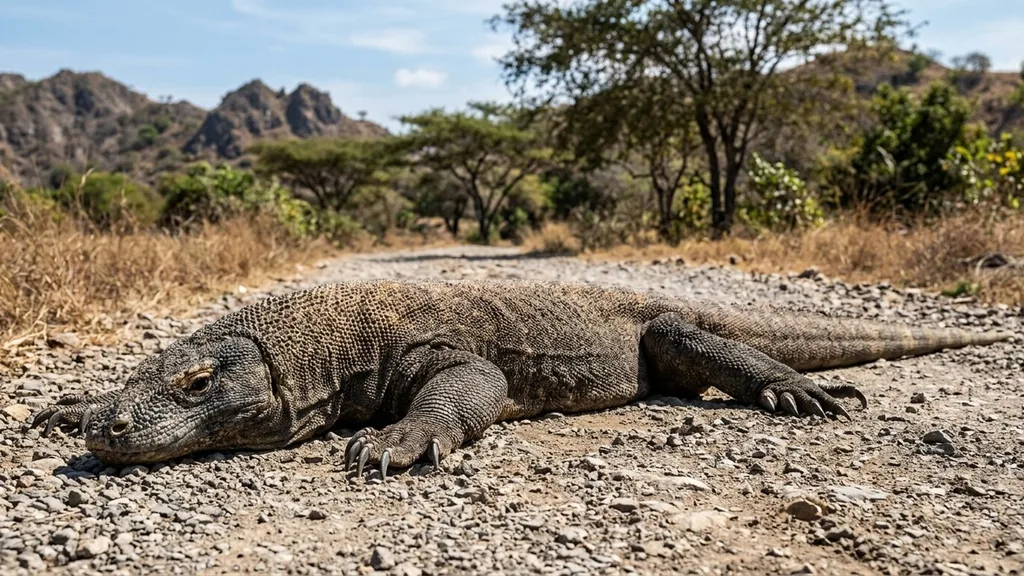
Most adult Komodo dragons are 6 to 10 feet (1.8 to 3 m) long and weigh 154 to 300 pounds (70 to 136 kg). Males grow larger and bulkier than females, and the biggest verified dragon measured 10.3 feet (3.13 m) and weighed 366 pounds (166 kg).
The Komodo dragon (Varanus komodoensis) represents the apex of living lizards. Among more than 3,000 lizard species globally, the Komodo dragon ranks as the planet’s largest living lizard. These formidable island predators possess an extraordinary physical presence matched by few modern reptiles. With maximum lengths reaching up to 10 feet and weights topping 300 pounds, these beasts constitute the heaviest lizards on Earth. Their massive bodies provide the mechanical power needed to dominate isolated ecosystems across the Indonesian archipelago.
Adult size varies depending on environmental conditions, individual age, and biological sex. Typical adults span from 6 to 10 feet (1.8–3 m) in total length, with males growing noticeably larger than females. In terms of overall body mass, healthy adult mass ranges between 154 and 300 pounds (equal to 70–136 kg), where males are consistently heavier than females. Average individuals in native wilderness typically weigh around 154 pounds (70 kilograms). Exceptional giants occasionally emerge under optimal feeding conditions, as the largest verified specimen reached 10.3 feet (3.13 meters) in total length and scaled at 366 pounds (166 kilograms).
Sexual dimorphism and divergent growth trajectories
Male and female dragons exhibit distinct developmental schedules despite sharing a uniform outward appearance. Even though mature males typically achieve greater bulk and larger size than females, no obvious external physical markers distinguish the two sexes. Biologists cannot separate adult lizards by coloration or body shape alone, relying instead on molecular and morphological methods, such as DNA testing, to establish sex in wild populations.
This size disparity arises through divergent energetic allocation during maturation. Field growth curves indicate that young males and females share similar body dimensions until roughly 7 years of age, when developmental pathways diverge and females shift toward a smaller maximum size. Before this critical inflection point, juvenile lizards invest their caloric intake strictly into rapid structural expansion to escape predation.
Once reproductive capabilities awaken, female somatic priorities change completely. Egg production, nest construction, and clutch defense consume vast quantities of energy that would otherwise sustain skeletal growth:
- Asymptotic limits: Trapping records reveal that wild females are never caught at measurements exceeding 117 cm SVL, while males continue expanding toward an asymptotic limit around 157 cm SVL near 62 years of age.
- Continuous growth: Female monitors never achieve a true asymptotic plateau, with the oldest captured females around 31 years of age continuing to register active growth.
- Reproductive onset: Reproductive maturity in wild females begins at roughly 8–11 years of age, determined by the anatomical dimensions of the smallest known nesting individuals.
- Survival costs: Severe energetic demands related to nesting appear to explain why female life expectancy is heavily truncated around 31 years, after which older females disappear completely from population surveys.
These physiological trade-offs explain why massive specimen encounters almost exclusively involve older male dragons. Sustained growth across decades permits dominant males to build the bulky frames required to win combat against rivals.
Hatchling development and the arboreal survival phase
Attaining gigantic dimensions requires surviving a vulnerable, protracted developmental journey. The reproductive cycle begins when adult females prepare subterranean nest chambers. A nesting female deposits between 20 and 30 eggs, actively defending her clutch during initial months of incubation.
Newly emerged young present a dramatic contrast to their formidable adult parents. At emergence, fresh hatchlings scale at under 3.5 ounces (100 grams) while averaging 16 inches (40 centimeters) in total length. Small and delicate after leaving the nest cavity, these tiny reptiles face lethal perils from island carnivores.
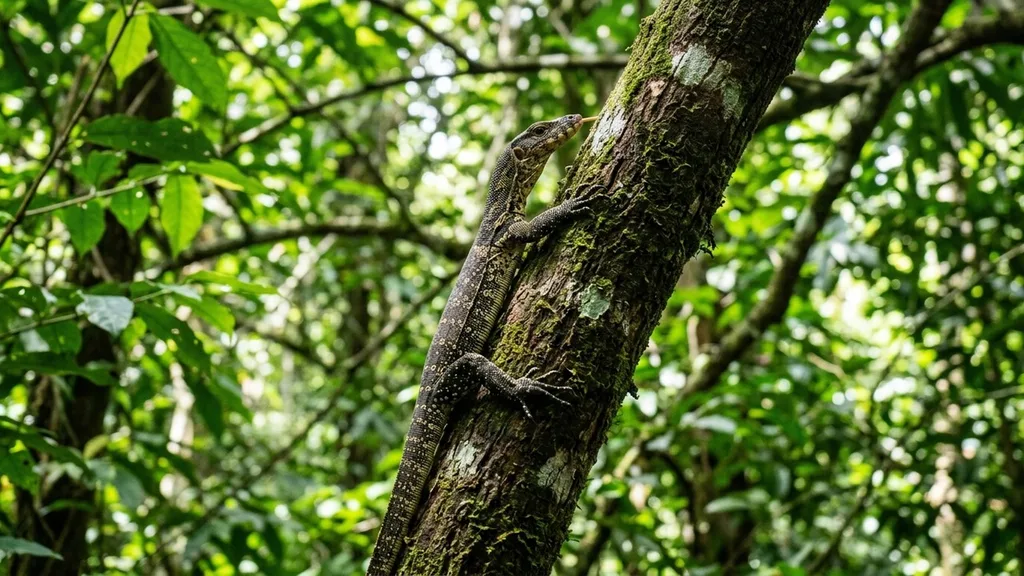
Adult dragons pose the gravest threat to neonatal survival, frequently hunting smaller conspecifics. Juvenile dragons reside high within forest branches to prevent being preyed upon by cannibalistic adult dragons. An arboreal lifestyle allows young lizards to utilize forest structures that cannot bear the mass of fully grown adults.
While sheltering up in branches, arboreal juveniles consume small prey like eggs, grasshoppers, beetles, and geckos. This high-protein invertebrate diet fuels steady growth while the young lizards stay clear of terrestrial combat zones.
Gradual development eventually forces young lizards to leave the canopy. Once juveniles reach roughly 4 years of age and measure 4 feet long (1.2 meters), they possess adequate size to begin living on the forest floor. At this stage, their increased speed enables them to evade larger adults while pursuing terrestrial prey.
The transition to hunting large game accelerates during the subsequent juvenile phase. By 5 years of age, maturing dragons reach around 55 pounds (25 kilograms) alongside an average length of 6.5 feet (2 meters), marking their transition to ambushing larger game. Surpassing this physical threshold unlocks the ability to subdue substantial mammalian herbivores.
Skeletal strength, cranial mobility, and natural armor
Supporting colossal body mass requires specialized anatomical reinforcement. Their commanding skeletal frame features long, flattened heads with rounded snouts, wide bowed limbs, armored skin, and massive, muscular tails. The heavy tail serves as an indispensable counterbalance during terrestrial locomotion and provides a stabilizing anchor when individuals rear upright.
Physical protection against territorial combat comes from an internal skeletal mesh. Their rugged dermis is densely fortified with internal osteoderms (bony plates), protecting them from injuries like scratches and bites.
Ingesting massive food items presents another biomechanical challenge solved through skull flexibility. Flexible skeletal linkages, notably the intramandibular hinge, enable the predator to drop its lower jaw remarkably wide when swallowing food. This cranial kinesis permits the ingestion of immense portions without preliminary mastication.
Feeding efficiency relies on specialized predatory dentition. The oral cavity houses roughly 60 short, serrated teeth tailored for shearing flesh. When striking prey, dragons clamp down with bladed teeth and pull backward using muscular neck force, producing extensive gaping wounds.
Gorging capacity, chemical weaponry, and ambush locomotion
The digestive capability of an adult dragon matches its formidable external dimensions. A highly distensible stomach allows a feeding adult to ingest up to 80 percent of its total body weight during one continuous feeding session. This elastic gut allows lizards to exploit episodic carcass abundance in environments where large meals occur unpredictably.
Feeding speed proves equally remarkable during communal carcass feeding. Field records note their rapid feeding rate, with individuals observed consuming 5.5 pounds of meat within one minute. Such rapid ingestion ensures that feeding individuals secure sustenance before dominant rivals assert ownership over the carcass.
Carrying such massive nutritional ballast incurs acute mobility costs. If startled or threatened after gorging, dragons can rapidly regurgitate their stomach contents to dump ballast and escape danger. Discharging heavy gut contents immediately restores running agility, allowing the animal to evade perceived threats.
Subduing quarry larger than the predator itself involves chemical assistance. Specialized venom glands in the mandible secrete compounds that lower blood pressure, prevent clotting, provoke heavy bleeding, and induce shock in bitten prey. Once the target collapses, feeding individuals process carcasses thoroughly, discarding merely about 12 percent of each captured carcass after consuming skin, bones, and organs.
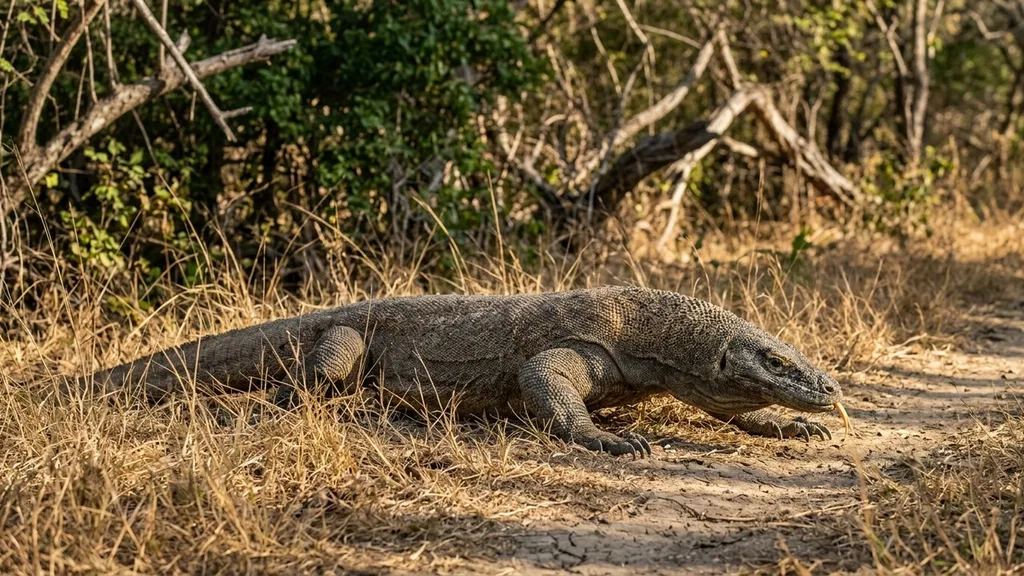
Locomotor performance combines patient ambush positioning with sudden explosive power. While capable of accelerating to brief sprints between 10 and 13 mph (16 to 20 kph), dragons rely primarily on camouflage, ambush, and muscular strength to subdue quarry. They conceal their bulky frames amid tall vegetation along frequented animal pathways, striking when prey wanders within lunging distance.
Sensory systems guide these heavyweight hunters across rugged terrain. Highly sensitive olfactory organs allow dragons to detect the odor of carrion from distances reaching 2.5 miles (4 kilometers) across island breezes. By constantly flicking their yellow forked tongues, dragons pinpoint microscopic chemical traces, tracking down distant carcasses across steep hillsides.
Restricted island habitats and conservation challenges
Despite their imposing bulk, Komodo dragons survive within an exceptionally fragile ecological bubble. Modern populations occupy a restricted geographical range of under 350 square miles (measured at 900 sq km) distributed over six clustered Indonesian islands. Their entire global existence depends on these few isolated parcels of tropical savannah and deciduous forest.
Human pressures and habitat deterioration have caused steep population contractions in recent decades. Between 1981 and 2021, wild populations declined from 5,000 down to 3,500 individuals, marking a 30% reduction over 40 years that caused the International Union for Conservation of Nature to reclassify the species as endangered. Protecting these colossal reptiles requires strict conservation measures to safeguard both their insular habitats and the prey animals that sustain them.
How long can a Komodo dragon get?
According to Animal Diversity Web, Komodo dragons can grow to greater than three meters in length, while National Geographic reports that they reach up to 10 feet. The San Diego Zoo Wildlife Alliance documents the longest verified individual at 10.3 feet (3.13 m). A study in PLOS ONE notes that female Komodo dragons cease being captured at sizes larger than 117 cm SVL. The same research models that males attain an asymptotic measurement of around 157 cm SVL at about 62 years.
How much does a Komodo dragon weigh?
The San Diego Zoo Wildlife Alliance lists Komodo dragon weight as 154 to 300 pounds (70 to 136 kg), while National Geographic notes that they can exceed 300 pounds. Smithsonian’s National Zoo states that wild individuals usually weigh around 154 pounds (70 kilograms). A PLOS ONE study documents sexual size dimorphism in the species of roughly 70 kg for males versus about 25 kg for females. The heaviest verified dragon documented by the San Diego zoo weighed 366 pounds (166 kg).
What is the biggest Komodo dragon ever recorded?
Smithsonian’s National Zoo reports that the largest verified individual measured 10.3 feet (3.13 meters) in length and weighed 366 pounds (166 kilograms).
Are male Komodo dragons bigger than females?
According to Smithsonian’s National Zoo, male Komodo dragons tend to become larger and bulkier than females, with no obvious morphological distinctions marking the sexes. A PLOS ONE study indicates that both sexes share similar sizes until about 7 years, after which their growth trajectories diverge as females tend toward a smaller maximum size than males.
Sources
- Smithsonian’s National Zoo: Komodo dragon | Smithsonian’s National Zoo and Conservation Biology Institute
- San Diego Zoo Wildlife Alliance: Komodo Dragon | San Diego Zoo Animals & Plants
- Animal Diversity Web: Varanus komodoensis (Komodo Dragon) | INFORMATION | Animal Diversity Web
- National Geographic: Komodo dragon, facts and photos | National Geographic
- PLOS ONE: Life-History and Spatial Determinants of Somatic Growth Dynamics in Komodo Dragon Populations | PLOS One
- Smithsonian’s National Zoo: How Dangerous Are Komodo Dragons? And Other Komodo Dragon Facts | Smithsonian’s National Zoo and Conservation Biology Institute