
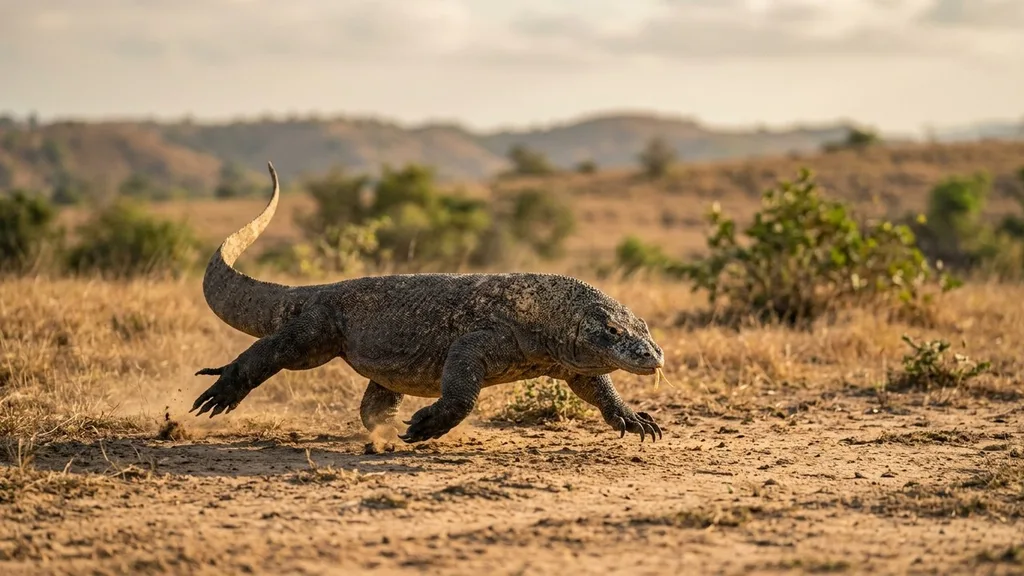
Adult Komodo dragons can accelerate to velocities between 10 to 13 mph, equivalent to 16 to 20 kph, during short sprints, though their primary predatory method relies on stealth and power. These massive lizards propel themselves forward in impressively fast bursts of speed by driving with long claws and a muscular tail. This sudden burst allows the heavy reptile to close distances rapidly when launching surprise attacks.
While Varanus komodoensis frequently consumes carrion, hunters can run quickly to overpower targets by knocking them downward and ripping tissue with sharp claws and teeth. Because high sprinting speeds demand intense anaerobic exertion, dragons cannot maintain this pace over long distances. Sprint velocity functions strictly for brief charges rather than prolonged chases.
Sprint mechanics and locomotion
Locomotion differs noticeably between routine walking and sudden predatory dashes. When walking at a normal pace, the lizard moves with an undulating wavelike motion, leaving a rhythmic sinusoidal track in the dirt as the tail tip drags. Lateral body bending helps advance each limb across flat ground.
Sprint mechanics alter this posture significantly during rapid acceleration. The appendage drags across the ground during slow steps, whereas during running, the tip lifts upward into the air. Raising the caudal tip eliminates friction against soil and rocks, allowing rear limbs to drive forward unimpeded.
Internal musculature coordinates this balance between agility and body control. Muscular bundles positioned in the transverse segment of the tail provide balance during rapid travel, whereas proximal caudal and pelvic tissues supply defensive force and postural stability. These muscle groups anchor the pelvic region during high-speed forward movement.
Caudal mass provides an essential counterweight against heavy cranial and pectoral structures. In heavy adult specimens, the caudal skeleton functions as a dynamic counterbalance against the weighty anterior body, maintaining equilibrium despite immense physical dimensions. This counterweight stabilizes sudden directional shifts during lunges.
The evolutionary commitment to this locomotive tool remains permanent throughout adulthood. Because the species cannot regrow a severed tail like certain smaller lizards, preserving the caudal structure and its lipid reserves is critical for lifelong survival.
Ambush hunting and predatory tactics
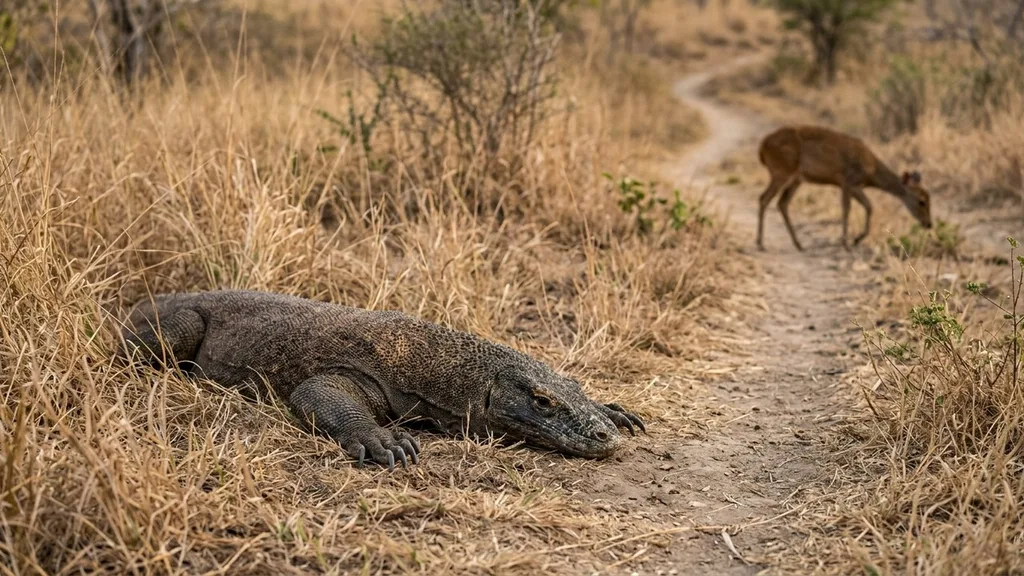
Because sustained high-speed pursuit is energetically costly, the predator relies on stealth. A dragon frequently remains motionless for hours beside an animal path, waiting for a passing deer or other nutritious quarry before striking. Natural coloration conceals the lizard among vegetation along game trails.
Even with patience and rapid acceleration, predatory attempts present challenges. The majority of ambush strikes initiated by the monitor fail to secure the quarry. Prey species frequently notice slight rustling and escape before the lizard closes the remaining distance.
When an attack connects, specialized skull mechanics replace prolonged running. Rather than crushing victims with immense jaw pressure, the dragon uses relatively weak bite forces supplemented by neck pulling and razor-sharp serrations. Powerful neck retractor muscles pull backward to slice through flesh.
This cutting action creates entry routes for chemical agents. The predator applies a vigorous grip-and-rip slashing motion with serrated dentition, opening deep parallel lacerations that facilitate venom absorption. Deep wounds expose vascular tissue to oral secretions.
Scientists have confirmed the presence of specialized venom glands housed within the lower jaw. Ducts convey venomous fluids between lower teeth into wounds during biting.
Envenomation prevents wounded prey from fleeing far. The toxic secretions trigger severe circulatory shock and rapid drop in blood pressure, incapacitating the wounded animal so it cannot flee. Once collapsed from shock, the target can no longer outpace the tracking dragon.
Sensory adaptations and body mass constraints
Physical bulk explains why peak running speed remains limited to short bursts. Wild individuals typically register around 154 pounds (or 70 kilograms), yet the record verified specimen reached an overall length of 10.3 feet (spanning 3.13 meters) and attained a body weight of 366 pounds, amounting to 166 kilograms. Moving such mass demands significant muscular effort from sprawling limbs.
Sexual dimorphism produces notable differences in locomotive bulk between sexes. Male dragons generally attain greater body length and heavier bulk compared to female counterparts. Heavier males invest in robust musculature suited for wrestling and charging strikes.
The lizard’s hide provides durable protection during overland travel. Durable hides varying between black and yellow-gray incorporate embedded osteoderms (bony plates) that shield the body against combat wounds and abrasions. This protective structure prevents injuries across jagged volcanic terrain.
To offset extreme weight during sudden emergencies, dragons possess a unique defense. If confronted by sudden danger, an individual can rapidly regurgitate recently ingested food to shed weight before sprinting to safety. Reducing stomach volume decreases inertia and facilitates faster flight.
Long-distance foraging relies on acute chemical detection rather than visual tracking. A foraging dragon can detect airborne scents of rotting flesh across distances of up to 2.5 miles, spanning roughly 4 kilometers. Sampling airborne chemicals guides lizards toward distant carrion.
While olfaction guides long-range searches, vision assists terminal attacks. Visual acuity allows these monitors to spot targets at distances reaching 985 feet (300 meters), with eyes tuned to track moving objects rather than still shapes. Movement triggers immediate predatory orientation.
Locomotion across life stages
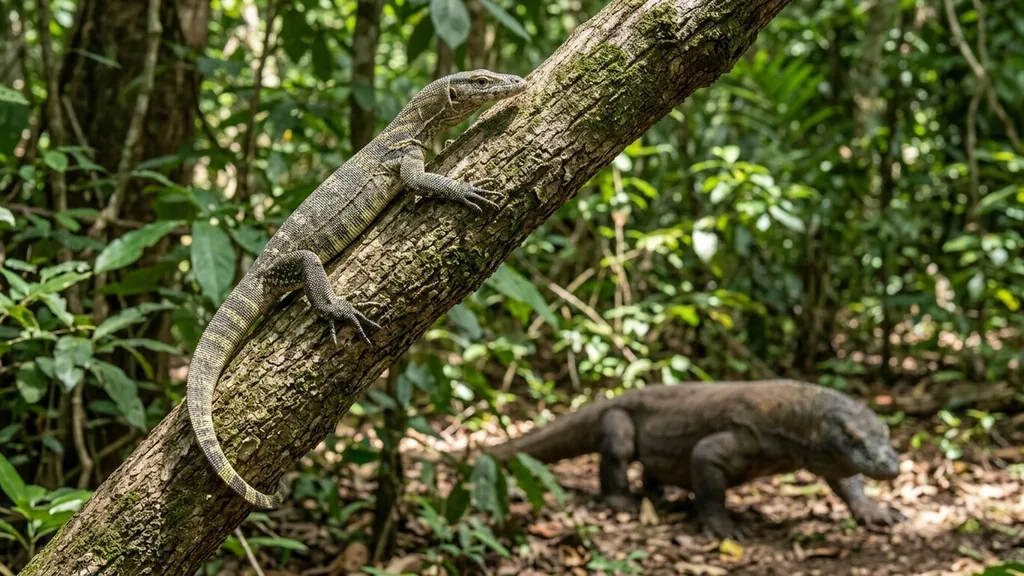
Locomotion transforms substantially across different developmental stages. Newly emerged hatchlings measure approximately 12 inches (30 cm) in total length. These slender young possess bodies adapted for climbing rather than terrestrial sprints.
Cannibalism from adult monitors drives immediate vertical evasion. Upon breaking out of the eggshell, the tiny youngster scurries toward the nearest tree canopy to evade cannibalistic adults. Reaching the forest canopy shields hatchlings from larger predators.
Caudal anatomy aids climbing and branch balance during youth. Young tree dwellers employ their tails to grip overhead branches when climbing down, avoiding fatal falls that would otherwise cause developmental defects or predation. Tail gripping secures stability as juveniles pursue small arboreal prey.
Maturation gradually shifts lizards toward a terrestrial lifestyle. Juveniles transition to fully mature adults between 5 to 7 years of age. As body mass increases, maturing dragons rely on ground ambushes.
Adult males employ powerful muscles during reproductive competition. During the breeding season, dominant rival males face each other in intense ritualized wrestling combat. Males stand upright on hind legs, using their tails for support while attempting to throw opponents.
Island territories and conservation status
Terrestrial environments shape daily foraging patterns and travel corridors. Mature lizards reside predominantly across tropical savannah forests across their native islands. Forest canopies and grassy understories provide cover for ambushes.
These reptiles adapt to several distinct topographical zones:
- Tropical savannah lowlands offering grass cover
- Sandy beaches where marine carrion washes ashore
- Elevated ridge tops providing basking spots
- Dry riverbeds that serve as natural travel routes
While preferring lowlands carpeted in bushes and tall grass, these adaptable reptiles also roam sandy beaches, elevated ridge tops, and dry riverbeds.
Daily activity takes place within established roaming zones. Solitary foragers spend daylight hours patrolling individual home ranges that can span up to 1.9 square kilometers. Dragons explore these tracts searching for scent trails.
Because territories overlap, social hierarchy determines feeding rights. Individuals do not guard fixed territorial boundaries, permitting overlapping activity zones where the largest dominant animal takes feeding priority. Subordinate lizards wait until dominant dragons finish feeding.
Geographic isolation restricts the entire species to a small island group. The global distribution is restricted to several Indonesian islands in the Lesser Sunda chain, including Rintja, Padar, Flores, and Komodo, which measures 22 miles (35 kilometers) in length. Ocean barriers prevent natural dispersal beyond these islands.
Available land area severely constrains total populations. Biologists calculate that the extant wild population occupies an aggregate geographic expanse under 350 square miles, encompassing roughly 900 sq km across isolated terrain. Limited space increases vulnerability to environmental shifts.
Recent surveys reveal population fragmentation across these islands:
- Komodo and Rinca supporting primary groups
- Flores maintaining fragmented pockets
- Gili Motang, Nusa Kode, and Padar harboring small subpopulations
Field assessments conducted as of 2021 estimate that approximately 3,500 wild individuals survive, partitioned into eight distinct subpopulations across the islands of Komodo, Rinca, Flores, and Padar, along with Gili Motang and Nusa Kode.
Preservation efforts focus on anti-poaching and habitat maintenance. The foundation of Komodo National Park in 1980 established crucial legal safeguards and anti-poaching measures to protect vulnerable habitats. Protecting prey populations ensures the continued survival of this formidable predator.
Sources
- Smithsonian’s National Zoo and Conservation Biology Institute: Komodo dragon
- San Diego Zoo Wildlife Alliance: Komodo Dragon
- PubMed Central: Biological Significance of the Komodo Dragon’s Tail (Varanus komodoensis, Varanidae)
- PubMed Central: A central role for venom in predation by Varanus komodoensis (Komodo Dragon) and the extinct giant Varanus (Megalania) priscus
- Animal Diversity Web: Varanus komodoensis (Komodo Dragon)