
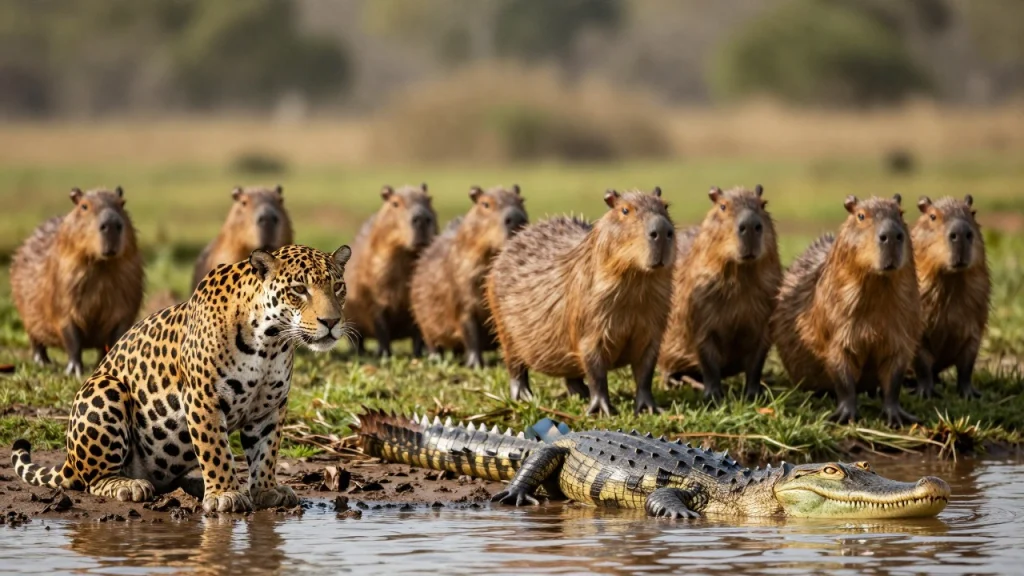
Yes, capybaras have predators. The greater capybara (Hydrochoerus hydrochaeris), the South American rodent that fills almost every animal photo labeled “capybara”, is hunted by jaguars, green anacondas, spectacled caimans and people, according to the species account on Animal Diversity Web.
Risk inside a group is very uneven. Most predators struggle with an adult’s size, but pups are taken far more easily, and jaguars remain the exception that can still kill grown animals. The cast of hunters a pup has to deal with is also far wider than the one aimed at grown animals.
Capybaras answer with group living, alarm calls and the ability to disappear into water, and all three work best where open water sits close to dry land.
The hunters on the capybara list
Predation here mixes large cats, snakes, crocodilians, wild dogs and people, and the roster changes with the age of the prey:
- Jaguar: the predator with the strongest claim on adults. A review of the capybara subfamily ranks the jaguar as its most important predator, with anacondas and caimans taking a share.
- Green anaconda and spectacled caiman: the two reptiles named in the species account alongside the jaguar and humans.
- Ocelots, harpy eagles and anacondas: singled out by the San Diego Zoo as the animals that youngsters can easily fall to.
- Feral dogs, bush dogs, foxes, puma and birds of prey: the rest of the fact sheet’s list, which shows how many kinds of hunter take capybara young.
- Humans: hunting is the other main cause of death, and over-hunting is already pushing some local populations down.
Jaguars pick capybara rather than find them by chance
How often a prey species gets eaten depends on whether the predator has a preference. A meta-analysis of jaguar kills pooled 25 studies and 3214 kills recorded across the jaguar’s range, and capybara were among the species that turned up most often in the diet. Once the abundance of each prey species was accounted for, jaguars showed a statistically significant preference for capybara and the giant anteater, meaning capybaras were taken more often than their numbers alone would predict.
Two findings from that review sharpen the risk. Jaguars are unselective about capybara age classes, so a pup gets no reprieve from a hunting cat, and in one documented case 30% of a population was killed within 2 months. A preference held across the jaguar’s whole range also means capybara losses to jaguars are not a local accident of opportunity.
Pups are the vulnerable stage
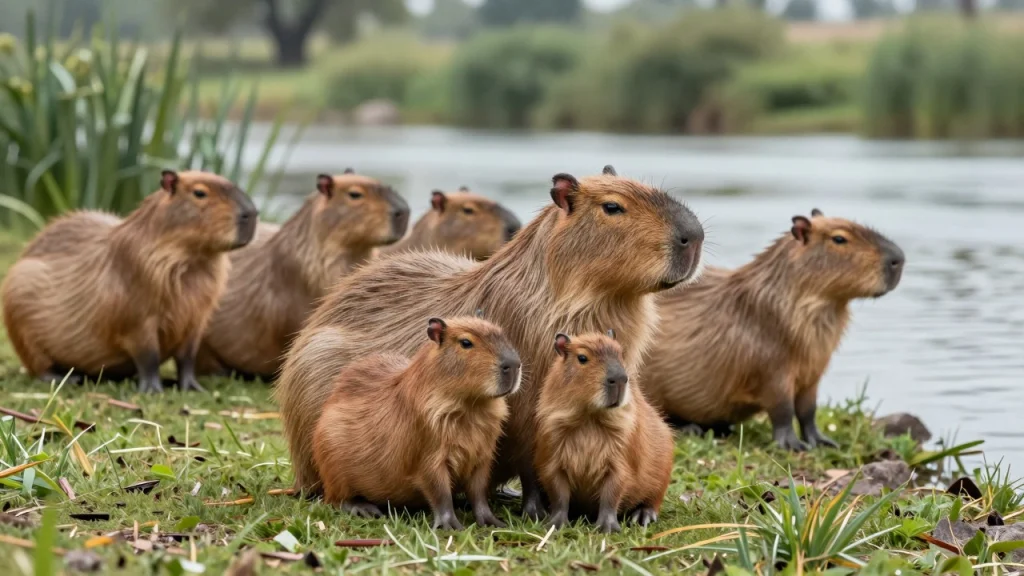
The species account is blunt about young capybaras: through most of their first year they are slow, easily tired and small, and that combination leaves them especially vulnerable to predators. The protection of the group a pup was born into is described as essential to staying alive, and the adults share the work of parenting, including watching for danger.
Group living is therefore a defense, not only a social arrangement. A typical group holds about 10 adults of both sexes, and group size ranges from 3 to 30, while the San Diego Zoo Wildlife Alliance fact sheet puts peak dry-season crowding at up to 100 animals gathered at water. San Diego Zoo makes the logic explicit: many sets of eyes watching the youngsters is what helps them survive, in a landscape where the same page still lists caimans, ocelots, harpy eagles and anacondas as hunters.
Pups also arrive small. A litter is typically 4 to 5 young, and the fact sheet records a birth weight of 1,500 grams, a fraction of an adult’s mass. A pup remains in its parents’ group for about a year, nursing through the first three months of that period, so the window of danger is long.
Water, barking and the shape of the habitat
Escaping into the water
The first response to a threat is to run for the water. Capybaras slip under with only their nostrils and eyes above the surface and can hold their breath for up to five minutes, and their eyes, ears and nostrils are crowded high on the skull, an arrangement that lets a submerged animal keep watching.
Alarm calls and habitat shape
The second defense is a warning bark that moves the rest of the group. Capybaras give that alarm bark while they are feeding, which matters because a diet of grasses and aquatic plants keeps them out in the open where a hunter can reach them.
Habitat shape is the third layer. The habitat they need is lowland grassland along rivers, ponds and lakes, with open water and dry land close together. One study that followed capybaras across several kinds of landscape picked out open water as the resource the animals lean on hardest, for keeping their body temperature in check, for mating and for slipping away from predators, and it also found that tree cover can give a group some cover from hunters.
When the predators disappear
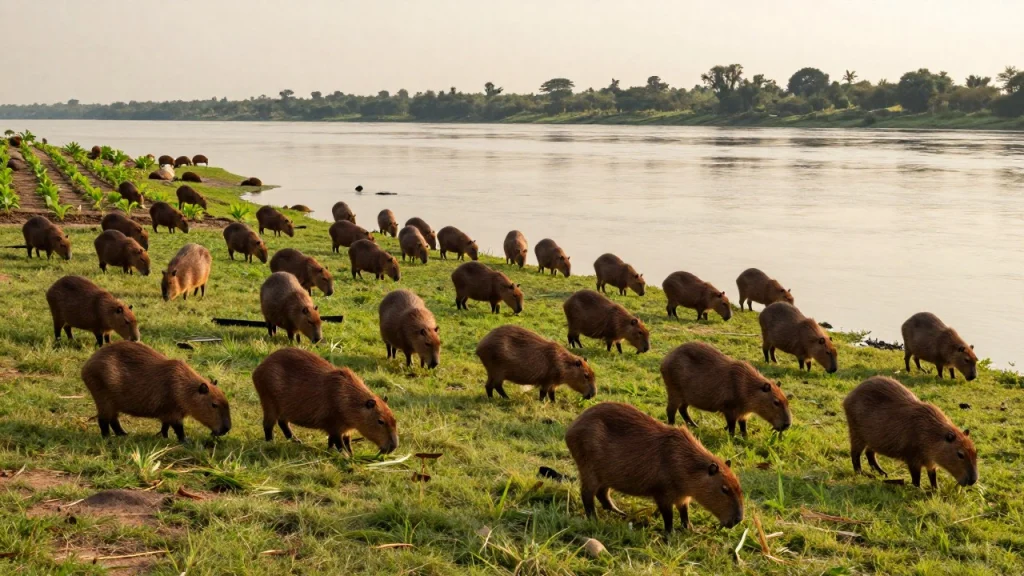
Take the big cats away and the balance of the system shifts. That same body of work credits two things for the population boom seen in recent decades in human-modified country: cropland feeding the animals in large quantity and at high quality, and large predators being far scarcer than they used to be. With fewer large predators around, capybaras are the only large grazer in much of their range, and their effect on the vegetation can be dramatic. Farmers see how that plays out in practice: across parts of the range, big capybara numbers travel with more damage done to crops.
Hunting pressure and the conservation status
In the wild the species averages about 6 years, and the longest-lived reach 10, and hunting adds a second source of death on top of predation. The species account reports that some local populations are already in decline because of over-hunting, and the San Diego Zoo lists deforestation, habitat destruction and illegal poaching among the threats, even though it does not treat the animal as endangered.
Conservation-wise the picture is reassuring: the IUCN places the species in the least concern category, on the basis of a large population, a broad distribution and frequent occurrence inside protected areas, and the San Diego Zoo calls the animal’s habitat prime.
Why most adult capybaras escape
Pulled together, capybaras are preyed on mostly as pups, and the adults that survive to breed are the ones with size, a group of watchers and water within reach. A wild capybara faces a long list of carnivores, but for a grown animal the jaguar is the one that stands out, and the losses that matter most are the young and the animals taken by people.
Sources
- Animal Diversity Web, University of Michigan: Hydrochoerus hydrochaeris (capybara) | INFORMATION | Animal Diversity Web
- Animal Diversity Web, University of Michigan: Hydrochoerinae (capybara) | INFORMATION | Animal Diversity Web
- San Diego Zoo Wildlife Alliance: Capybara | San Diego Zoo Animals & Plants
- San Diego Zoo Wildlife Alliance Library: Capybaras (Hydrochoerus spp.) Fact Sheet
- Frontiers in Ecology and Evolution: Prey Preferences of the Jaguar Panthera onca Reflect the Post-Pleistocene Demise of Large Prey
- PLOS ONE, via PubMed Central: Habitat selection in natural and human-modified landscapes by capybaras (Hydrochoerus hydrochaeris), an important host for Amblyomma sculptum ticks