
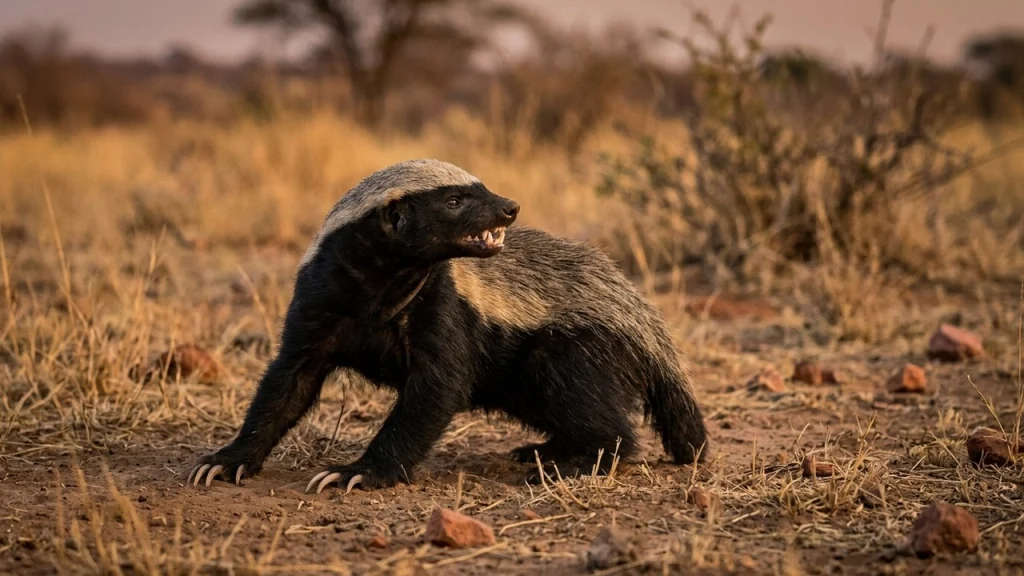
Yes. A honey badger (Mellivora capensis), also called the ratel, can rotate its body inside its own hide and come up facing whatever has just seized it, and that ability is the foundation of its fearsome reputation. The hide is not simply thick. It hangs slack around a stout, muscular body, so a bite or a paw that closes on the animal often ends up gripping a loose sleeve with nothing inside it.
Researchers at the San Diego Zoo Wildlife Alliance credit that looseness with denying a predator a firm hold in the first place, and Animal Diversity Web credits it with letting a caught animal wheel round and bite back. Two things work together here: a covering that is both tough and roomy, and a temperament that treats being grabbed as an opening rather than an ending.
What the hide is actually made of
Underneath the fur the skin is described as thick and tough, measuring 6 mm (0.2 in) at the throat, and only the underparts carry thin skin. Thickness decides whether a bite lands at all. Slackness decides what happens next, because a predator that sinks teeth or claws into a rubbery envelope often finds no purchase and the badger inside it can pivot to face the attacker.
The coat above that skin is built for abrasion rather than for looks. Hair is coarser and thicker along the back and thinner toward the belly, and African populations have no underfur at all. A pale mantle, white to light gray or gray-brown, extends from the crown of the head to the base of the tail over black underparts, while the dark band along the back deepens as the animal ages.
Turning a defensive grab into an attack
Reversing direction only matters if the animal also bites, and honey badgers bite. The San Diego Zoo’s list of defensive behaviour includes a loud rattling call, standing ground instead of fleeing, holding the body firmly with the tail erect, dribbling offensive-smelling gland secretions, and charging with the hair raised. Biting the holder comes at the end of that sequence, but it comes often enough to matter.
The teeth behind that bite are robust, 32 in total, and typically show a high degree of wear. Each foot has 5 toes with a claw, and the claw on the third digit runs about 38 mm (1.5 in), while the hind claws are shorter and blunt enough not to touch the ground.
What the hide still cannot do
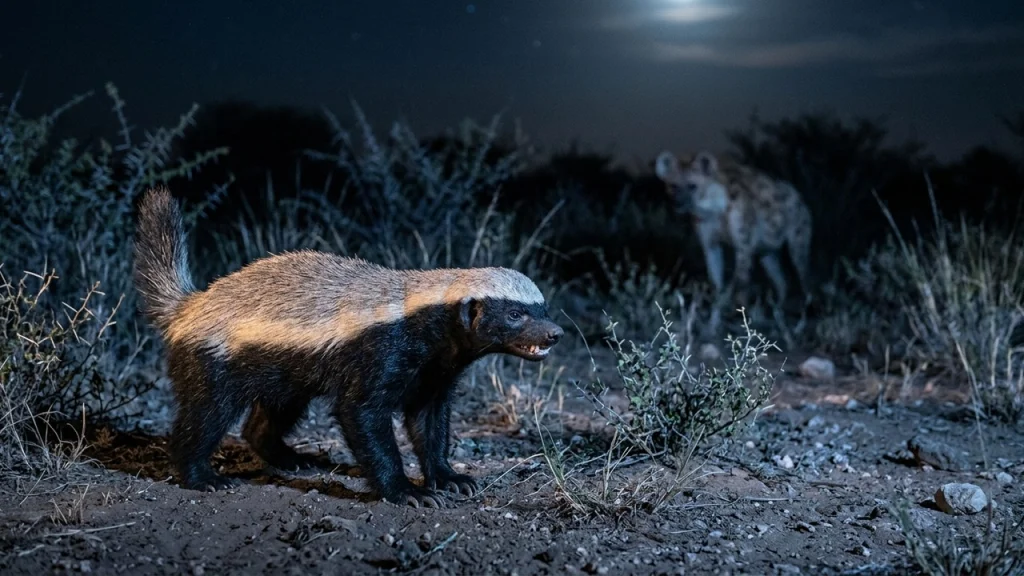
Tough is not the same as invincible. The San Diego Zoo fact sheet is blunt about the folk image, noting that reports of the animal’s indestructibility are inaccurate and that adults fall to leopard, lion and spotted hyena. Animal Diversity Web adds the qualifier that matters most: big cats generally take the older and weaker individuals, because the thick, loose skin makes young ones hard to hold.
The skin also carries a chemical backup. Anal glands release offensive-smelling fluid when the animal is excited, and the badger dribbles that secretion rather than squirting it. Paired with a raised coat, an upright tail and the rattling call, the display gives a would-be attacker room to reconsider.
Why an animal that gets grabbed usually bites first
Honey badgers are as willing to start an encounter as to end one. Animal Diversity Web records that they frequently charge attackers, and the name ratel comes straight from the aggressive, rattling grunts the animal makes, a label given by settlers in South Africa.
Digging into hives, and what a badger really eats
The honey in the name is a bit of a misnomer, since the animal is primarily carnivorous and insectivorous, and that half of the name reflects a fondness for honey and for wild bee larvae. Opening a hive is physical work: the long foreclaws tear away the wood to expose it, and the comb is scooped out.
Honey badgers are opportunistic foragers whose diet shifts with seasonal changes in prey abundance, and the San Diego Zoo records them taking prey across a very wide size range, from 2-2000 g. The recorded menu looks like this:
- Small mammals and small reptiles such as geckoes and skinks
- Venomous reptiles including mole snakes, puff adders and Cape cobras
- Mid-sized mammals such as the springhare
- Honeybees, their honeycomb, and solitary bee larvae
- Ground squirrels, birds and other small carnivores
In the southern Kalahari, small mammals made up 80% of the diet from September to December, and large snakes 58% from January to April. Adult males ate 1.3 kg of food a day on average, females 0.9 kg. Much of that food comes out of the ground, and securing a larger snake can mean nearly 10 minutes of digging. Prey is consumed almost whole, and poisonous snakes are attacked at the head first.
Built around burrows rather than a fixed territory
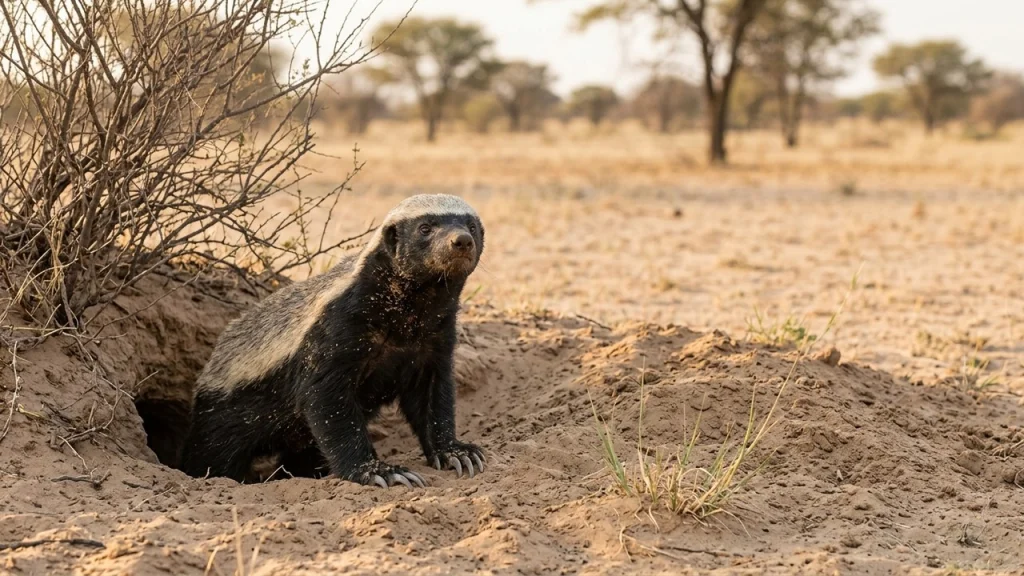
The IUCN assessment calls the range extensive, reaching through most of sub-Saharan Africa. Beyond the continent the animal is found in Arabia, Iran and western Asia, and as far as the Indian peninsula and Nepal. Honey badgers are essentially nocturnal, though they may be active by day in places with little human disturbance, and they range from equatorial African rain forest through miombo and mopane woodland to the arid country at the edges of the Sahara and Namib.
Males are about 33% heavier than females. The forefeet are broad and carry big claws that serve both to pick up prey and to run on. A separate measurement puts a male at a mean 9.4 kg and a female at 6.2 kg. Shelter drives the daily routine: badgers are largely solitary and nomadic rather than territorial, and a female with a young cub moves to a different burrow each night once the cub is around 3 months of age. Males can cover 27 km in a day while foraging, females nearer 10 km.
Family, lifespan and numbers
Litters are usually one cub, born blind and hairless after a gestation of 50 to 70 days. That cub stays with its mother across 12 to 16 months, during which she provides every meal up to 10 to 12 months of age. Wild badgers tend to live 7 to 8 years, cut short by predation and injury, while captive-bred individuals have reached 26 years.
Why the status looks better than the animal’s day
The IUCN Red List assessment, published in 2016 and dated February 28 2015, places the honey badger in the Least Concern category. The category rests on a very wide distribution and a lack of obvious ecological specialisation.
The species is still scarce. Night counts suggest a density of 0.1 individual/km² in the Serengeti, and 0.03 adult/km² in South Africa’s Kgalagadi Transfrontier Park, and the Red List attributes that thinness to small litter size, a long birth interval and a very large home range. Animal Diversity Web records an overall decreasing trend, and the IUCN notes that clearly identifiable threats are causing localised declines and could justify a higher category once better data exist.
The main pressures are persecution by beekeepers and small livestock farmers using steel-jawed traps and poisons, along with use in the bushmeat and traditional medicine trades. Even the hide is not enough against that. Honey badgers do show some resistance to snake venom, and the thickness of their skin may limit how much a bite injects, yet individual badgers have died from honeybee stings. Toughness that shrugs off a bite is not the same as invulnerability.
The short answer
A honey badger never sheds or inverts its skin. It carries a tough, slack hide that lets it reverse direction while a predator is still holding on, and a willingness to bite back that makes reversing worthwhile.
Sources
- San Diego Zoo Wildlife Alliance: Physical Characteristics – Ratel/Honey Badger (Mellivora capensis) Fact Sheet
- San Diego Zoo Wildlife Alliance: Taxonomy & History – Ratel/Honey Badger (Mellivora capensis) Fact Sheet
- San Diego Zoo Wildlife Alliance: Diet & Feeding – Ratel/Honey Badger (Mellivora capensis) Fact Sheet
- San Diego Zoo Wildlife Alliance: Behavior & Ecology – Ratel/Honey Badger (Mellivora capensis) Fact Sheet
- Animal Diversity Web: Mellivora capensis (honey badger)
- IUCN Red List: Mellivora capensis – The IUCN Red List of Threatened Species