

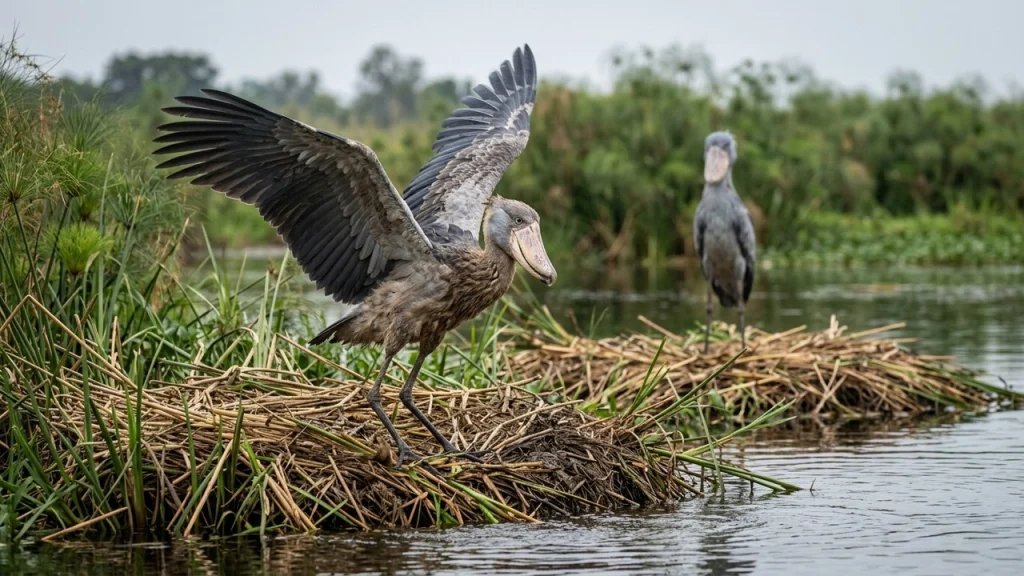
Shoebills can and do fly, even though their bulk and stern look suggest a bird that never leaves the mud. The wings are huge, with a span of almost eight feet, and they carry a body that is lighter than it looks.
How a shoebill flies
Flight is unhurried. The wingbeat runs at only about 150 flaps per minute, which places it among the slowest in the bird world.
Adults also often soar on thermals above their territory during daylight. In the air they keep the neck pulled in, a posture that gives the bird a compact profile overhead.
Despite its stork-like look and name, the shoebill’s closest relatives are the pelicans.
Movement on the wing also serves a practical purpose. In some parts of their range, shoebills shift seasonally between nesting zones and feeding zones.
Size and weight: what the wings must lift
Adults stand 110 to 140 cm tall, and males are larger than females, with longer bills.
Weight figures depend on the source. National Geographic lists average weights of 11 pounds for females and 12 pounds for males, while the San Diego Zoo Wildlife Alliance gives an upper limit of 16 pounds. One number describes a typical bird, the other the heaviest.
The legs are built for wet ground rather than for takeoff. Long, thin legs with large feet suit walking across marsh vegetation.
Young shoebills take months to fly
Development is slow compared with most birds. Feathers are fully grown at about 60 days and fledging comes at 95 days, but the first true flights arrive only at roughly 105 to 112 days old.
Even after fledging, adults keep supplying food for about one month, and then the young are fully independent. A shoebill reaches maturity at three to four years old.
Every fledgling is a small success. Females lay an average of two eggs, hatching takes about a month, and typically only one chick survives to fledge.
Where the shoebill lives and hunts
Shoebills live in freshwater swamps and large, dense marshes. The core populations are in southern Sudan, especially the White Nile Sudd, plus wetlands of northern Uganda, western Tanzania and the Bangweulu swamp in northeastern Zambia.
Hunting relies on stillness more than on flight. A shoebill can hold still for hours, so a lungfish surfacing for air may not notice it in time.
The strike itself is a lunge. The bird waits silently by the water, then thrusts forward with wings spread and drops bill-first onto a fish. Researchers call the technique collapsing.
Poorly oxygenated water works in the shoebill’s favor, because fish rise to the surface for air more often and become easier to catch.
What a shoebill eats
Lungfish are the favorite meal, and they can reach six feet long and nearly eight pounds. Catfish, eels, water snakes and even small crocodiles also make the menu.
The tool for the job is a bill about a foot long that resembles a Dutch clog, with sharp edges and a hook at the tip.
In the wetlands they occupy, shoebills rank as important predators. Few animals prey on adults.
Solitary habits and family life

Shoebills are solitary, and even a mated pair feeds at opposite sides of its territory. Both parents share nest building, incubation and chick care.
Shoebills are mostly silent, but they sometimes clatter their bills as a greeting and while nesting. To keep cool, they use gular fluttering, which vibrates the throat muscles to shed heat.
Nests built on water
Nests sit on a small island or a mass of floating vegetation. To cool the eggs, a parent carries a bill full of water and pours it over the nest.
Conservation status and lifespan
The shoebill is listed as Vulnerable on the IUCN Red List. The IUCN estimates only between 3,300 and 5,300 adult birds remain, and the population is going down.
Clearing land for pasture is a major threat, and cattle sometimes trample nests. People also hunt shoebills, for food in some places and as a bad omen in others.
Safe from those pressures, a wild shoebill can live to almost 36 years, which makes every lost adult a long-term loss for the population.