
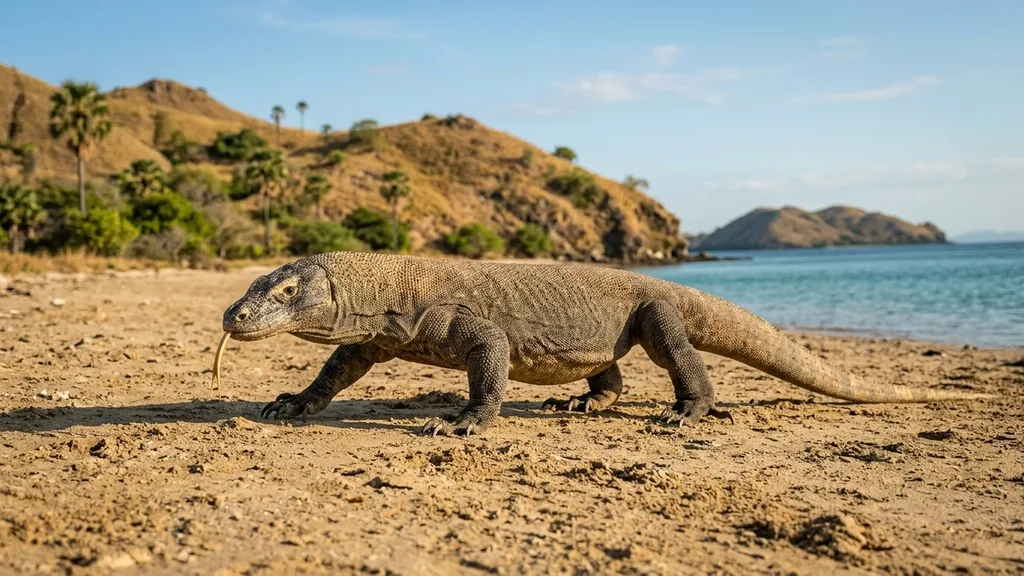
Komodo dragons live in the wild on only a handful of Indonesian islands, all part of the Lesser Sunda group in the east of the country. The best known are Komodo and Rinca, but small numbers also live on other nearby islands.
Within those islands, adults favor dry savanna and open lowlands with tall grass and bushes. They also turn up on beaches, ridgetops and dry riverbeds, so the species is not tied to a single kind of ground.
Which islands do Komodo dragons live on?
The San Diego Zoo Wildlife Alliance names Flores, Gili Motang, Komodo, Nusa Kode and Rinca as islands with living populations, and it also lists Padar. Together these islands hold the species’ entire wild population.
Padar deserves a caveat. The Smithsonian’s National Zoo reports that nobody has seen a dragon there since the 1970s, and it links the loss to heavy poaching of deer, the lizard’s main prey.
The largest island in the group is Komodo itself, at 22 miles (35 kilometers) long. Even so, the animals are not spread evenly. Almost 70% of all dragons live on Komodo and Rinca combined, while Flores holds three separate subpopulations.
What is the Komodo dragon’s habitat like?
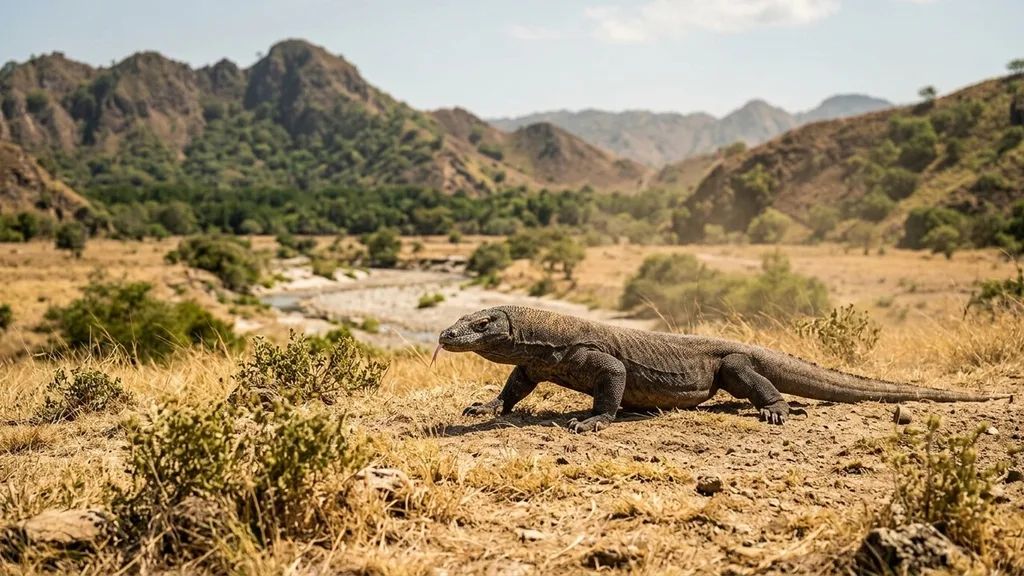
The islands are volcanic, rugged and hilly. Forest covers part of the land and savanna grassland covers the rest.
The climate is hot. During the dry season, daytime temperatures often reach 95 degrees Fahrenheit (35 degrees Celsius), with humidity around 70%.
Dragons are found from sea level up to roughly 820 m in elevation. That range covers the beaches and the ridgetops that the National Zoo describes.
How dragons cope with the heat
Adults dig burrows and retreat into them at night and when the weather turns very hot. Some of these shelters appear on the slopes of dry streambeds, among tree roots.
A typical day includes basking in a sunny spot, then hunting, then a long rest in the shade at the hottest hour.
Young dragons live in trees
Juveniles use a different part of the habitat. They are arboreal and stay in forested areas until they are eight months old.
How much space does a Komodo dragon need?
Although it is the largest lizard, the Komodo dragon lives in a smaller range than any other large predator on Earth, according to the San Diego Zoo Wildlife Alliance. The whole species is squeezed into an area of less than 350 square miles (900 sq km).
An individual dragon’s own territory is also modest. Animal Diversity Web puts the home range of a Komodo dragon at approximately 1.9 km^2.
Are Komodo dragons at risk on their home islands?
Yes. As of 2021, roughly 3,500 adults and juveniles were estimated to remain. A decline from 5,000 dragons over 40 years led the IUCN to move the species from vulnerable to endangered.
Their tiny range makes them vulnerable. Rising seas could remove between 30–70% of the native range by 2040, according to predictions cited by the San Diego Zoo Wildlife Alliance.
Protection is uneven. No more than 10% of the Flores subpopulation is estimated to live inside a protected area, whereas dragons elsewhere have benefited from Komodo National Park, created in 1980, along with strict laws against poaching.