
Orcas carry a name that sounds like a warning, but it began as a description of their hunting. In the eighteenth century, Basque whalers watched these predators overpower much larger cetaceans and gave them a Spanish label that meant assassin of whales. Over time the words swapped order in English, turning whale killer into killer whale.
That old label stuck because some orcas still earn it every day. Mammal hunting pods cooperate during pursuits, while fish eating pods follow a very different menu. Scientists therefore treat the nickname as a clue about diet and teamwork, not temperament toward people.
How whale killer became killer whale
The original phrase put the victim first and the hunter second. It highlighted animals that could kill whales, rather than whales that kill everything. English speakers later reversed the order, which made the name sound as if orcas threaten all large creatures, including humans.
That reversal matters because it changed the meaning. Whale killer describes a predator of whales, while killer whale sounds like a whale that kills. The first version points to observed hunts. The second version invites fear without explaining behavior.
Early sailors had good reason to notice those hunts. They saw streamlined, dark backed animals surround, exhaust and tear apart prey much bigger than themselves. The spectacle was rare among ocean predators, so the assassin label felt accurate to witnesses.
Not whales at all, but giant dolphins
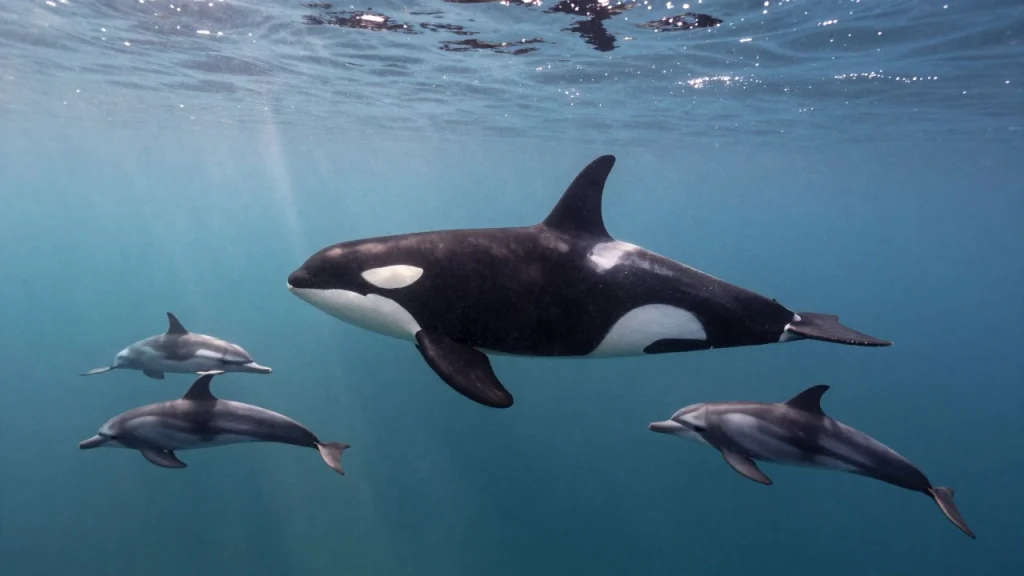
Despite the common name, orcas belong with dolphins in everyday and scientific grouping. Their formal name is Orcinus orca, and they sit inside the Delphinidae family, which holds all dolphin species plus some larger forms with whale in their names. In other words, killer whale is a popular label, while dolphin reflects ancestry.
They are also toothed hunters, members of the suborder Odontoceti. That means they seize single animals with teeth instead of straining tiny food from water. Teeth shape the whole lifestyle, from the species pursued to the way meat is shared or ripped apart.
These dolphin relatives rank as the biggest living representatives of their family, with measured adults reaching 23 to 26 feet long and weighing four to eight tons. Males run larger than females, and one well known measurement puts the average male around 7,200 kg.
A black and white hunter built for recognition
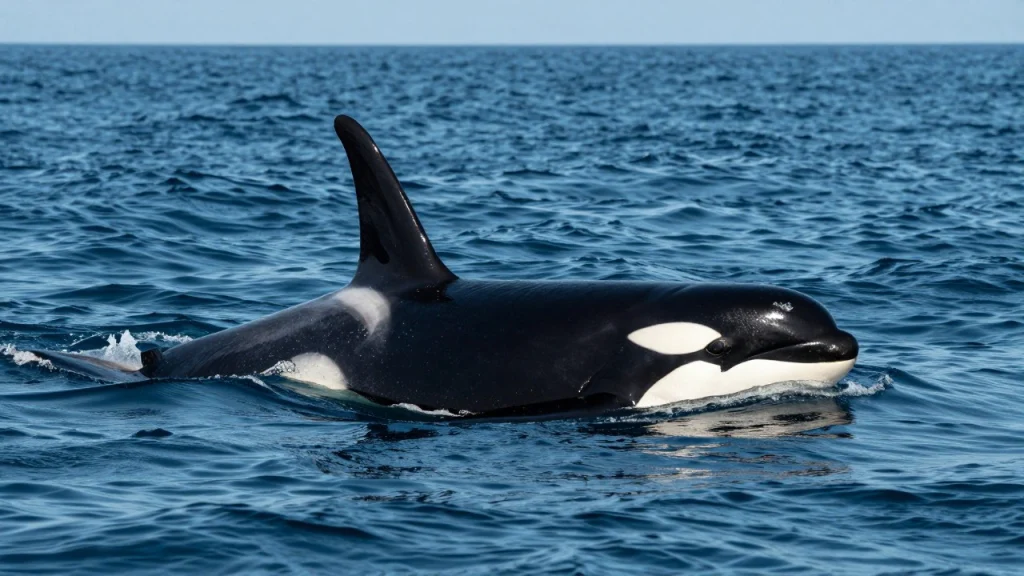
Orcas show dark backs and light undersides, with pale markings on the chin, belly and eye area plus a gray saddle near the dorsal fin. The pattern breaks up the outline when seen from above or below, which helps a predator approach without early detection. Researchers also use the saddle and fin shape, photographed from the left side, to tell individuals apart.
The dorsal fin adds another visual clue. A mature male carries a tall, roughly triangular fin that can rise up to six feet above the water, while females and younger animals show a shorter, more curved fin. The difference becomes clear as males mature and the fin straightens and grows.
Newborns start much smaller and look slightly different. Calves span roughly 2 to 2.4 m in length, with birth mass near 136 kg, and the pale areas can carry a yellowish tint during early life. The contrast sharpens with age as the adult pattern develops.
What earned the fearsome nickname
Orcas sit at the very top of the marine food web. They face little threat once grown, and their success comes less from size alone than from flexible feeding and social coordination. Different populations specialize, so the species as a whole eats an unusually broad range of foods.
Overall, orcas display the broadest feeding range among cetaceans, although each population usually focuses on particular prey and foraging methods. That combination explains the reputation: one species can act like a fish catcher in one bay and a whale hunter in another ocean. The nickname captures only the second role.
Their prey list shows the breadth: they pursue seals, sea lions, smaller whales, dolphins and fish. Such variety means pods need different skills. Fish eaters often herd schools and pick out single targets with sound. Mammal eaters stalk warm blooded prey that hears well, learns fast and fights back, so stealth and timing matter more.
Pods that hunt like wolf packs
Orcas live in tight family pods and often strike together, coordinating roles the way wolf packs do. Sailors once likened them to sea wolves since relatives cooperate during pursuits, echoing wolf pack tactics. The point is coordination: animals take roles, herd prey, create waves and block escape routes.
The tactics can be dramatic. A family group at times teams up to encircle a huge creature, for example a blue whale. The group then pursues, bites and tires the giant until it can feed. Against ice dwelling prey they slap tails and lift water to knock seals into the sea.
Meals match the method. Orcas take in about 45 kg of food a day on average, although hungry animals can eat much more. They gulp smaller catches whole and rip bigger carcasses into chunks before swallowing.
Their mouths suit that style. Adults carry about 45 teeth, each close to 3 inches long, shaped for ripping and tearing prey. The teeth do not grind, so they are built for ripping and tearing prey rather than chewing.
Fish lovers and mammal hunters follow different rules
Not every pod hunts whales, which is central to the name puzzle. Resident families lean toward fish, while transient families pursue sea mammals. The two forms can share waters yet keep separate diets, social habits and travel paths.
Movement reflects those choices. Resident groups eat fish and range over at least 800 miles, while transient groups eat marine mammals and cover at least 1,500 miles. Wider travel helps mammal hunters find scattered, mobile prey.
Local feeding records make the split concrete. In shared waters, resident animals focus on fish, while transient animals pursue harbor seals plus harbor porpoise, Dall’s porpoise and sea lions. Transients surface briefly, travel quietly in small parties and use shoreline rocks to hide their fins.
Ocean wanderers with deep family ties
Worldwide they form the most broadly spread group among whales and dolphins, living both offshore and near shore. That reach partly explains why many cultures met them and shared stories about fierce black and white hunters.
Depth use is flexible. They often cruise at 20 to 60 m, visit shallow shorelines and can dive to 300 m when chasing food. Daily travel can be large, and animals shaped by open water routinely cover up to 40 miles a day while searching for meals and working out.
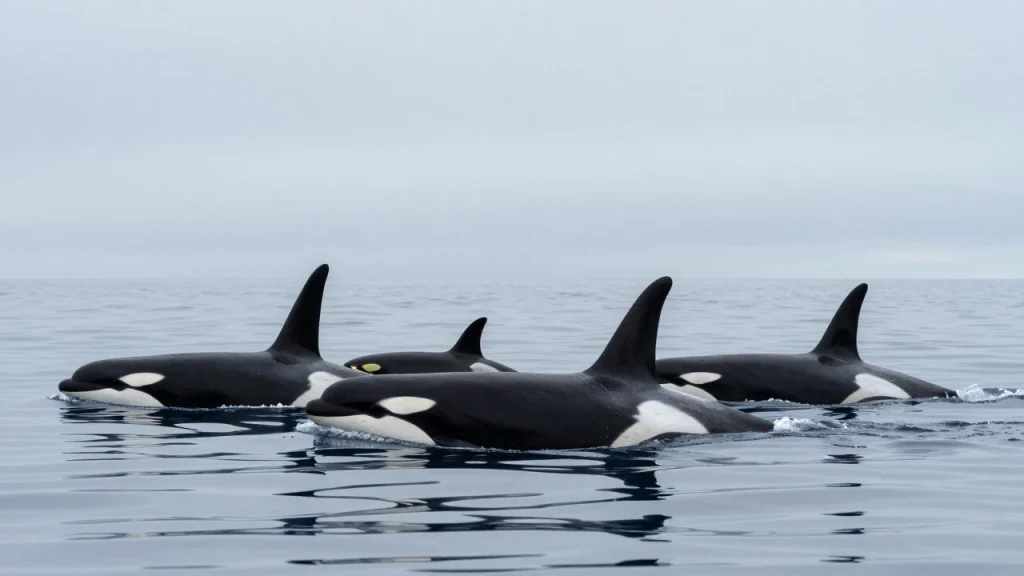
Social life anchors that wandering. Orcas are highly social and individuals tend to remain with their birth pods for years. Typical pods hold two to 15 animals, although bigger gatherings form for mating, social contact or seasonal feeding. Other field accounts describe deadly family pods of up to 40 individuals working together.
Sound holds the society together. Orcas use echolocation to sense surroundings and keep in touch, sending sounds that travel underwater and bounce back from objects to reveal location, size and shape. Clicks serve mainly for sensing surroundings, while calls and whistles carry social messages. The echoes can form hearing based images precise enough to single out one silver salmon inside a mixed school.
Why the label misleads today
The name suggests danger to people, yet field history tells another story. Observers have never recorded a free living orca causing a person’s death. Captive incidents and wild behavior belong in separate categories, because confinement, training and social disruption change how these wide ranging animals act.
Long lives also complicate the monster image. Average life span in the wild reaches 50 to 80 years. Long memory lets pods pass hunting methods, vocal styles and travel routes across generations.
Numbers give context too. Researchers estimate around 50,000 killer whales globally, spread across many forms with different habits and home waters. Some groups face heavy pressure from noise, contaminants and scarce prey, while others remain more stable. The variation is why one grim nickname cannot describe every pod.
So the answer fits in one sentence: orcas are called killer whales because whalers first knew them as killers of whales. The name honors whale hunting skill, not a habit of attacking people, and it hides an equally important truth that these social, vocal and wide ranging ocean specialists are dolphins first.
Sources
- U.S. National Park Service: Orca (Killer Whale) – Kenai Fjords National Park
- NOAA Fisheries: Killer Whale: Science | NOAA Fisheries
- National Geographic: Orcas (Killer whales) | National Geographic
- Animal Diversity Web: Orcinus orca (killer whale) | INFORMATION | Animal Diversity Web
- National Geographic: Orca | National Geographic Kids