
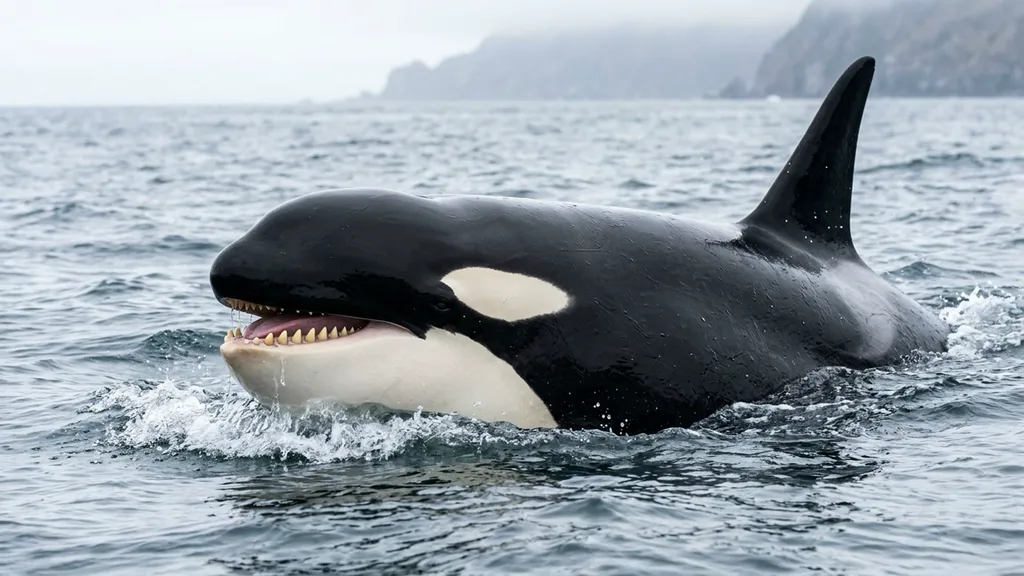
None of the university, government or research sources behind this article gives a measured bite force for orcas. What they do give is one thesis that estimated total jaw-muscle force, analyzed jaw stiffness and drew a conclusion about how powerful the bite is.
That thesis, a 2025 master’s thesis from West Chester University, concludes that the killer whale does not appear to have an especially powerful bite for a predator with a skull of its size. It also observes that very little work has been done on killer whale feeding biomechanics.
What the thesis analyzed
For jaw stiffness, the author used finite element analysis on a juvenile male Bigg’s killer whale. The killer whale lacks an especially stiff mandible compared with the false killer whale and the saltwater crocodile, the thesis reports. Separately, it used the dry skull method to estimate how much force the Bigg’s killer whale’s jaw muscles produce in total.
The thesis finds no clear specialization in jaw stiffness or bite strength. It suggests this may be related to the size of most of the killer whale’s prey compared with the whale itself, and to its pack hunting behavior.
Two methods behind the estimates
A 2015 paper in PLOS ONE says dry skull studies of mammals have built a database of bite force estimates that it calls comprehensive and rigorous, and that these estimates run only slightly lower than results from finite element analysis (FEA).
Orca teeth and how orcas eat
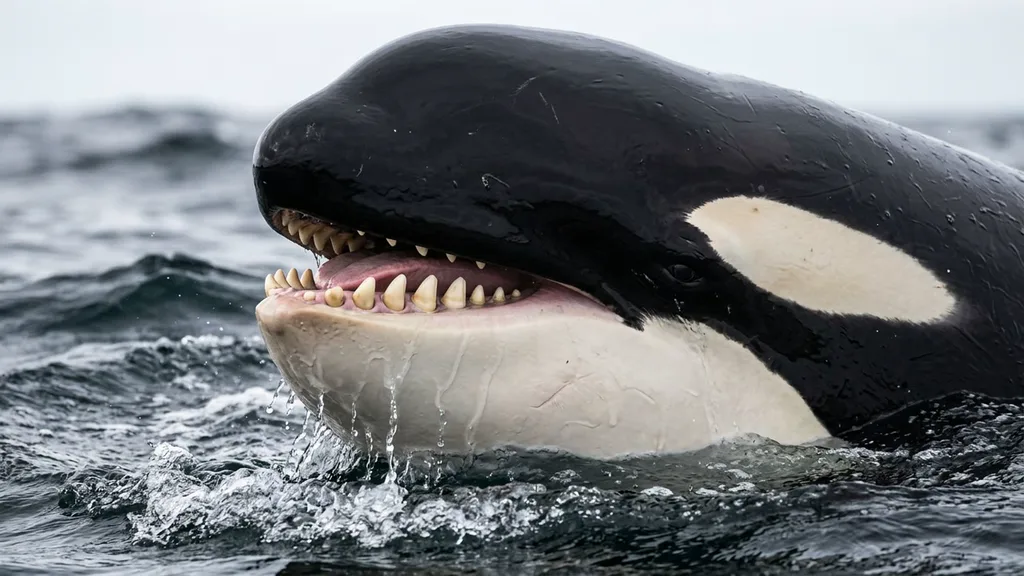
NOAA Ocean Today says an orca has between 40 and 56 interlocking teeth, each about three inches long. The teeth are cone-shaped and rip and tear rather than chew.
Animal Diversity Web says orcas swallow small prey whole but tend to tear larger prey up before eating it. On average an orca eats 45 kg of food a day, and it can eat much more.
Hunting in groups
NOAA Fisheries calls the orca the ocean’s top predator and the largest member of the dolphin family, at up to 32 feet in length and up to 11 tons in weight. Animal Diversity Web adds that orcas often hunt in packs, relying on coordinated social behavior and communication to take prey larger than themselves.
Bigg’s killer whales and residents differ in skull shape
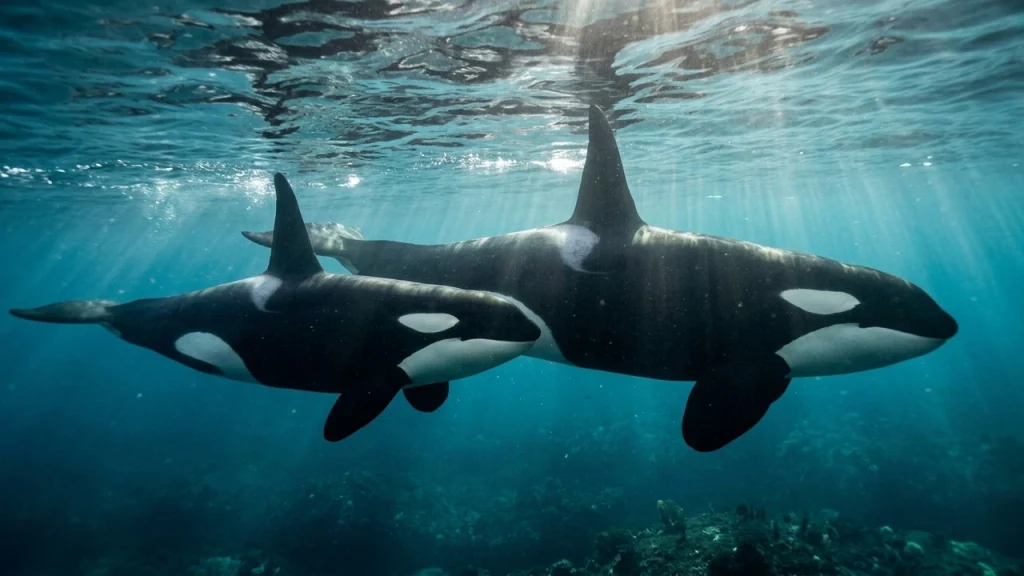
NOAA Fisheries says no other cetacean has a more varied diet than the species as a whole, but populations are usually specialized in what they eat and how they forage. In the North Pacific there are three main types, or ecotypes: Resident, Transient and Offshore, which differ in appearance, diet, habitat, genetics and behavior. In the U.S. Pacific Northwest, Residents eat exclusively fish, mainly salmon, while Transients, also called Bigg’s killer whales, primarily eat marine mammals and squid.
A study in Royal Society Open Science reports that Bigg’s killer whale skulls are longer and more robust than resident skulls. An analysis of both skull measurements and jaw measurements yields distinct clusters for the two ecotypes.
Sources
- West Chester University (Digital Commons): The Prize Biter of Modernity? Investigating Killer Whale Bite Mechanics
- PLOS ONE: Bone-Breaking Bite Force of Basilosaurus isis (Mammalia, Cetacea) from the Late Eocene of Egypt Estimated by Finite Element Analysis
- NOAA Fisheries: Killer Whale
- NOAA Ocean Today: Killer Whale Anatomy
- Animal Diversity Web: Orcinus orca
- Royal Society Open Science (via PubMed Central): Revised taxonomy of eastern North Pacific killer whales (Orcinus orca): Bigg’s and resident ecotypes deserve species status