
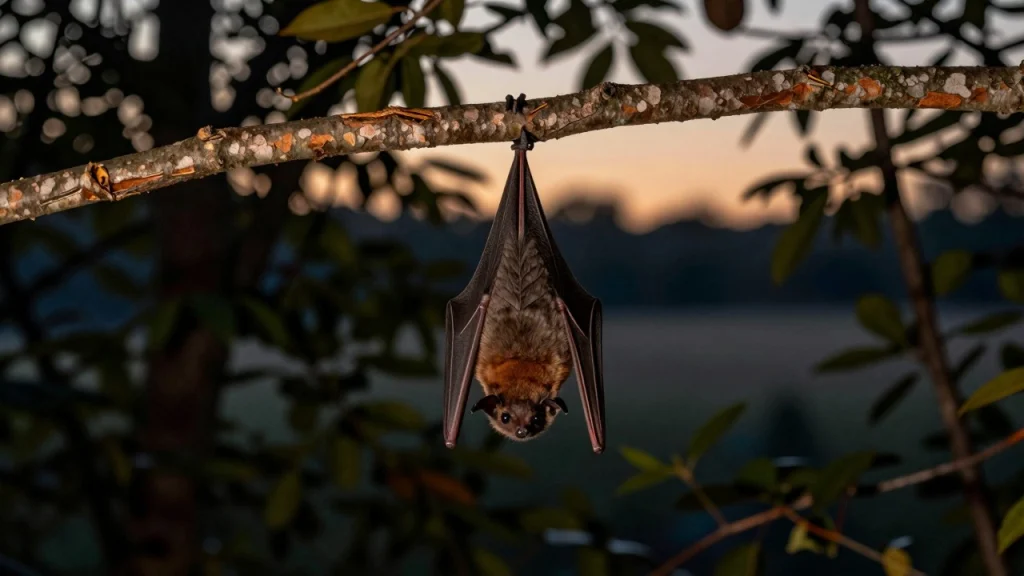
Bats are not used to people, and most of them would rather keep their distance. That answer sounds obvious until you notice that the bats which give people a fright are usually the ones behaving abnormally, not the ones behaving normally.
Avoidance is the normal rule. Researchers in Colorado reviewed bats that had contact with people and found that individuals mixing with humans carried rabies far more often than those that steer away, which is what you would expect if most bats give people a wide ber and only the sick ones fail to.
What fear looks like in a flying mammal
Bats pass the daylight hours hanging in a roost, then emerge after dark to hunt, so the hours when a person is most likely to be outdoors are hours when bats are shut away indoors. Predator avoidance shapes the rest of their behavior too: they hide in sheltered places by day and survive the night through agile flight, which is why you rarely see one settle down in the open when a person is near.
Their sonar is not the problem. Bats call well above the pitch of human hearing, which lets them work out a pitch-dark space in fine detail without any light at all. What does affect them is noise. They actively steer clear of ultrasound in their surroundings, and they shift their calls whenever other sound masks what they are listening for.
A field experiment measured that response. Researchers set up at three waterside sites on the River Teme and played ultrasonic deterrent sounds over open water. While the deterrent played, overall bat activity fell by 30%. The bats that stayed changed how they moved too, flying significantly faster along less tortuous paths. Straight, fast flight is how a bat commutes rather than hunts, so that switch reads as an attempt to leave, not an attempt to work around the noise.
A sleeping colony advertises its unease
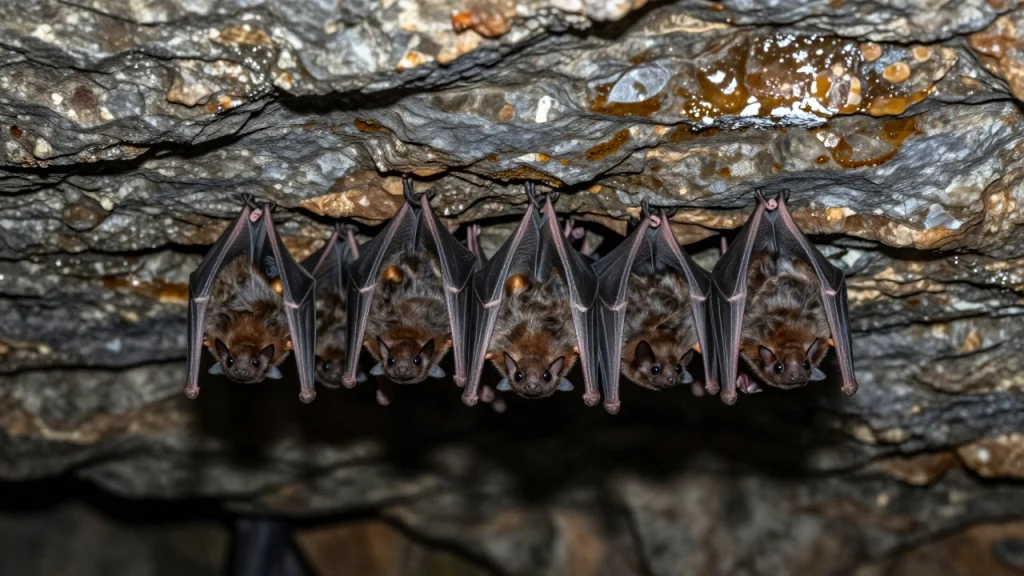
Resting bats are not indifferent ones, and sleep does not shield them. Even deep in torpor, a bat can react to high-frequency noise and to the sound of human voices. Loud sound and ground vibration make resting animals stir more often, using up the fat they have stored and sometimes pushing them out of the cave entirely. Managers running a tourist cave have recommended holding visitors at least 12 m back from roosting bats for that reason.
Colonies also reveal alarm in their daily timing. Disturbed bats hang separately and in fewer, smaller groups instead of pressed shoulder to shoulder. A colony that feels unsafe may begin its evening departure later than normal, and the whole exit can stretch out for longer than usual. In one monitored roost, machinery switched on outside made the animals take flight indoors, settle somewhere else, and appear far more alert than before.
The bat that stops being wary is the warning sign
Here is the part of the question that matters for personal safety. Rabies does something specific to behavior in wildlife generally: the infected animal acts abnormally, drops its usual caution around people, and turns aggressive. A healthy bat’s caution is exactly what keeps most encounters harmless, so a bat that has become unconcerned around humans has lost the protection that usually prevents a bite.
The scale of the risk is small but not zero. Bats that act oddly or that seek contact with people are up to 10 times more likely to carry rabies than the average wild bat. In the Colorado data, 30% of the bats that bit people were rabid, compared with 14% of the bats that never bit anyone.
Most bat encounters are accidents
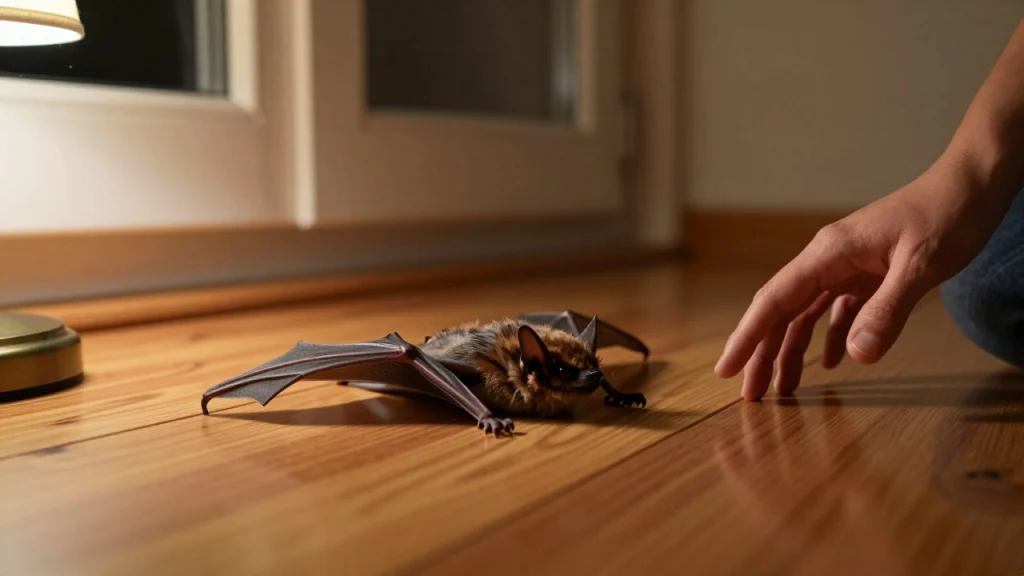
Four everyday situations accounted for 62% of the recorded encounters. A bat landed on someone who was awake in 19% of cases, someone picked up a grounded bat outdoors in 18%, a sleeper discovered one in the room in 15%, and a person tried to free a bat from a building in 10%. Roughly a third of the incidents were avoidable in hindsight.
A bat on the floor is the classic case, and its helplessness is built into its anatomy. Getting airborne means releasing a perch and dropping, and a good many bats cannot launch from a flat surface at all. A bat found on the floor, inside a car, or in a bedroom is therefore far more likely to be stuck, chilled, or unwell than choosing to be there.
What human fear costs bats
Bats are the only mammals with true powered flight, and they are a large order, numbering close to 1,000 species. Only 3 of them drink blood, and that blood is usually cattle’s rather than a person’s, so the vampire image reflects a very small minority of the group.
The argument for leaving them alone is ecological as much as humanitarian. Bats keep environments healthy for animals and people alike, and they are already under pressure. About 25% of the species in the order, close to 240 of them, are considered threatened by the IUCN.
Reproduction is slow. A mother usually bears a single pup, occasionally two, in a season, and a newborn bat weighs between 10% and 30% of its mother’s weight. Wild individuals are commonly documented surviving 10 to 25 years, and many live past 30.
If a bat turns up close to you
- Watch wildlife from a distance and keep your hands off it, including keeping children from picking up a grounded bat.
- If one acts defensively, lies on the ground, hovers near, or touches someone, report it to a ranger immediately and leave it alone.
- Treat any bite or scratch as urgent, because rabies travels in bat saliva through a wound. It is 100% preventable in people with proper medical care, though without treatment it is nearly always fatal.
- Close the gaps. Sealing overnight dwellings such as tents or cabins against small openings stops bats getting in to begin with.
The short version is that bats are wary of us the way most wild animals are, and their caution works in your favor far more often than against it. The exception is a bat that has lost its normal behavior, and that is the one to report rather than rescue.
Sources
- Emerging Infectious Diseases (CDC): Risk for Rabies Transmission from Encounters with Bats, Colorado, 1977-1996
- U.S. National Park Service: Bats and People
- San Diego Zoo Wildlife Alliance: Bat
- Animal Diversity Web, University of Michigan Museum of Zoology: Chiroptera (bats)
- Journal of Experimental Biology: Acoustic deterrents influence foraging activity, flight and echolocation behaviour of free-flying bats
- Frontiers in Conservation Science: Collaborative conservation of cave-roosting bats: guidance on managing rock climbing near caves