
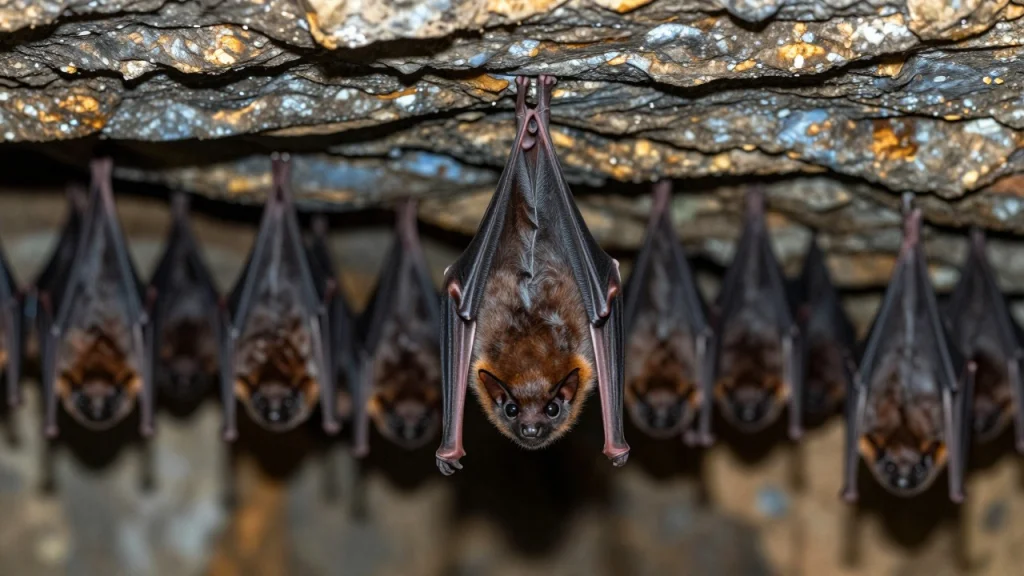
Bats are the mammals that break the rules on lifespan. Wherever researchers have long-term data, wild bat lifespans are typically documented from 10 to 25 years, and many individuals go on living past 30. Most mammals follow a simple script in which lifespan rises with body size, which makes a bat’s numbers look implausible at first glance.
Bats alone break that pattern, with a typical species living at least 3.5 times as long as similar-sized mammals.
The reasons are a package of habits rather than a single trick. Bats hibernate through cold seasons, spend daylight hours in protected roosts, fly agilely at night, and reproduce slowly, spreading a small number of offspring across a very long life. Researchers have also found that exceptional longevity evolved separately in at least four bat lineages, so long life is something this order solved more than once.
Individual bats have been followed for more than 30 years
One field record involves a little brown bat (Myotis lucifugus) that was banded and then caught again 33 years later. Adults of that species weigh just 7 grams, roughly one third the size of a house mouse.
The account that compiles that recovery also notes that the little brown bat is among the most studied bats on Earth, and that other, less well-known species may live even longer. Read the 33-year figure as a floor rather than a ceiling.
The species holding the record
A genome study of Brandt’s bat (Myotis brandtii) names it the longest-lived bat species recorded so far, a lifespan beyond 40 years, and its reported maximum is at least 41 years. Adults weigh only 4 to 8 g and the species ranges across temperate parts of Europe and Asia, resting by day, feeding at night and hibernating through winter.
For a general summary the National Park Service puts it more simply, noting that a few individuals reach 35 years, and it counts more than 1,300 species in the order. Across a group that large, longevity varies widely, so no single figure describes every bat.
Measuring longevity against body size
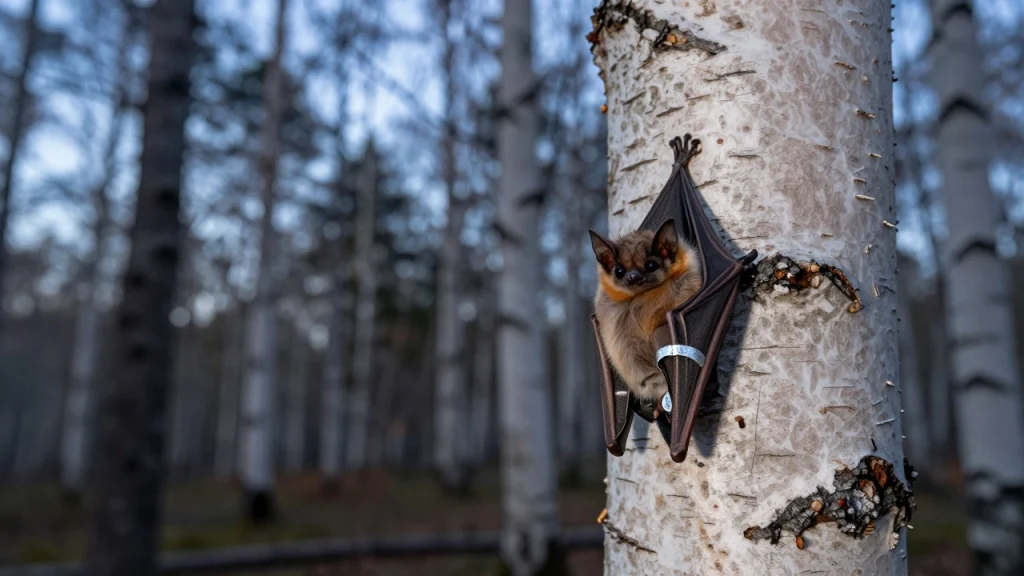
Comparing animals of equal weight is done with a simple ratio. Researchers divide how long a bat actually lives by the lifespan predicted for a placental mammal of the same weight that does not fly, and call the ratio a longevity quotient, or LQ. An LQ above 4.2 marks a lineage as extreme, and four bat lineages clear that bar: horseshoe bats of the genus Rhinolophus, the vampire bat Desmodus rotundus, and long-eared bats of the genus Plecotus, plus at least one Myotis branch.
The common ancestor of bats is reconstructed as living 2.64 times longer than a placental mammal of equal size, and one species sits far beyond the rest of the pack, since Myotis brandtii registers an LQ of 8. Flight alone cannot be the explanation, because every bat flies.
Hibernation, cave roosts and daily torpor
Energy supply is part of the story, since hibernation and daily torpor may hold down the total energy a bat burns across its whole life. Three of the four extreme-longevity lineages hibernate. The fourth is instructive: the common vampire bat stays flexible instead, dropping into torpor between feeding bouts, and its network of food sharing lowers the risk of starvation.
The comparative analysis is more specific. For species that hibernate, longevity tracks three factors: body mass, how far the range sits from the equator, and cave use. Species that do not hibernate are shaped by a different set: overall size, use of caves and any sexual dimorphism.
Species that roost in caves live longer, while species in which males are bigger than females live shorter lives, a pattern researchers link to the way males fight for access to females. A bat working in the dark is difficult prey even for an owl. Flexible control of body temperature may also help bats ride out infections.
Few pups, many breeding seasons
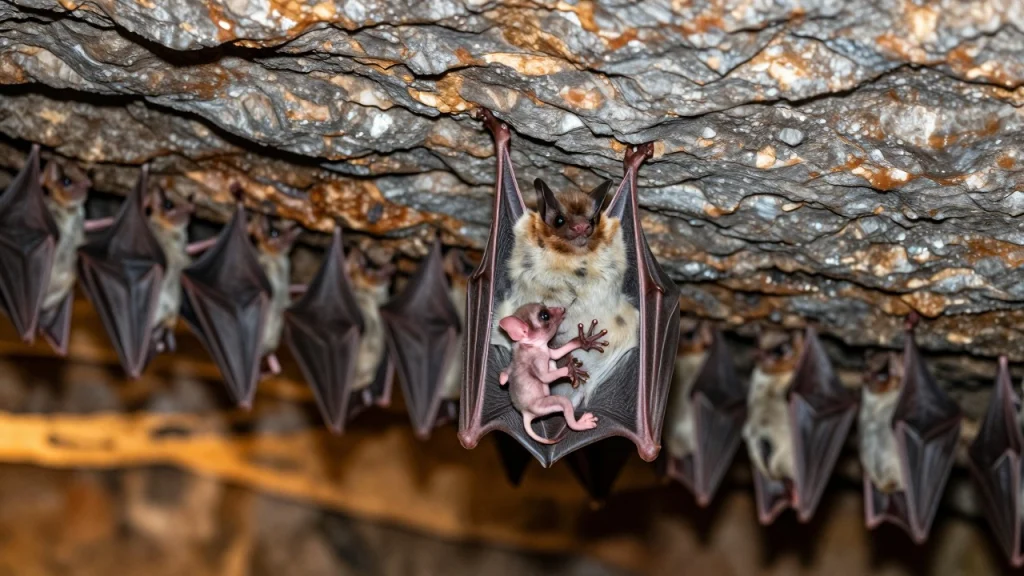
Longevity only pays off if the animal stays alive long enough to breed again and again. Bats usually raise a single pup a year, and females in most species deliver one or two young a year while breeding repeatedly over a long life. Group living stretches the same limited energy further, since clustering in a roost is one of the main ways bats conserve heat.
Bats in captivity outlive their wild relatives
A long life in the wild does not mean a long life everywhere. Zoo and laboratory bats tend to outlive their wild counterparts, and the gap can be large. Wild vampire bats reach 15 to 17 years, and the same species can extend to about 30 years in captivity, where starvation and predation, two risks that cut lives short outside, are largely removed. Researchers working on the group also report that many bat species enjoy decades free of disease and disability, which is unusual for a mammal that size.
Slow to rebuild, quick to lose
A fungal disease called white-nose syndrome, caused by Pseudogymnoascus destructans and first documented in New York during the winter of 2006, has spread across the United States and Canada. It is killing millions of bats, and in some hibernation sites it has wiped out up to 99% of a colony. Bats that breed once a year cannot replace losses on that scale quickly.
Not every species faces the same odds, since those with small geographic ranges or specialized diets are the ones at greatest risk, and pesticide use reaches them indirectly through the insects and plant products they eat. Animal Diversity Web, citing the IUCN’s assessment, counted nearly 240 species as threatened, about 25% of the order, and reported that twelve species had already gone extinct in recent times.
Sources
- Animal Diversity Web, University of Michigan: Chiroptera (bats) | INFORMATION
- U.S. National Park Service: All About Bats – Bats (U.S. National Park Service)
- U.S. National Park Service: White-nose Syndrome – Bats (U.S. National Park Service)
- Biology Letters (Royal Society): Recurrent evolution of extreme longevity in bats
- Nature Communications: Genome analysis reveals insights into physiology and longevity of the Brandt’s bat Myotis brandtii
- Annals of the New York Academy of Sciences: Bats as instructive animal models for studying longevity and aging