
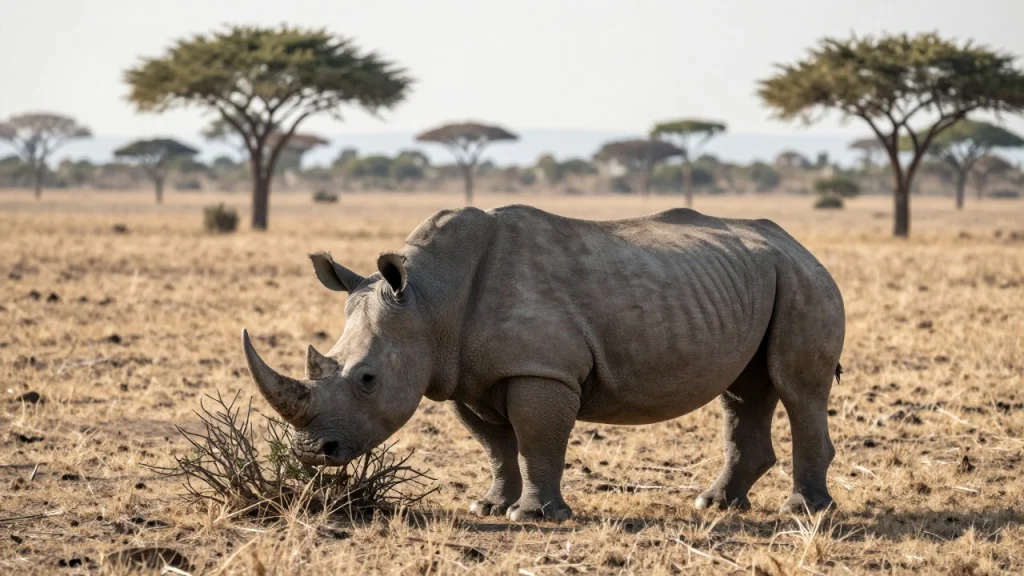
Rhinoceroses are all under major conservation pressure, but their IUCN categories differ: three are Critically Endangered, the greater one-horned rhinoceros is Vulnerable, and the white rhinoceros is Near Threatened. Today, rhino populations face severe challenges due to habitat loss and intense poaching driven by the illegal trade in rhino horn. While dedicated conservation programs have helped some species stabilize or recover, others remain critically close to extinction.
Understanding the conservation status of rhinoceroses requires looking at each species individually, as their population numbers, geographical distributions, and survival outlooks differ dramatically across Africa and Asia.
The conservation status of the five rhino species
Rhinoceroses are divided into five distinct species: two native to Africa (the white rhino and the black rhino) and three native to Asia (the Indian rhino, the Javan rhino, and the Sumatran rhino). Their survival statuses are categorized by the International Union for Conservation of Nature (IUCN).
Critically endangered rhino species
Three of the five rhino species are classified as Critically Endangered, meaning they face an extremely high risk of extinction in the wild:
- Black rhinoceros (Diceros bicornis): Native to eastern and southern Africa, black rhinos experienced a devastating population crash in the 20th century due to poaching. Intensive anti-poaching efforts have helped numbers gradually recover from fewer than 2,500 individuals in the 1990s to over 6,000 today, but they remain critically threatened.
- Sumatran rhinoceros (Dicerorhinus sumatrensis): As the smallest rhino species and the only two-horned Asian rhino, only a few dozen Sumatran rhinos survive in fragmented rainforest habitats in Indonesia. Habitat fragmentation makes it extremely difficult for remaining individuals to find mates.
- Javan rhinoceros (Rhinoceros sondaicus): The Javan rhino is the rarest of the five rhino species; fewer than 80 individuals remain in a single population at Ujung Kulon Nature Reserve on the southwestern tip of Java, Indonesia.
Vulnerable and Near Threatened species
The remaining two species have larger populations, but their long-term survival still depends on constant protection:
- Greater one-horned rhinoceros (Rhinoceros unicornis): Also known as the Indian rhino, this species was brought back from the brink of extinction in India and Nepal: from about 150 individuals at its low point, the population in protected areas grew to about 2,600 by 2015, and it is listed as Vulnerable.
- White rhinoceros (Ceratotherium simum): The southern white rhino is the most numerous rhino subspecies, with more than 15,000 individuals living mostly in small pockets of southern Africa. It is classified as Near Threatened. However, the northern white rhino subspecies is functionally extinct, with only two females remaining alive under constant guard.
Primary threats to rhinoceros survival

Rhinoceroses have survived for millions of years, but human activities have rapidly reduced their numbers over the past century.
Poaching and the illegal horn trade
Illegal poaching is a major threat to rhinoceroses. Rhino horn is used in folk medicine in some parts of Asia and is also valued as a status symbol; it has not been shown to cure illness.
Rhino horn is composed almost entirely of keratin, the exact same protein found in human hair and fingernails, and possesses no scientifically proven medicinal value. Despite this, high demand drives lucrative black-market prices, incentivizing organized criminal networks to poach rhinos even within protected national parks.
Habitat loss and fragmentation
As human populations expand across Africa and Asia, natural landscapes are converted into agricultural fields, roads, and urban settlements. Rhinos require vast areas of grassland, scrubland, or forest to find sufficient food and water.
Habitat fragmentation isolates small populations from one another. When rhinos are confined to isolated patches of wilderness, natural breeding becomes difficult, reducing genetic diversity and making populations vulnerable to disease outbreaks and localized natural disasters.
How rhinoceros conservation efforts are helping
Protecting rhinos requires a combination of local community involvement, international policy, wildlife science, and habitat protection.
Key conservation strategies include:
- Anti-poaching patrols and law enforcement: Protected reserves employ ranger units equipped with tracking technology, dogs, and aerial surveillance to deter poachers.
- Community engagement: Programs that involve local communities in wildlife management create economic benefits through eco-tourism and incentive schemes, turning local residents into active conservation partners.
- Translocations and reintroductions: Moving individuals to secure reserves creates new breeding groups and reestablishes rhinos in areas where they were historically exterminated.
- Dehorning initiatives: In high-risk zones, conservationists carefully trim rhino horns under anesthesia to make the animals unattractive targets for poachers. Because keratin grows back, the procedure must be repeated periodically.
While the threat of poaching remains constant, successful population recoveries in species like the southern white rhino and the Indian rhino show that targeted conservation action can effectively prevent extinction and restore wild herds.
Sources
- San Diego Zoo Wildlife Alliance: Rhinoceros | San Diego Zoo Animals & Plants
- Animal Diversity Web, University of Michigan: Diceros bicornis (black rhinoceros) | INFORMATION | Animal Diversity Web
- Animal Diversity Web, University of Michigan: Rhinoceros unicornis (Indian rhinoceros) | INFORMATION | Animal Diversity Web
- Animal Diversity Web, University of Michigan: Ceratotherium simum (white rhinoceros) | INFORMATION | Animal Diversity Web